
anneal
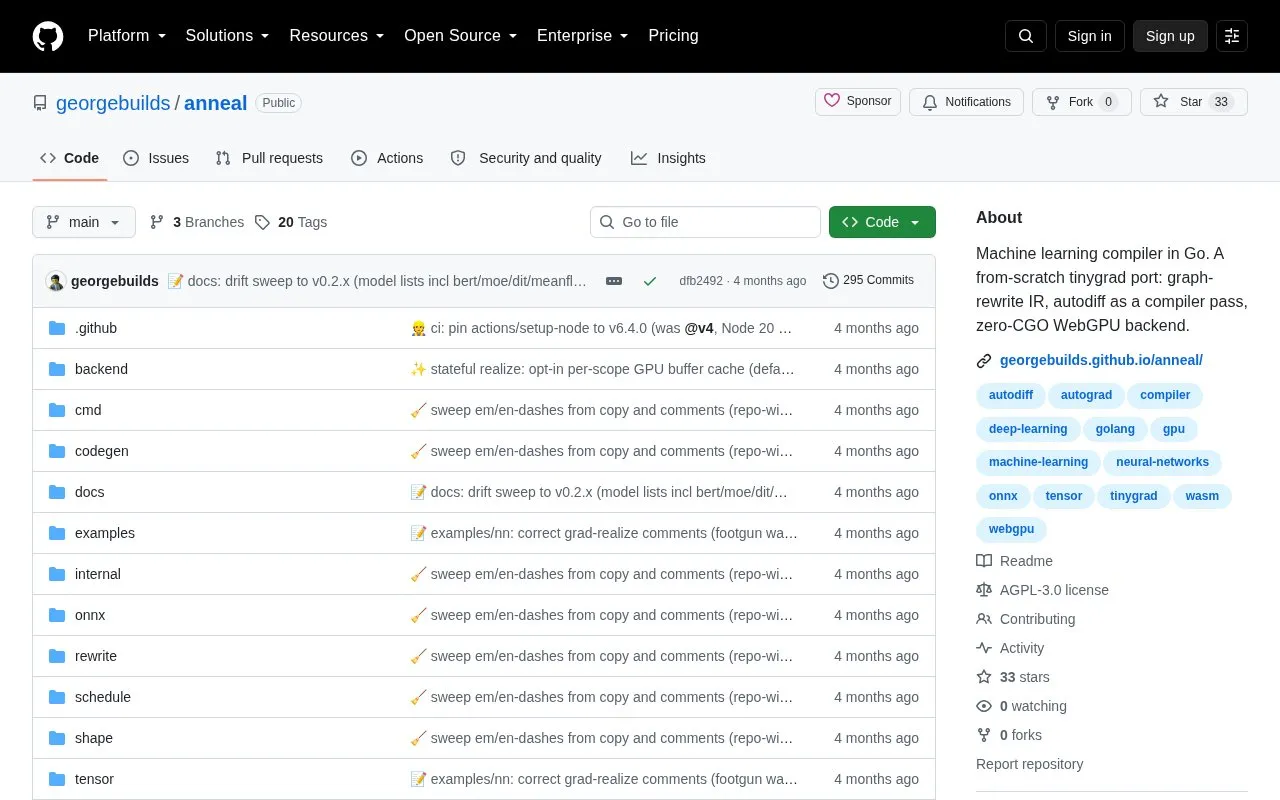
The anneal project is a Go machine learning compiler with graph rewriting, autodiff, and a WebGPU backend.
About anneal
anneal is an open-source machine learning compiler written in Go, described as a from-scratch port of tinygrad's rangeify-era core. It takes tensor programs, lowers them through a graph-rewrite IR, and emits fused GPU kernels via a zero-CGO WebGPU backend. Autodiff is implemented as a compiler rewrite pass rather than a recorded tape, so forward operations, gradients and movement ops live in one graph that the scheduler can rewrite and fuse. It can train a small MLP, a small convolutional network, a char-level nanoGPT, a char-level Llama-style decoder and a tiny Vision Transformer end to end on GPU hardware reached through WebGPU, and it can load GPT-2-small weights from HuggingFace.
The project also provides a local browser studio served as a single binary at :3001 with eight deep-linkable views, and the same compiler builds to WebAssembly to power its visualizer. ONNX 1.17 models can be imported with pure-Go protobuf bindings; about 45 op handlers cover a CNN core and a transformer core, with symbolic dim_param axes carried through as anneal Variables. It is presented as a research project and learning vehicle built in phases, not a drop-in replacement for a production framework, and the repository includes a limitations document.
Key features
- Graph-rewrite IR that lowers tensor programs and emits fused GPU kernels
- Autodiff implemented as a compiler rewrite pass instead of a recorded tape
- Zero-CGO WebGPU backend; compiler builds to WASM for browser use
- Zero-CGO ONNX 1.17 import via pure-Go protobuf bindings, about 45 op handlers
- Single-binary browser studio at :3001 with eight deep-linkable views
- CLI for environment checks and training MLP, conv, nanoGPT and transformer models
Best for: Go developers, compiler enthusiasts and researchers who want to study or experiment with a small machine learning compiler stack rather than build on a production framework.
Good for
- Forward ops, gradients and movement ops share one graph, allowing kernel fusion across the forward/backward boundary
- Movement ops such as reshape, permute, expand, pad, shrink and flip become index math rather than data copies
- Local browser studio is described as having zero telemetry and zero accounts, with model bytes staying on the machine
Watch out for
- Described as a research project built in phases, not a drop-in replacement for a production framework
- ONNX op handlers target a CNN core and a transformer core rather than the full operator set
- Running it requires an environment able to reach a WebGPU device, which the anneal doctor command checks
anneal at a glance
- Category
- Development › Developer Tools
- Type
- Open-source project
- Pricing
- Not confirmed. Check the site
- Open source
- Yes · Source code
- Language
- English
- Last checked
- Oct 6, 2026 · Online when checked
- Listed
- Oct 5, 2026
Guides for Developer Tools

anneal alternatives
Tools and sites you could use instead, ranked by how closely they match.

ONNX-Scala provides an API and backend for deep and classical machine learning in Scala.
Open source
24 alternatives
Machine learning pipelines can use whylogs, an open-source library for logging data quality and model performance.
Open source
24 alternatives
The Pattern Recognition Toolbox provides MATLAB tools for pattern recognition and machine learning.
Open source
24 alternatives
Netron displays neural network, deep learning, and machine learning models across formats such as ONNX, TensorFlow, and PyTorch.
Open source
24 alternatives
Automatic machine learning, hyperparameter tuning, and pipeline abstractions are provided by the Neuraxle software library.
Open source
24 alternatives
Opyrator turns machine learning code into microservices with a web API and interactive interface.
Open source
24 alternativesPopular in Developer Tools
Well-known listings from the same topic.
AppDevToolsappdevtools.comCommand Not Foundcommand-not-found.comTestFlighttestflight.apple.com/join/A8GwCnq8Sourcegraphabout.sourcegraph.comProject Wallaceprojectwallace.comCarbon Calculatorwebsitecarbon.com


anneal FAQ
Is anneal a drop-in replacement for an existing machine learning framework?
No. The project describes itself as a research project and a learning vehicle built in phases, and points to its status section for what v1 does and does not do.
Does anneal require CGO?
The ONNX importer and the WebGPU backend are described as zero-CGO. ONNX 1.17 models are parsed with pure-Go protobuf bindings.
Can anneal run in a browser?
The same compiler builds to WASM and powers the project's visualizer, which runs the real compiler, and anneal web serves a local studio at :3001.
Is something wrong or out of date?
Tell us and an editor will check it.
Own this website?
Claim this listing
Claim the listing and suggest updates yourself. An editor checks every claim first.