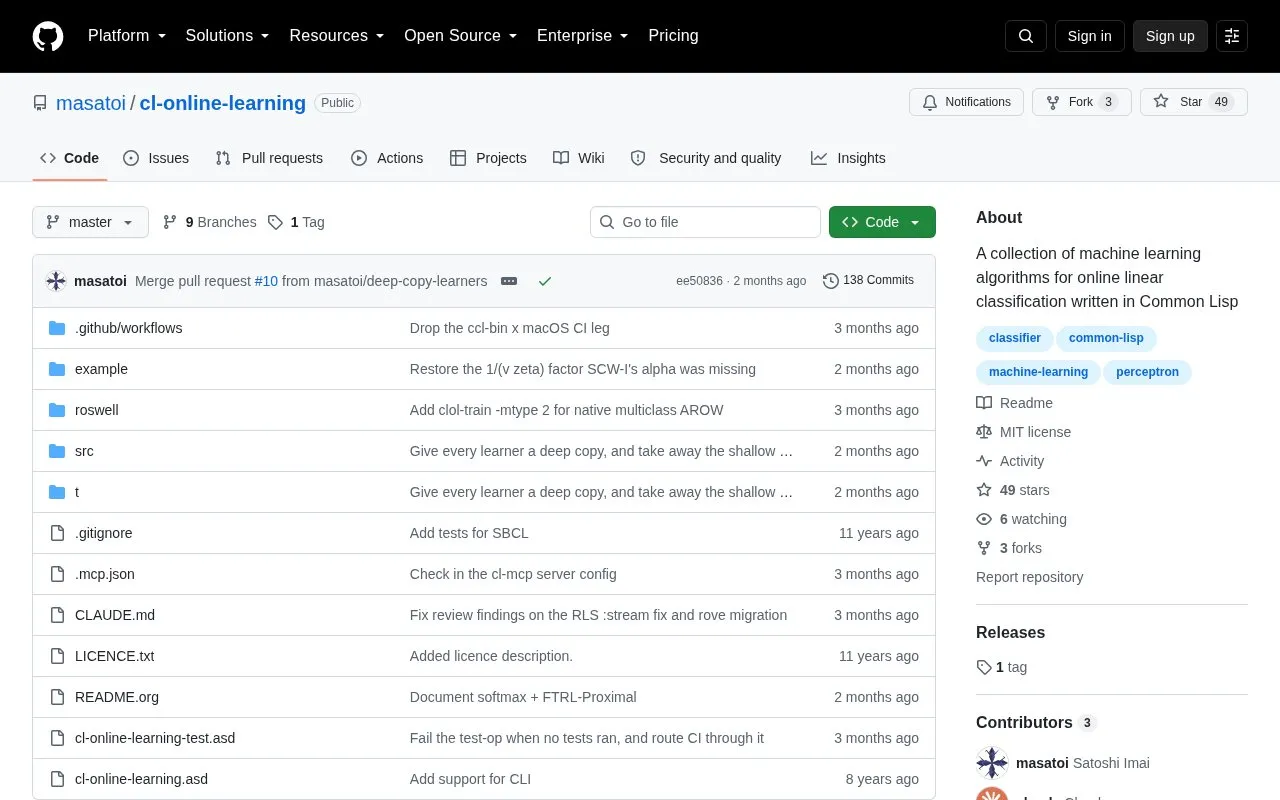
cl-online-learning is an open-source Common Lisp repository that implements online linear classification algorithms, covering both binary and multiclass classifiers. Binary options include Perceptron, AROW, SCW-I, logistic regression with SGD or ADAM, and FTRL-Proximal; multiclass options include one-vs-rest, one-vs-one, multiclass AROW, and softmax with FTRL-Proximal. Learners can be updated one data point at a time or trained collectively with a train function, and predictions can be tested against a dataset. Datasets use class labels and input vectors declared as single-float, and a READ-DATA function reads LIBSVM sparse format when given the feature count. The library can be loaded via Quicklisp, cloned from GitHub, or installed with Roswell, and command-line tools are provided as roswell scripts. The README notes that no convergence test is implemented, so training may need to be run several times.
Key features
Binary classifiers: Perceptron, AROW, SCW-I, logistic regression with SGD or ADAM, FTRL-Proximal
Multiclass methods: one-vs-rest, one-vs-one, multiclass AROW, softmax with FTRL-Proximal
FTRL-Proximal drives weights to exactly zero via L1 regularization
Data point is a class label and single-float input vector
READ-DATA reads LIBSVM sparse format when given the number of features
Command-line tools implemented as Roswell scripts
Best for: Common Lisp developers who need online linear classification algorithms for binary or multiclass datasets.
Good for
Open source repository with multiple online linear classification algorithms
Available from Quicklisp and installable via Roswell or GitHub clone
Supports both binary and multiclass classification tasks
Watch out for
Convergence test is not implemented; training may need several calls
Input vectors and class labels must be declared as single-float
READ-DATA requires the number of features to be supplied
It is available from Quicklisp via (ql:quickload :cl-online-learning), by cloning into quicklisp/local-projects, or with Roswell using ros install masatoi/cl-online-learning.
What format does the dataset reader expect?
READ-DATA reads a sparse format used in LIBSVM and requires the number of features; data points are a class label (+1 or -1) and a single-float input vector.
Can I train a model incrementally?
Yes, each model has an update function for one data point, and a TRAIN function learns a dataset collectively; the README notes training may need to be called several times until convergence because a convergence test is not implemented.
Is something wrong or out of date?
Tell us and an editor will check it.
Own this website?
Claim the listing and suggest updates yourself. An editor checks every claim first.