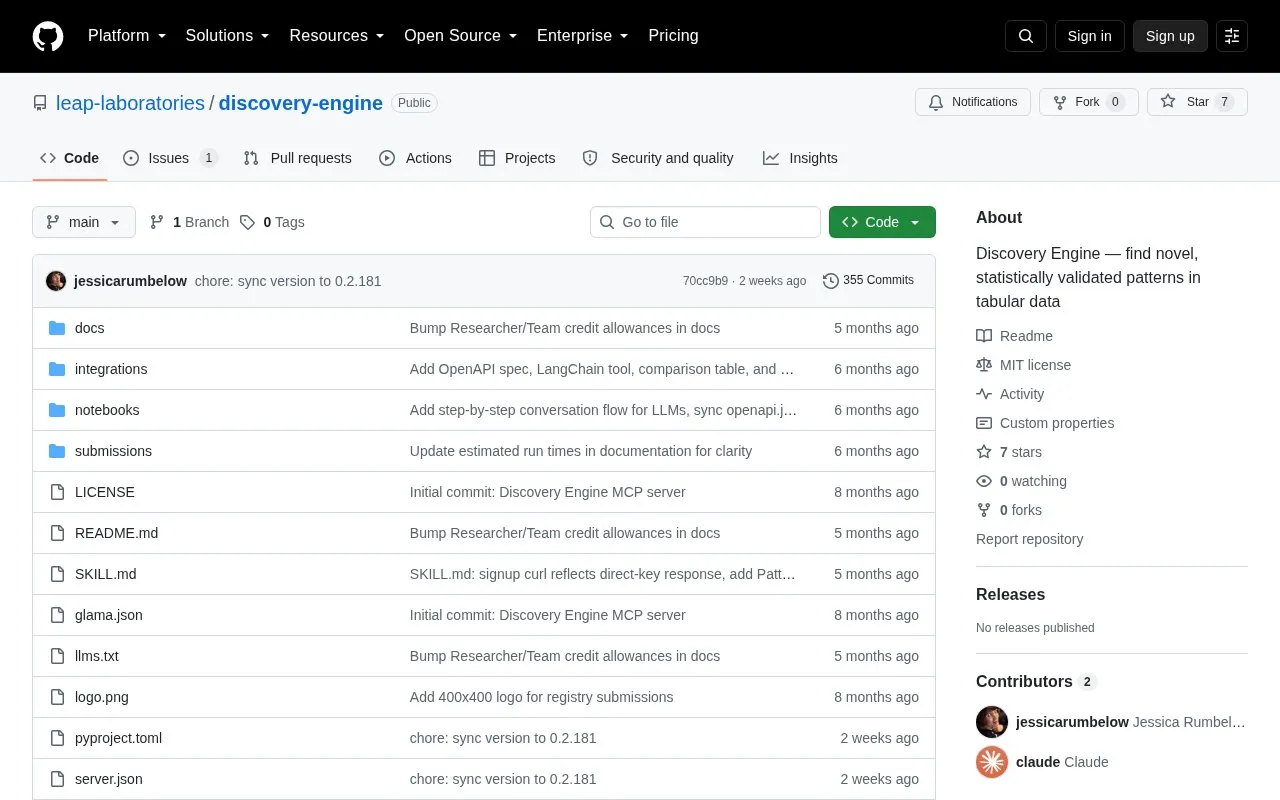
Disco is the Discovery Engine published by Leap Laboratories as an open-source repository. It searches tabular data for combinations of feature conditions that significantly shift a chosen target column, rather than starting from a user's hypothesis. Typical findings include feature interactions, subgroup effects and conditional relationships, expressed with specific thresholds instead of vague correlations.
Each pattern is validated on a hold-out set, carries FDR-corrected p-values and effect sizes, and is checked against academic literature and classified as novel or confirmatory, with citations. Results also link to an interactive web report. Analyses run through an API key and take a few minutes; the Python client polls automatically and logs queue position, current pipeline step and ETA. The project states it is not intended for summary statistics, visualisation, filtering or SQL queries.
Key features
Finds combinations of feature conditions that shift a target column
Reports FDR-corrected p-values and effect sizes per pattern
Validates each pattern on a hold-out set
Checks patterns against academic literature and classifies novelty
Python SDK polls queued runs and logs progress and ETA
Links results to an interactive web report of patterns
Best for: Analysts and data scientists with tabular datasets who want to surface validated interactions and subgroup effects without pre-specifying a hypothesis.
Good for
Open-source repository with an installable Python package (discovery-engine-api)
Patterns include hold-out validation, FDR-corrected p-values and support counts
Each pattern comes with literature citations and a novel-versus-confirmatory classification
Watch out for
An API key obtained through email verification is required to run analyses
Explicitly not intended for summary statistics, visualisation, filtering or SQL queries
Analyses run on a queue and take a few minutes rather than returning instantly
A description, the feature conditions and their thresholds, a hold-out-validated FDR-corrected p-value, effect direction and size, support count and percentage, a novelty type with an explanation, and literature citations.
What is Disco not meant for?
The project lists summary statistics, visualisation, filtering and SQL queries as out of scope, recommending pandas for those tasks.
How do you run a first analysis?
Install the discovery-engine-api package, obtain an API key by email verification or from the developers page, then call the engine's discover method with a file and target column.
Is something wrong or out of date?
Tell us and an editor will check it.
Own this website?
Claim the listing and suggest updates yourself. An editor checks every claim first.