

Sourcetable combines spreadsheets and data analysis tools for creating financial models and working with datasets.
dplyr
A fast, consistent tool for working with data frame like objects, both in memory and out of memory.
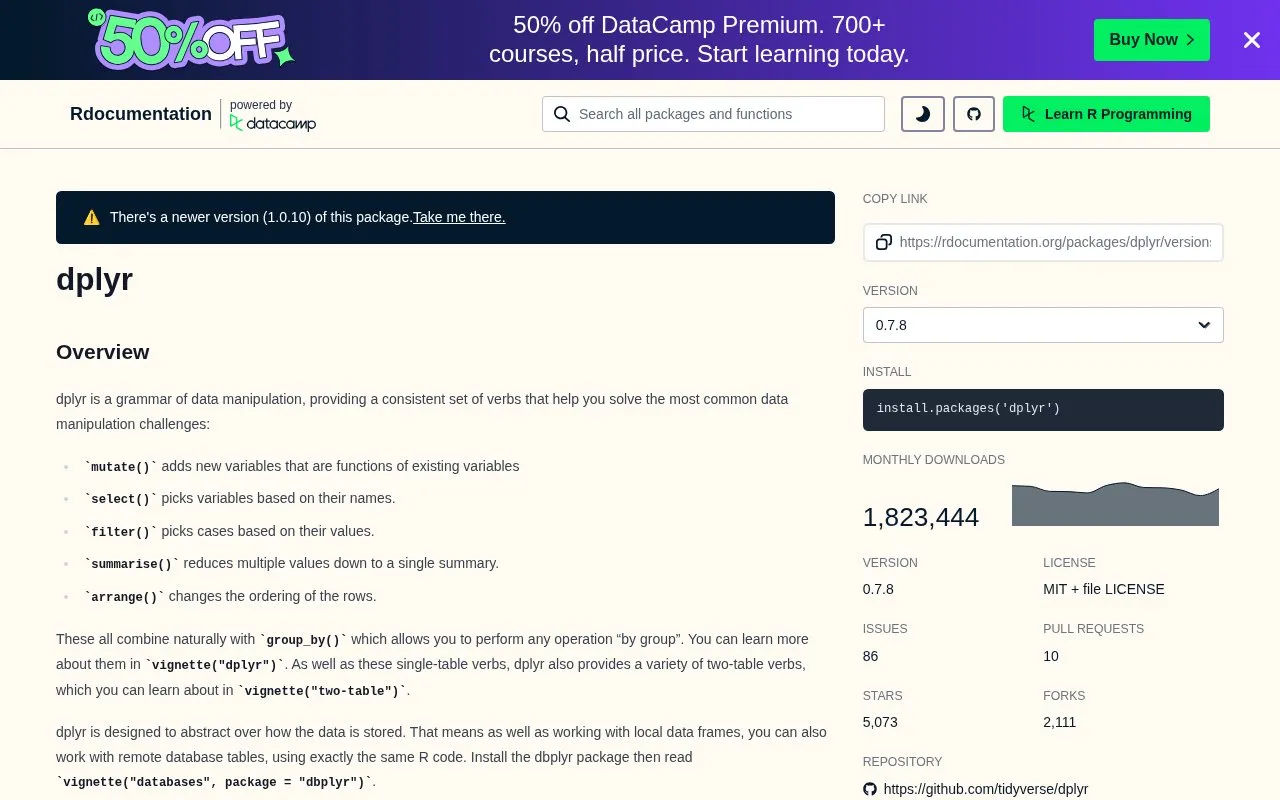
About dplyr
dplyr is an R package that provides a grammar of data manipulation: a consistent set of verbs for common tasks such as adding variables, selecting columns, filtering rows, summarising values and reordering rows. These verbs combine with group_by() to run operations by group, and two-table verbs handle combining tables. Because dplyr abstracts over how data is stored, the same R code can be used with local data frames and with remote database tables once the dbplyr package is installed.
Key features
- mutate() adds new variables computed from existing variables
- select() picks variables by name; filter() picks cases by value
- summarise() reduces multiple values to a single summary
- arrange() changes row ordering
- group_by() applies any operation by group
- Two-table verbs, and remote database tables via the dbplyr package
Best for: R users who want one consistent set of verbs for common data manipulation tasks on local data frames or remote database tables.
Good for
- Consistent verb-based interface for common data manipulation challenges
- Abstracts over data storage so the same R code works with local and remote data
- Includes single-table and two-table verbs, plus grouped operations
Watch out for
- The page documents version 0.7.8 and notes a newer version (1.0.10) exists
- Working with remote database tables requires installing the separate dbplyr package
- Requires R and package installation to use
dplyr at a glance
- Category
- AI & Machine Learning › AI Data & Analytics
- Type
- Online tool
- Pricing
- Not confirmed. Check the site
- Platforms
- Web
- Open source
- Not stated
- Language
- English
- Last checked
- Oct 6, 2026 · Online when checked
- Listed
- Oct 5, 2026
dplyr alternatives
Tools and sites you could use instead, ranked by how closely they match.

Powerdrill Bloom presents an AI workspace with memory for data analysis and agents.

REP provides an IPython-based machine learning environment for consistent, reproducible data-driven research.

DataHub helps users discover, access, and work with datasets, collections, and data solutions through an AI-native platform.

BigML provides a platform for creating machine learning models and working with data.

PyTorch Frame provides a library for applying deep learning models to tabular data.
Open source
24 alternativesPopular in AI Data & Analytics
Well-known listings from the same topic.
Dotgetdot.aiForvioforvio.comFluidAI Medicalfluidai.mdApache Zeppelinzeppelin.apache.orgSola Securitysola.securityQuadraticquadratichq.com


dplyr FAQ
Can dplyr work with database tables?
Yes. dplyr is designed to abstract over how data is stored, so remote database tables can be used with the same R code after installing the dbplyr package.
How do you install dplyr?
The easiest way is to install the whole tidyverse with install.packages("tidyverse"), or install just dplyr with install.packages("dplyr"). A development version can be installed from GitHub with devtools.
Is this the newest version of dplyr?
This page covers version 0.7.8, last published November 10th, 2018, and it notes a newer version (1.0.10).
Is something wrong or out of date?
Tell us and an editor will check it.
Own this website?
Claim this listing
Claim the listing and suggest updates yourself. An editor checks every claim first.