
gonum/mat
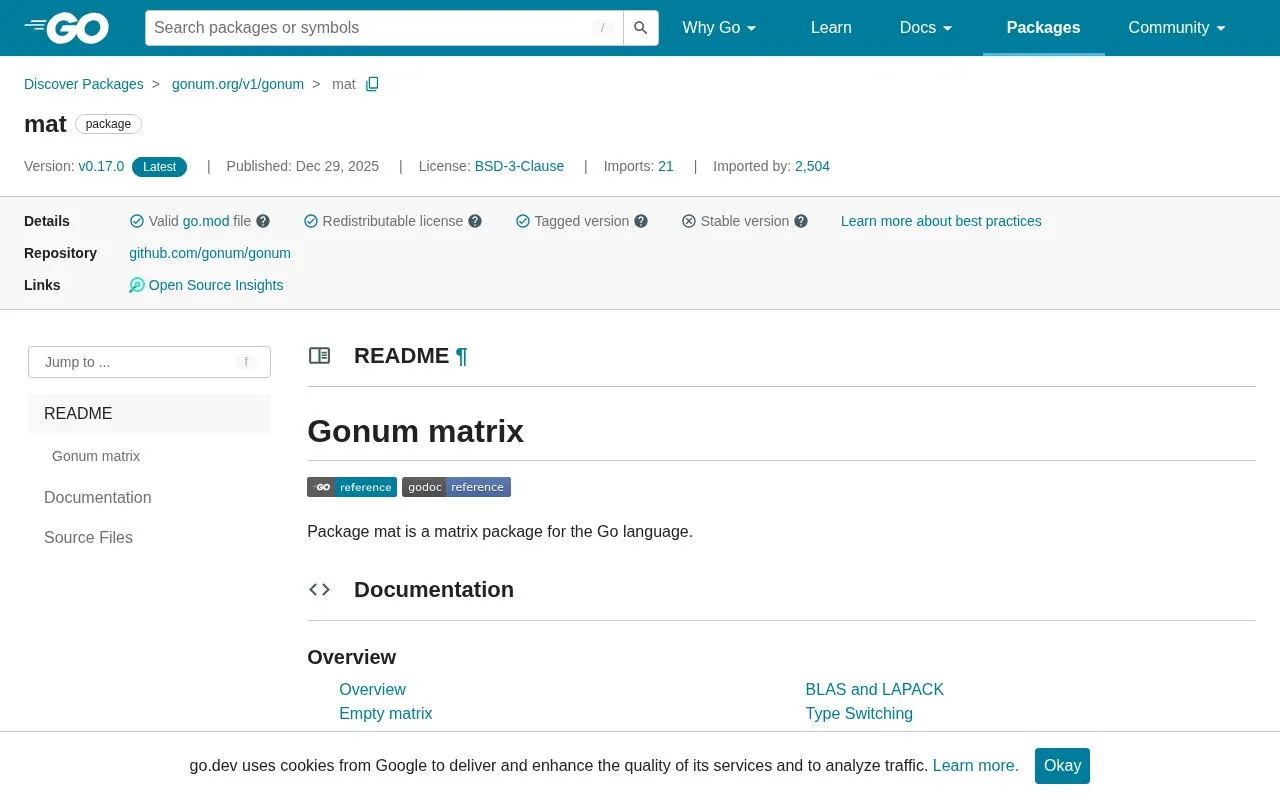
Package mat provides implementations of float64 and complex128 matrix structures and linear algebra operations on them.
About gonum/mat
gonum/mat is a matrix package for the Go language. It provides float64 and complex128 matrix structures and linear algebra operations, including concrete types such as Dense, SymDense, TriDense and VecDense, interfaces for Matrix, Symmetric and Triangular types, and factorization types such as QR and LU.
Matrices are stored in row-major format and can be created zeroed or from a supplied data slice. Functions accept interface types, and empty matrices resize automatically to operation results; non-empty destinations panic if sized incorrectly.
Key features
- Float64 and complex128 matrix structures with linear algebra operations
- Concrete types Dense, SymDense, TriDense, and VecDense
- Matrix factorization types including QR and LU
- Empty matrices automatically assume correct result size
- Transpose with T and conjugate transpose with H
- Row-major storage with zeroed or supplied backing data
- Accepts Matrix interfaces, allowing use of internal and external matrix types
- Tagged stable v1 version for more predictable builds
- Redistributable license with minimal use and redistribution restrictions
- Operations panic if a non-empty destination has the wrong size
- Empty matrices cannot be sliced, only expanded with Grow where available
- Reset should not be used when matrices share the same backing slice
gonum/mat at a glance
- Category
- AI & Machine Learning › AI Data & Analytics
- Type
- Online tool
- Pricing
- Not confirmed. Check the site
- Platforms
- Web
- Open source
- Not stated
- Language
- English
- Last checked
- Oct 5, 2026 · Online when checked
- Listed
- Oct 5, 2026
Popular in AI Data & Analytics
Well-known listings from the same topic.


gonum/mat FAQ
How do I create a matrix?
What happens when the result matrix is empty?
How is transposition expressed?
Tell us and an editor will check it.
Claim the listing and suggest updates yourself. An editor checks every claim first.