

TONCO provides concentrated-liquidity trading on TON, with tools for liquidity providers and traders using its decentralized exchange.
Integral
Integral helps liquidity providers earn trading fees without selecting price ranges for their capital.
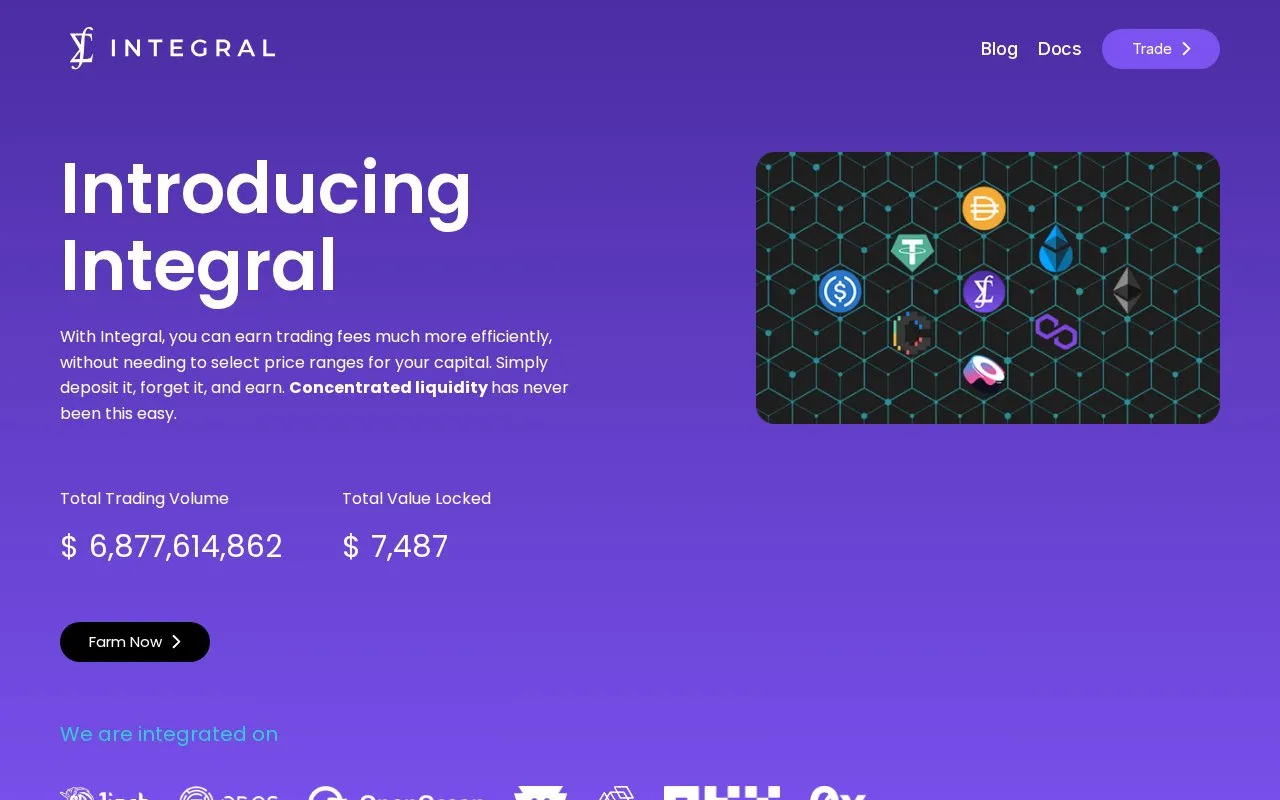
About Integral
Integral provides liquidity pools where users deposit tokens to earn a share of trading fees without choosing price ranges. A fee is charged on orders executed in the pool, and most of the fees are redistributed to liquidity providers.
Pools use dynamic token ratios that can shift with the direction of trade flow, so withdrawal proportions may differ from the original deposit. Listed APR is calculated as 24-hour fees divided by TVL multiplied by 365, excluding token rewards.
Key features
- Deposit liquidity without selecting price ranges
- Earn a share of fees from pool orders
- Dynamic token ratios that shift with trade flow
- External oracle and trade delay mechanism
- Pool display of TVL, 24-hour volume and APR
- Lists ETH-USDC, ETH-USDT and ETH-ARB pools
Best for: Liquidity providers who want fee income without managing price ranges for concentrated liquidity.
Good for
- No price-range selection is required to deposit capital
- Most order fees are redistributed to liquidity providers
- Pools are designed to reduce front-running and cross-exchange arbitrage
Watch out for
- LP token ratio can change over time with trade flow
- APR calculation excludes token rewards
Integral at a glance
- Website
- integral.link
- Type
- Website
- Pricing
- Not confirmed. Check the site
- Platforms
- Web
- Open source
- Not stated
- Last checked
- Oct 5, 2026 · Online when checked
- Listed
- Oct 5, 2026
Integral alternatives
Tools and sites you could use instead, ranked by how closely they match.
Reactor describes concentrated-liquidity trading with instant execution on its decentralized exchange.
AshSwap combines stable-swap pools with concentrated liquidity in an automated market maker for decentralized token trading.
On Linea, Etherex supports concentrated-liquidity trading and liquidity provision.

mySwap offers concentrated-liquidity trading on Starknet through its exchange interface.

Shadow Exchange is a Sonic-native concentrated-liquidity exchange for digital assets.
Popular in Decentralized Exchanges (DEX)
Well-known listings from the same topic.
1inch Swap1inch.comAborean CLaborean.financeAerodrome Slipstreamaerodrome.financePools Financepools.financeRhea Dexdex.rhea.financeBeam Swapswap.onbeam.com


Integral FAQ
How does Integral Pool generate returns for LPs?
Integral charges a fee on each order executed in the liquidity pool and redistributes most of the fees to liquidity providers.
I deposited 50/50 liquidity. Why did my position ratio change?
Pools use dynamic token ratios that change based on trade flow direction, so you may need to wait to withdraw at a desired pool ratio.
Why is impermanent loss described as low?
Pools are designed for mean-zero impermanent loss in the long term using an external oracle and trade delay mechanism to reduce front-running and cross-exchange arbitrage.
Is something wrong or out of date?
Tell us and an editor will check it.
Own this website?
Claim this listing
Claim the listing and suggest updates yourself. An editor checks every claim first.