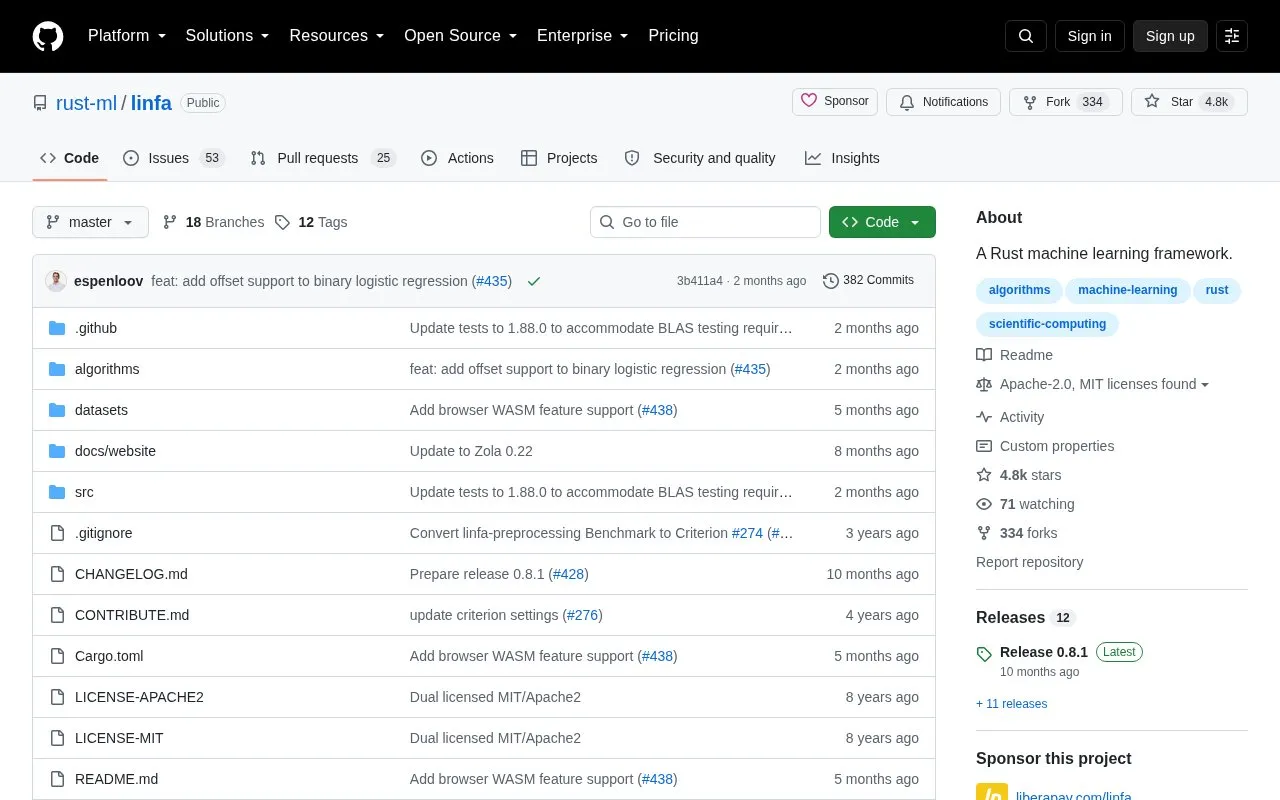
linfa is a machine learning framework for building machine learning applications with Rust. Similar in spirit to Python's scikit-learn, it focuses on common preprocessing tasks and classical machine learning algorithms.
It provides sub-packages for supervised learning, clustering, dimensionality reduction, preprocessing, and partial-fit methods. By default it uses a pure-Rust implementation for linear algebra routines, with optional external BLAS/LAPACK backends and a wasm-bindgen feature for browser-style WASM on wasm32-unknown-unknown.
Key features
Supervised learning with Naive Bayes, logistic regression, SVMs and trees
Clustering via K-Means, DBSCAN, OPTICS, GMM and hierarchical methods
Preprocessing with normalization, count vectorization, TF-IDF and kernel mapping
Dimensionality reduction using PCA, t-SNE, diffusion mapping and random projections
Incremental model updates with FTRL and logistic regression partial fit
Optional external BLAS/LAPACK backends including OpenBLAS, Netlib and Intel MKL
Best for: Developers building classical machine learning applications in Rust.
Good for
Covers preprocessing, supervised learning, clustering and dimensionality reduction in Rust
Uses pure-Rust linear algebra by default with optional BLAS/LAPACK backends
Dual-licensed to be compatible with the Rust project
Watch out for
Logistic regression builds two-class models
OpenBLAS and Netlib backends are listed with Linux support only in the compatibility table