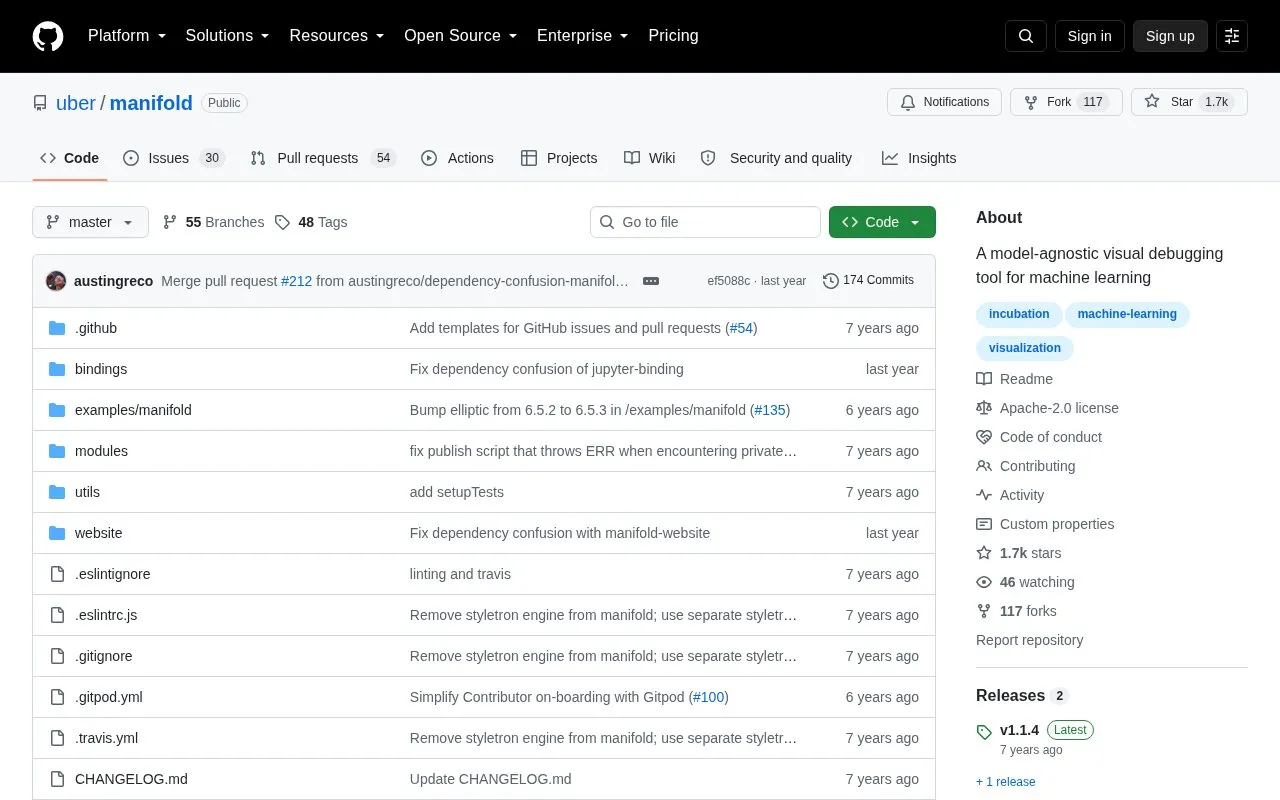
Manifold is a model-agnostic visual debugging tool for machine learning. It helps practitioners move beyond summary metrics such as AUC and RMSE to find data subsets where predictions are inaccurate and to surface feature distribution differences between better and worse-performing subsets.
It provides a Performance Comparison View for comparing models across automatically created segments and a Feature Attribution View for feature distributions by performance level. Data can be added by CSV upload in the demo app or programmatically as a component, using matching x, yPred, and yTrue arrays; the recommended size is 10,000–15,000 instances, with random subsampling for larger datasets.
Key features
Compare prediction performance across models and data subsets
Identify under-performing data subsets for further inspection
Visualize feature distributions across performance levels
Segment data automatically with k-Means performance clustering
Import data by CSV upload in demo app
Input feature, prediction, and ground-truth arrays programmatically
Best for: ML practitioners who need to locate and explain under-performing data subsets beyond summary metrics.
Good for
Works across model types without model-specific setup
Compares multiple models across automatically created performance segments
Surfaces feature distribution differences between better and worse subsets
Watch out for
Requires data in specific x, yPred, yTrue format with matching order
Recommended for 10,000-15,000 instances; larger datasets need subsampling
Use CSV upload in the demo app, or convert data programmatically using x, yPred, and yTrue when using the component in your own app.
What format must input data follow?
x holds feature objects, yPred holds prediction lists per model, and yTrue holds ground truth; the order of instances must match across all three.
How does the Performance Comparison View group data?
It uses k-Means clustering on per-instance scores — log-loss for classification and squared-error for regression by default — to create segments based on performance similarity.
Is something wrong or out of date?
Tell us and an editor will check it.
Own this website?
Claim the listing and suggest updates yourself. An editor checks every claim first.