

Briefing supports browser-based audio, video, and text chat as a free open source video meeting app.
Mirotalk
The MiroTalk project supports self-hosted, peer-to-peer browser video meetings using WebRTC.
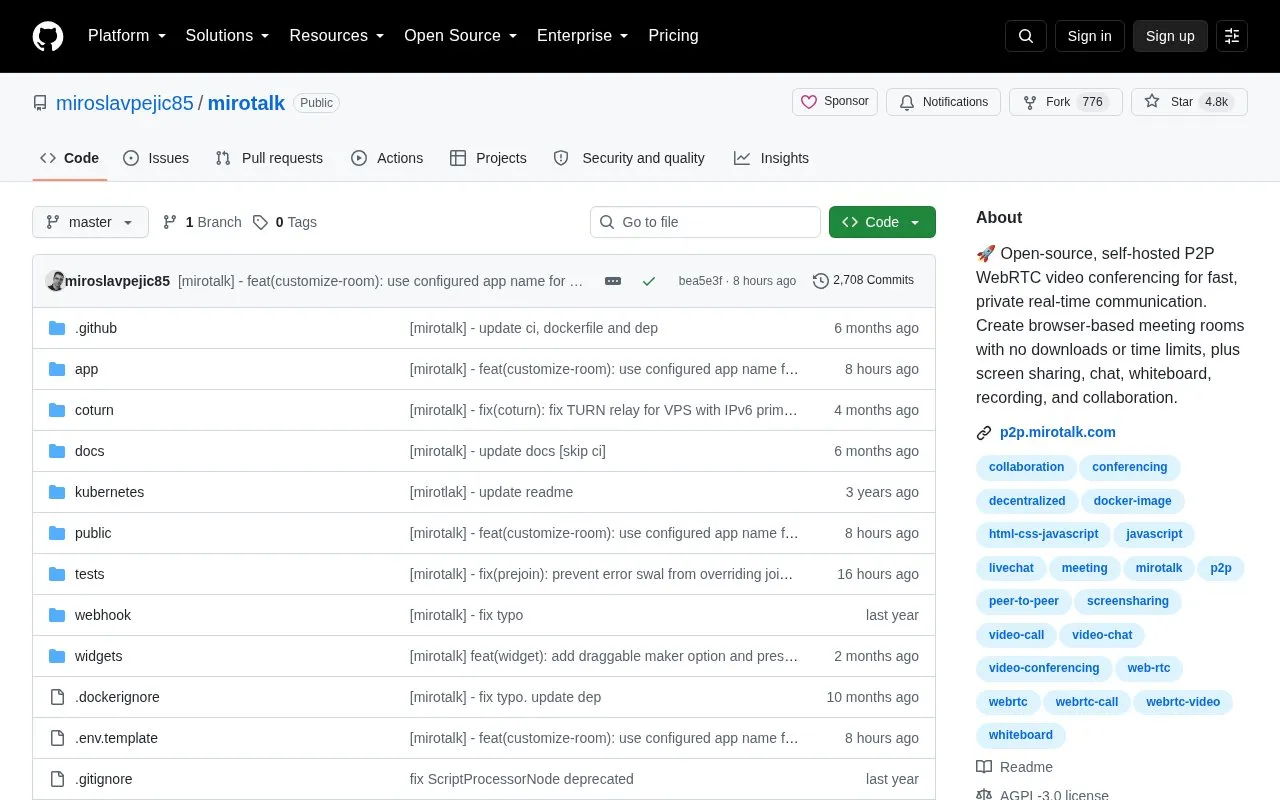
About Mirotalk
MiroTalk (MiroTalk P2P) is an open-source, self-hosted WebRTC video conferencing project distributed as a GitHub repository. It uses direct peer-to-peer connections to create browser-based meeting rooms, which the project describes as needing no downloads and having no time limits, with unlimited concurrent rooms. Deployment is done on your own server through Docker, Node.js or a one-click install script, and the interface is offered in 133 languages. The project advertises video resolution up to 8K at 60fps.
Meeting capabilities include screen sharing, recording, picture-in-picture, file sharing, chat with Markdown and emoji, and a collaborative whiteboard. Access controls include room passwords, JWT credentials, OIDC authentication and host protection, alongside a REST API, an embeddable iframe and widget, and Slack and Mattermost integrations. Some features depend on external services: the ChatGPT integration uses OpenAI, and camera background effects load MediaPipe Tasks Vision and its WASM files from jsDelivr plus the selfie segmentation model from Google Storage, so those hosts must be reachable and permitted by any custom content security policy. Background effects require WebGL2 and canvas capture, are capped at 1280 x 720 and 15 FPS, and fall back to the plain camera if they fail.
Key features
- Peer-to-peer WebRTC browser meetings with no downloads or time limits
- Screen sharing, recording, picture-in-picture and file sharing
- Chat with Markdown and emoji plus a collaborative whiteboard
- Room passwords, JWT credentials, OIDC authentication and host protection
- REST API, embeddable iframe and widget, Slack and Mattermost integration
- Camera background blur or image, processed locally in the browser
Best for: Teams and individuals who want to run their own browser-based video meetings on their own server instead of using a hosted conferencing service.
Good for
- Open source under AGPLv3 with full source code, deployable via Docker, Node.js or a one-click install script
- Peer-to-peer WebRTC design with unlimited rooms and no time limits, plus OIDC authentication and room passwords
- Local background images up to 10 MB are processed in the browser and are not uploaded
Watch out for
- Self-hosting is required; the page describes deployment on your own server rather than a hosted service
- Camera background effects depend on jsDelivr and Google Storage being reachable, need WebGL2 and canvas capture, and are capped at 1280 x 720 and 15 FPS
- ChatGPT features depend on OpenAI integration, and speech recognition and other third-party services may be involved
Mirotalk at a glance
- Category
- Social & Communities › Messaging Apps
- Type
- Open-source project
- Pricing
- Not confirmed. Check the site
- Open source
- Yes · Source code
- Language
- English
- Last checked
- Oct 6, 2026 · Online when checked
- Listed
- Oct 5, 2026
Mirotalk alternatives
Tools and sites you could use instead, ranked by how closely they match.

Chitchatter provides decentralized, serverless peer-to-peer chat designed for temporary conversations.
Open source
17 alternativesMiroTalk SFU supports self-hosted WebRTC video conferencing, offering a platform for building a video meeting service.

Talky offers group video chat and screen sharing through a simple browser-based meeting page.

Chitchatter enables peer-to-peer messaging without a central chat server, using a serverless and decentralized approach.

otr.to enables people to chat directly with each other through a web browser.
Popular in Messaging Apps
Well-known listings from the same topic.
Proton Meetproton.me/meetAltusgithub.com/amanharwara/altusProseprose.orgCoyIMcoy.imxabberxabber.comPidginpidgin.im


Mirotalk FAQ
How is MiroTalk deployed?
The repository provides Docker and Docker Compose files with an image on Docker Hub, a Node.js quick start using git clone, npm install and npm start, and an install.sh one-click script.
Are camera background images uploaded to a server?
Local PNG, JPEG and WebP images up to 10 MB are processed in the browser and are not uploaded. The effect model files themselves are loaded from jsDelivr and Google Storage, and effects fall back to the camera without effects if loading fails.
Are there time or room limits?
The project states unlimited rooms and no time limits for its self-hosted deployment.
Is something wrong or out of date?
Tell us and an editor will check it.
Own this website?
Claim this listing
Claim the listing and suggest updates yourself. An editor checks every claim first.