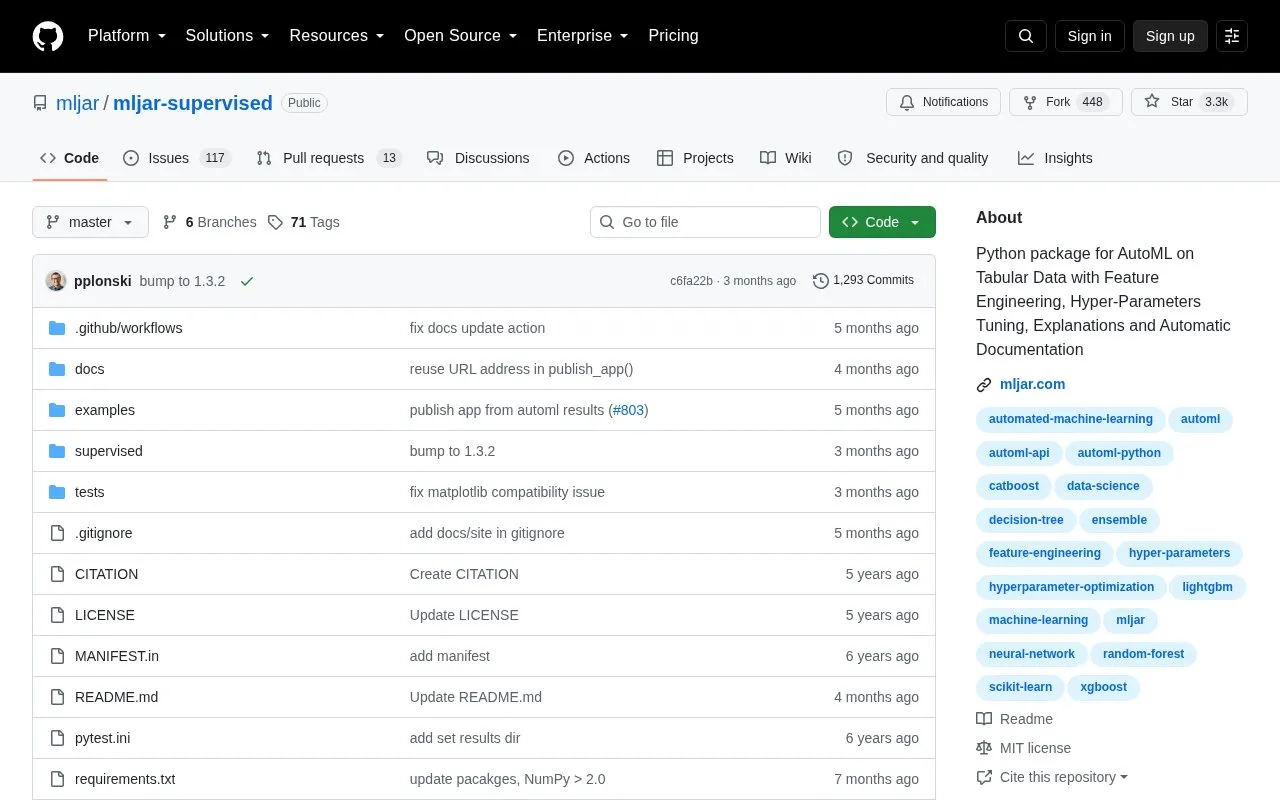
mljar-supervised is an open-source Python package for AutoML on tabular data. It automates data preprocessing, algorithm selection, and hyper-parameter tuning, and produces Markdown reports that show how each ML pipeline was constructed.
It provides four modes: Explain, Perform, Compete, and Optuna. It also can generate a Mercury-based web app from a trained model for single predictions and batch predictions from CSV files.
Key features
Tests Baseline, Linear, Random Forest, Extra Trees, LightGBM, XGBoost, CatBoost, Neural Networks, Nearest Neighbors
Automated preprocessing including missing values and categorical conversion
Hyperparameter tuning with Explain, Perform, Compete, and Optuna modes
Model explanations with SHAP, permutation importance, and decision tree visualization
Automatic Markdown reports detailing each trained model and pipeline
Mercury-based web app generation for single and batch CSV predictions
Best for: Data scientists working with tabular data who need automated modeling with inspectable reports.
Good for
Shows pipeline construction in detailed Markdown reports for each model
Supports multiple algorithms with greedy ensemble and level 2 stacking
Can generate a prediction web app for use without Python code
Watch out for
Designed for tabular data
Level 2 stacking is available in Compete mode or with stack_models set
Optuna mode is available from version 0.10.0 onward
Explain for understanding data, Perform for production pipelines, Compete for ensembling and stacking, and Optuna for tuning when computation time is not limited.
How is a web app created from a trained model?
After fitting, call automl.app() to generate files, automl.local_app() to run locally, or automl.publish_app() to publish.
Is something wrong or out of date?
Tell us and an editor will check it.
Own this website?
Claim the listing and suggest updates yourself. An editor checks every claim first.