Neural Networks and Deep Learning by Michael Nielsen
This online book teaches neural networks and deep learning through explanations and exercises.
About Neural Networks and Deep Learning by Michael Nielsen
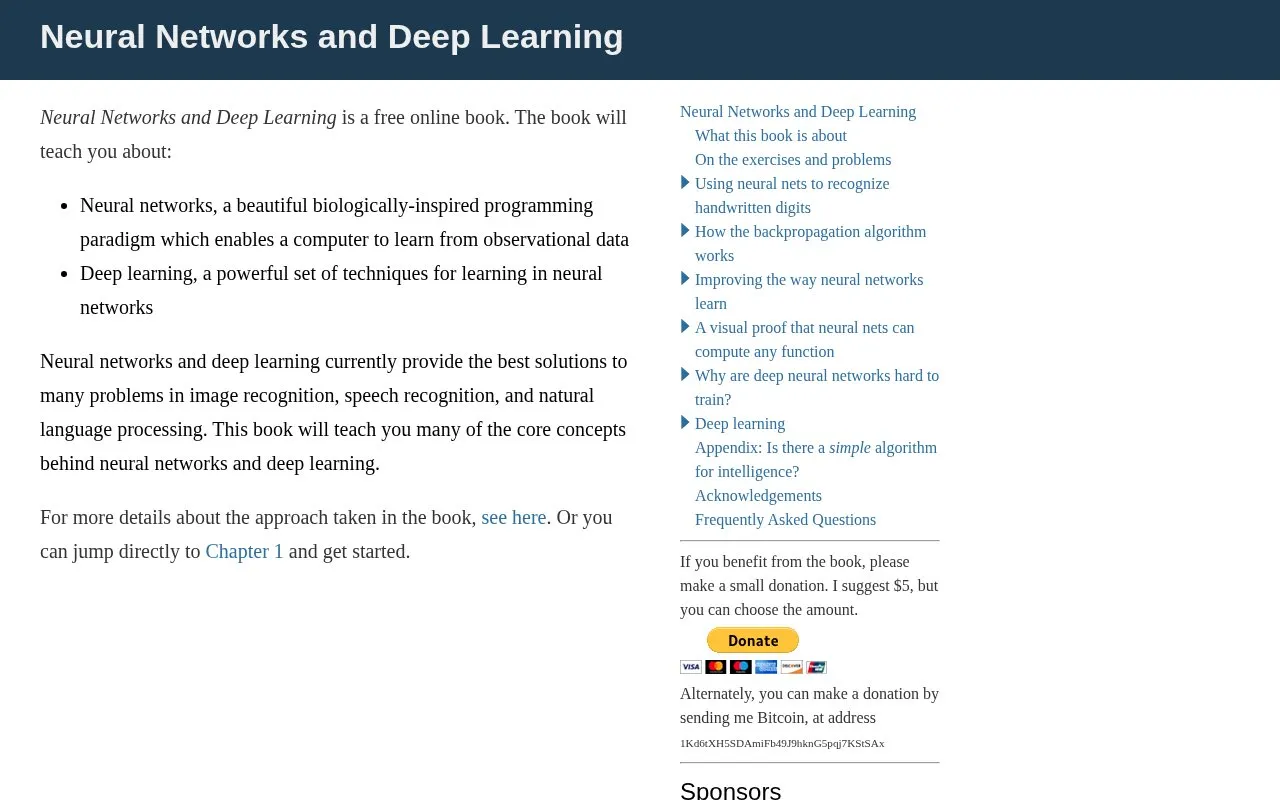
Neural Networks and Deep Learning is an online book by Michael Nielsen that teaches the core concepts of neural networks and deep learning. Its main aim is a solid understanding of principles rather than a hazy grasp of many ideas. Readers need some programming experience, but they do not have to be professional programmers. The book covers perceptrons, backpropagation, regularization and convolutional networks, and it includes exercises. The code is written in Python, and a small neural network library is built as the book proceeds. It is licensed for non-commercial sharing, so commercial use requires contacting the author.
Key features
- Covers perceptrons, sigmoid neurons and gradient descent
- Covers backpropagation and overfitting with regularization
- Introduces convolutional networks and the vanishing gradient problem
- Builds a small neural network library in Python through the book
- Includes interactive JavaScript elements that the text often expects readers to use
- Code is written in Python 2.7
- Not a tutorial for a particular neural network library
- No PDF or print edition
- Last update listed is December 2019
- No published solutions to the exercises and problems
Neural Networks and Deep Learning by Michael Nielsen at a glance
- Official website
- neuralnetworksanddeeplearning.com
- Category
- Education & Learning › AI Learning & Guides
- Type
- Publication
- Pricing
- Free
- Platforms
- Web
- Details verified
- Oct 22, 2026 · Official source
- Language
- English
- Last checked
- Oct 5, 2026 · Online when checked
- Listed
- Oct 5, 2026
Popular in AI Learning & Guides
Well-known listings from the same topic.


Neural Networks and Deep Learning by Michael Nielsen FAQ
Can I translate the book?
Tell us and an editor will check it.
Claim the listing and suggest updates yourself. An editor checks every claim first.