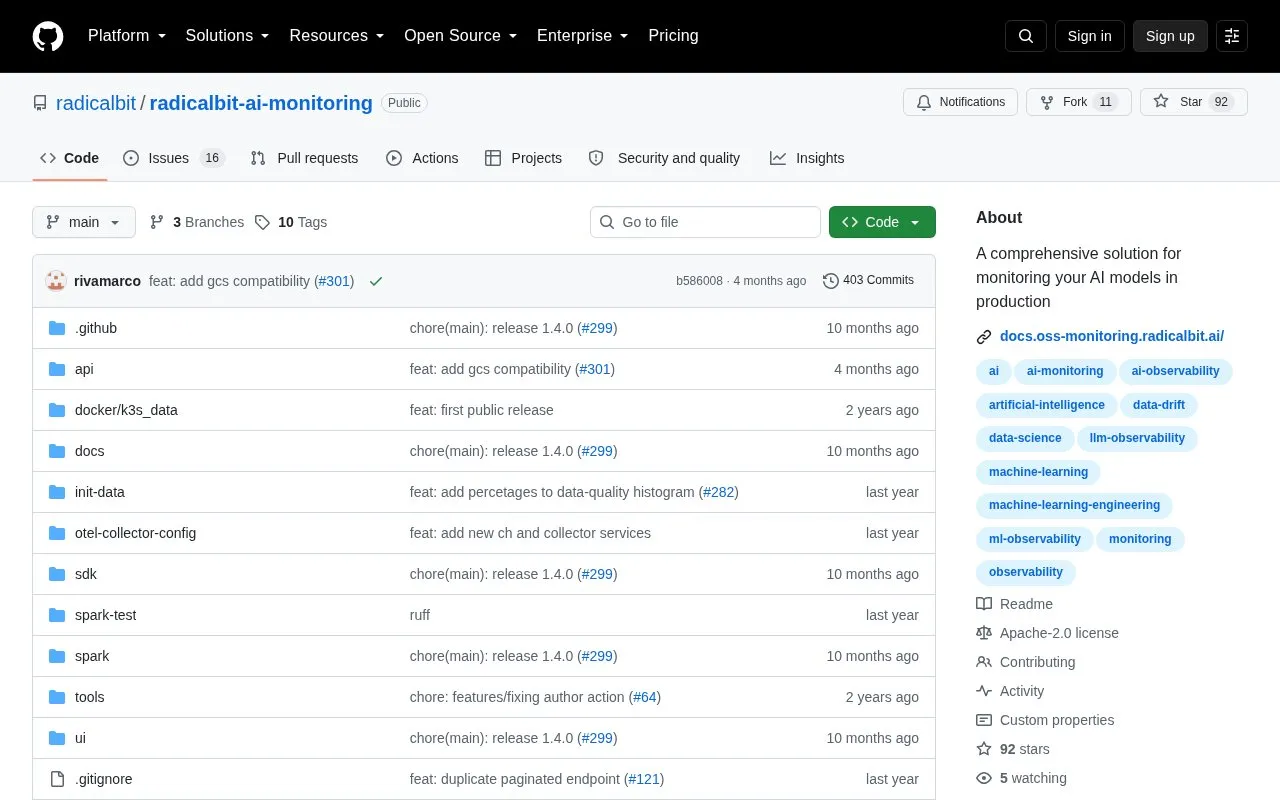
Radicalbit AI Monitoring is an open-source repository for operating a platform that monitors machine learning and large language models in production. It compares a reference dataset from pre-production validation with current data to track data quality, model quality, and model drift.
The repository includes UI, API, SDK, and Spark components and runs locally with Docker Compose and a K3s cluster. Dashboards cover binary and multiclass classification and regression for tabular data.
Key features
Compare reference datasets with current production datasets
Track data quality for production models
Track model quality for production models
Track model drift related to data shifts
Show dashboards for classification and regression on tabular data
Calculate monitoring metrics with Spark jobs
Best for: Teams running machine learning models in production who need to compare live data with validation data.
Good for
Open-source repository with UI, API, SDK, and Spark code
Local deployment with Docker Compose, K3s, and demo data
Python SDK with documentation for metrics and model sections
Watch out for
Dashboards cover only classification and regression for tabular data
What model types do the current dashboards support?
Binary and multiclass classification and regression models for tabular data.
What components are included to run the platform?
The repository contains UI, API, SDK, and Spark projects and runs locally with Docker Compose and a K3s cluster.
Can the platform use AWS storage instead of MinIO?
Yes, the API container environment variables can be changed to use AWS_ACCESS_KEY_ID, AWS_SECRET_ACCESS_KEY, AWS_REGION, and S3_BUCKET_NAME and remove S3_ENDPOINT_URL.
Is something wrong or out of date?
Tell us and an editor will check it.
Own this website?
Claim the listing and suggest updates yourself. An editor checks every claim first.