
spurious correlations
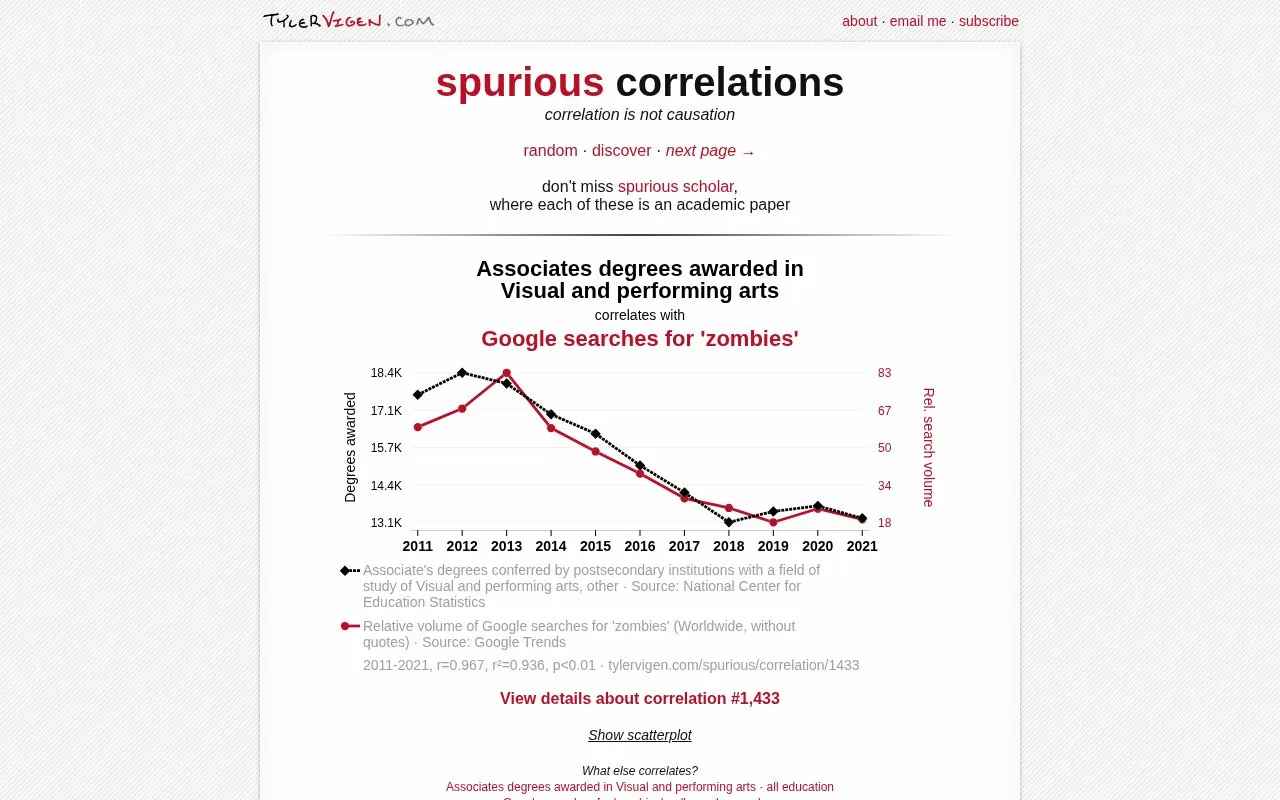
Spurious Correlations shows charts of real data with unusual correlations and highlights that correlation does not establish causation.
About spurious correlations
Spurious Correlations publishes charts of real data that pair unrelated variables to show that correlation is not causation. Users can browse correlations, view details and scatterplots, see what else correlates with a variable, view a random correlation, and read Spurious Scholar papers based on the correlations.
The site states it compares 25,237 variables in 636,906,169 calculations through data dredging. Pages are automatically generated using years as the base variable, so some pairs shown may in fact be related.
Key features
- Charts pairing unrelated variables from real datasets
- Detail pages for individual correlations with scatterplots
- Random correlation viewer and discovery tool
- Lists of related correlations by variable category
- Spurious Scholar research paper versions of correlations
- Explanation of data dredging method
- Uses real data for the correlations
- Explains data dredging and lack of causal connection
- Covers many topics such as names, food, stocks, and weather
- Pages are automatically generated and may show variables that are actually related
- Uses years as the base variable, so unrelated yearly events can appear correlated
spurious correlations at a glance
- Category
- Lifestyle & Hobbies › Fun & Interesting Sites
- Type
- Website
- Pricing
- Not confirmed. Check the site
- Platforms
- Web
- Open source
- Not stated
- Language
- English
- Last checked
- Oct 5, 2026 · Online when checked
- Listed
- Oct 5, 2026
Popular in Fun & Interesting Sites
Well-known listings from the same topic.


spurious correlations FAQ
Why do unrelated variables show strong correlations on the site?
Are any of the correlated variables actually related?
Tell us and an editor will check it.
Claim the listing and suggest updates yourself. An editor checks every claim first.