
This project presents a study on improving language model factuality and reasoning through multiagent debate.
Publication
StreamingLLM is a technique that can enable language models like Llama-2 to have conversations that span across millions of tokens.
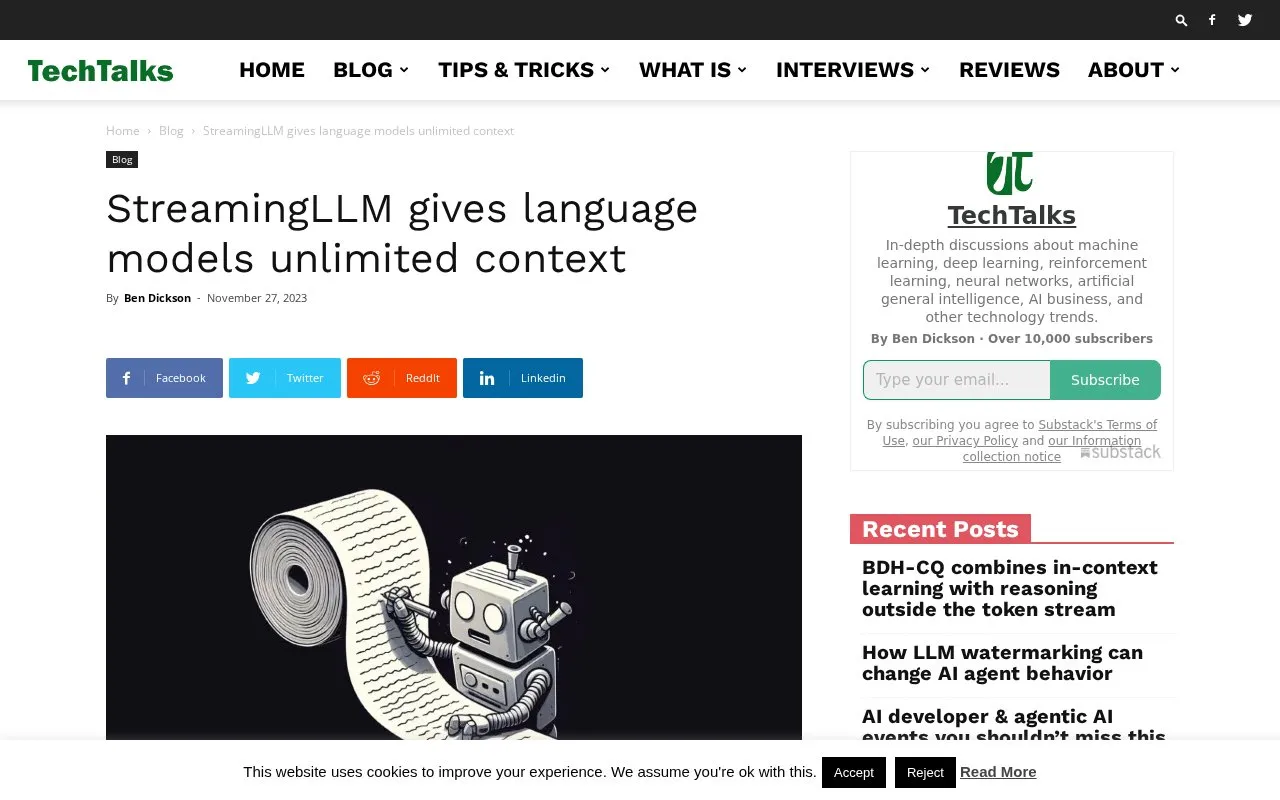
This is a web article from TechTalks that explains StreamingLLM, a research technique for extending the context of large language models. Language models have a fixed context length set by their architecture and training, so long chat sessions can reach that limit. The article says StreamingLLM was developed by researchers from Meta AI, MIT, and Carnegie Mellon University, and it describes the technique as able to extend a model's context to millions of tokens without vast compute and memory resources while preserving high-quality performance.
The article contrasts StreamingLLM with other approaches. It notes that longer context usually requires retraining, which can be expensive, and that a sliding context window forces recomputation of the cached attention values, which lowers throughput and can reduce quality. It also describes the researchers' observation that autoregressive models such as Llama-2 and GPT-3.5 assign a large share of attention to the initial tokens. The page excerpt ends before the method is fully explained.
Other listings in Academic Papers with the most in common.
This project presents a study on improving language model factuality and reasoning through multiagent debate.
This article compares methods for detecting hallucinations in retrieval-augmented generation systems.
Well-known listings from the same topic.
Tell us and an editor will check it.
Claim the listing and suggest updates yourself. An editor checks every claim first.


