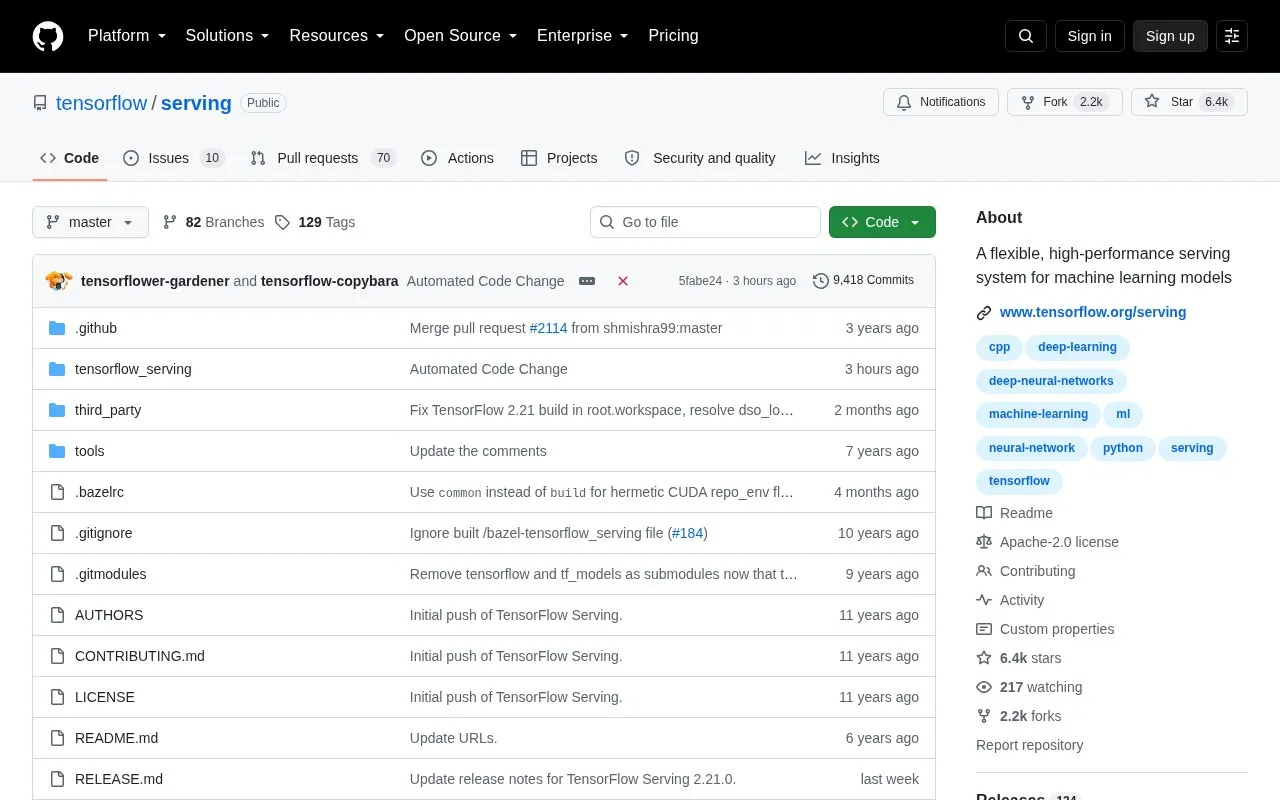
TensorFlow Serving is an open-source serving system for machine learning models, intended for production environments. It focuses on inference: it takes models after training, manages their lifetimes, and gives clients versioned access through a high-performance, reference-counted lookup table. It integrates out of the box with TensorFlow models and can be extended to serve other model types and data.
It can serve multiple models or multiple versions of the same model at once, exposes gRPC and HTTP inference endpoints, and lets new model versions be deployed without changing client code, including canarying and A/B testing. Installation is handled through Docker images (the recommended route), Kubernetes, or a build from source; installing without Docker is documented but not recommended. The repository also describes a scheduler that batches inference requests for joint execution on GPU with configurable latency controls, and a modular architecture whose parts can be used individually or extended to new use cases.
Key features
Serves multiple models or multiple versions of one model simultaneously
Exposes both gRPC and HTTP inference endpoints
Deploy new model versions without changing client code
Supports canarying new versions and A/B testing experimental models
Scheduler batches inference requests for joint GPU execution with latency controls
Supports servables including embeddings, vocabularies, feature transformations and non-TensorFlow models
Best for: Teams running TensorFlow models in production that need versioned, low-overhead inference serving they host themselves.
Good for
Out-of-the-box integration with TensorFlow models, with SavedModel as the export format
Modular architecture lets parts such as batch scheduling be used individually or extended
Docker image path is documented as the easiest setup, with a short example serving and querying a model
Watch out for
Installing and building without Docker is documented but explicitly not recommended
Serving non-TensorFlow model types requires extending the system
No hosted service is described; deployment is on your own Docker, Kubernetes or built-from-source setup
The README shows pulling the tensorflow/serving Docker image, running the container on the REST API port, mounting a model directory, and querying the predict API with a curl POST request.
How are model updates handled?
New model versions can be deployed without changing client code, and the system supports canarying new versions and A/B testing experimental models, with clients receiving versioned access.
What do I need to export from TensorFlow first?
A SavedModel, described as a language-neutral, recoverable, hermetic serialization format, is exported from a TensorFlow program before serving.
Is something wrong or out of date?
Tell us and an editor will check it.
Own this website?
Claim the listing and suggest updates yourself. An editor checks every claim first.