
The Illustrated VQGAN
This illustrated article explains VQGAN and how it can generate high-resolution images from text.
About The Illustrated VQGAN
The Illustrated VQGAN is a long-form article by LJ V. Miranda about how VQGAN works for text-to-image synthesis. It presents VQGAN-CLIP as an interaction between two separate models: VQGAN generates images, while CLIP judges how closely an image matches a text prompt and guides the generator over many iterations.
Pricing is not clearly stated.
Key features
- Starts from a theory of perception based on discrete representations
- Explains how transformers can model long-range dependencies
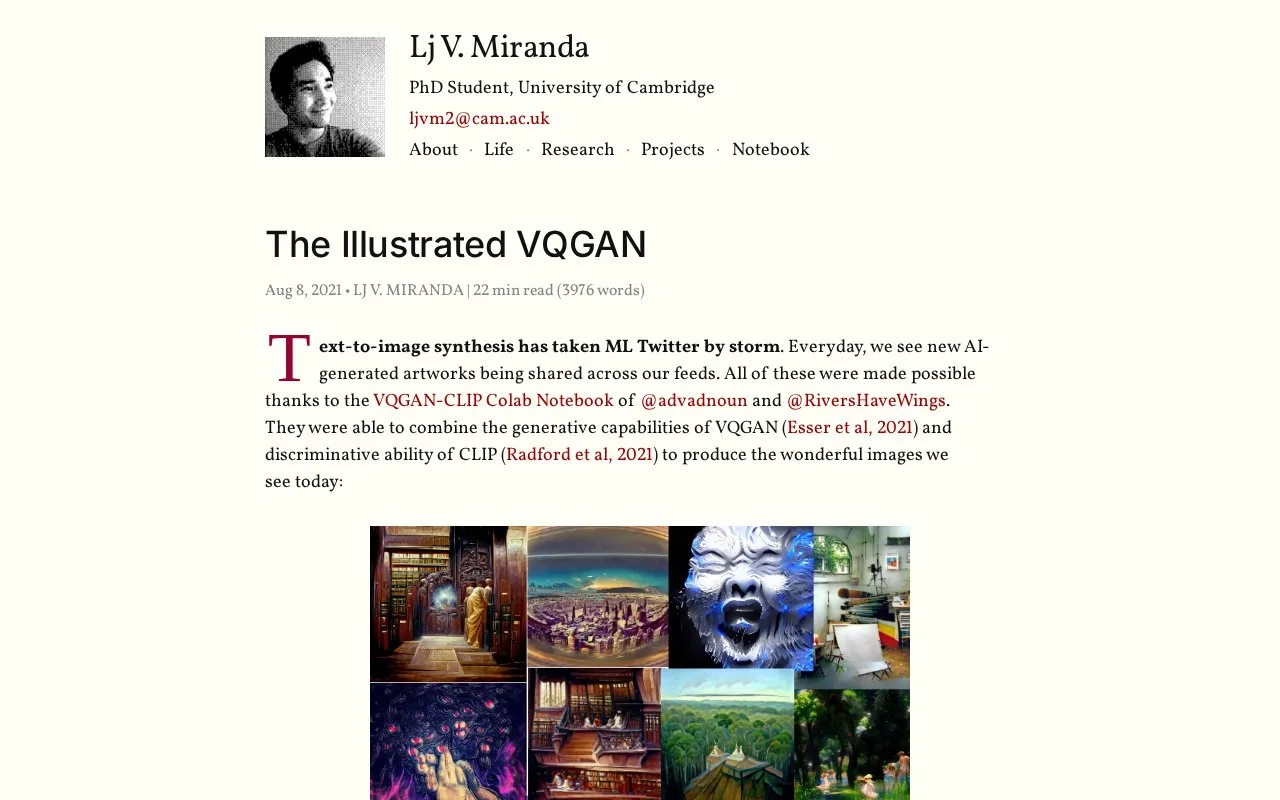
- Uses example VQGAN-CLIP images by several creators
- Focuses on the paper “Taming Transformers for high-resolution image synthesis”
- Cites the VQGAN and CLIP papers
Best for: Readers who want a bottom-up explanation of how VQGAN works.
Watch out for
- Focuses on VQGAN and sends readers elsewhere for a full explanation of CLIP
The Illustrated VQGAN at a glance
- Official website
- ljvmiranda921.github.io/notebook/2021/08/08/cl…
- Category
- Education & Learning › AI Learning & Guides
- Type
- Publication
- Platforms
- Web
- Details verified
- Oct 22, 2026 · Official source
- Language
- English
- Last checked
- Oct 5, 2026 · Online when checked
- Listed
- Oct 5, 2026
Popular in AI Learning & Guides
Well-known listings from the same topic.
NN Visualnn-visual.comTutorialSearchtutorialsearch.ioTutor AItutorai.meAnimated AIanimatedai.github.ioMade With MLmadewithml.comR-bloggersr-bloggers.com


The Illustrated VQGAN FAQ
What do VQGAN and CLIP stand for?
VQGAN stands for Vector Quantized Generative Adversarial Network, and CLIP stands for Contrastive Image-Language Pretraining.
Is something wrong or out of date?
Tell us and an editor will check it.
Own this website?
Claim this listing
Claim the listing and suggest updates yourself. An editor checks every claim first.