

The Dutch National Archives supports public access to information and helps governments manage and publish records for long-term preservation.
Tierstimmenarchiv - Museum für Naturkunde Berlin
Berlin’s Tierstimmenarchiv holds about 120,000 animal sound recordings for research, documentation, and long-term preservation.
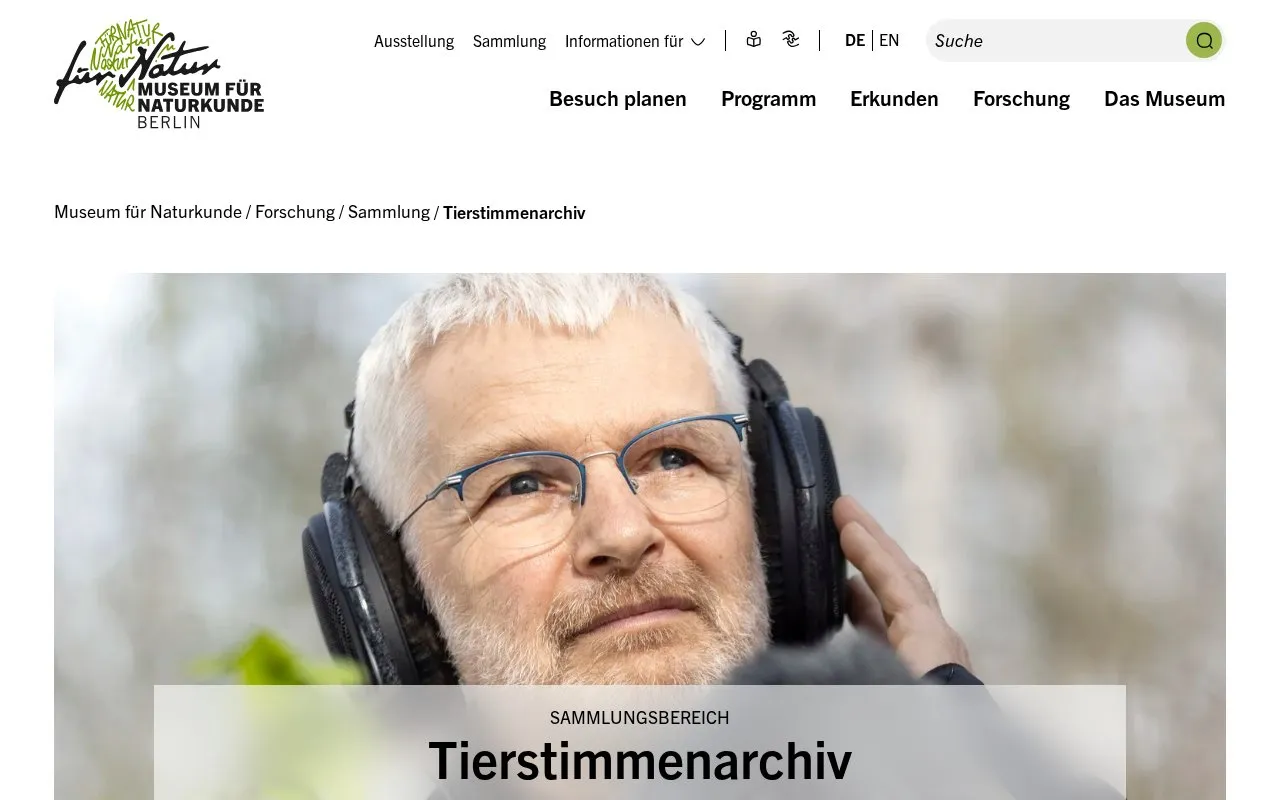
About Tierstimmenarchiv - Museum für Naturkunde Berlin
The Tierstimmenarchiv is the animal sound archive of the Museum für Naturkunde Berlin. It holds more than 120,000 sound recordings of birds, mammals, and other animal groups, including fish, amphibians, reptiles, and insects. The archive is used for research, documentation, and long-term preservation of acoustic biodiversity. According to the site, it is one of the oldest collections of its kind and the third-largest bioacoustic collection in the world. About a third of the recordings are field recordings, mainly from Central and Eastern Europe. The remaining two thirds were made in zoological institutions or under experimental conditions. The site states that recordings from all continents are now represented.
Access to the recordings is through the archive's database, where the site says more than 40,000 sound documents are currently available. Older recordings, mostly made on magnetic tape before the 1990s, were digitised at 96 kHz and 24-bit for long-term preservation. New recordings are made only in digital format. Research enquiries are directed to the archive's scientific management. The site does not state pricing or terms of use for the database.
Key features
- Database access to more than 40,000 sound documents
- Recordings of birds, mammals, fish, amphibians, reptiles and insects
- Digitised historical tape recordings at 96 kHz and 24-bit
- Reference recordings for comparative and playback experiments
- Long-term recordings for monitoring changes in animal communities
- Research on automated methods for identifying animal species from sound
Best for: Researchers in bioacoustics, animal behaviour, and biodiversity monitoring who need reference animal sound recordings.
Good for
- Large collection covering several animal groups across many species
- Historical recordings digitised at a stated high resolution for preservation
- Recordings are used by researchers worldwide, according to the site
Watch out for
- Only over 40,000 of the roughly 120,000 recordings are stated as currently accessible online
- Two thirds of the recordings were made in zoos or under experimental conditions rather than in the wild
- Field recordings are mainly from Central and Eastern Europe
Tierstimmenarchiv - Museum für Naturkunde Berlin at a glance
- Category
- Research & Data › Open Data & Datasets
- Type
- Website
- Pricing
- Not confirmed. Check the site
- Platforms
- Web
- Open source
- Not stated
- Language
- German
- Last checked
- Oct 6, 2026 · Online when checked
- Listed
- Oct 5, 2026
Tierstimmenarchiv - Museum für Naturkunde Berlin alternatives
Tools and sites you could use instead, ranked by how closely they match.
FishSounds inventories research on fish sound production, with search by fish group, recordings, or references.

Coscine provides research data management for structured storage, metadata management, collaboration, and long-term storage of project data.

KonDATA is the University of Konstanz research data repository for publishing data with long-term visibility and citable records.

The LTER-Italy Data Registry is a digital asset register for the Italian long-term ecological research network.

DEIMS-SDR helps users discover long-term ecosystem research and observation sites worldwide, along with associated people and networks.
Popular in Open Data & Datasets
Well-known listings from the same topic.
data.worlddata.worldNASA APIapi.nasa.govCosmoSimcosmosim.orgdata.meudon.frdata.meudon.frESS-DIVEess-dive.lbl.govState of Hawaiidata.hawaii.gov


Tierstimmenarchiv - Museum für Naturkunde Berlin FAQ
How can researchers request access to the recordings?
Research enquiries can be directed to the scientific management of the Tierstimmenarchiv.
Are all of the archive's recordings available online?
No. The site states that more than 40,000 sound documents are currently available through the database, out of about 120,000 recordings in total.
Where were the recordings made?
The site says the field recordings come mainly from Central and Eastern Europe, and that original recordings from all continents are now included.
Is something wrong or out of date?
Tell us and an editor will check it.
Own this website?
Claim this listing
Claim the listing and suggest updates yourself. An editor checks every claim first.