

Workbench supports learning and prototyping with GNOME technologies through an environment for experimenting with them.
Workbench
GNOME developers can experiment with GNOME technologies and prototype GTK interfaces in the Workbench code playground.
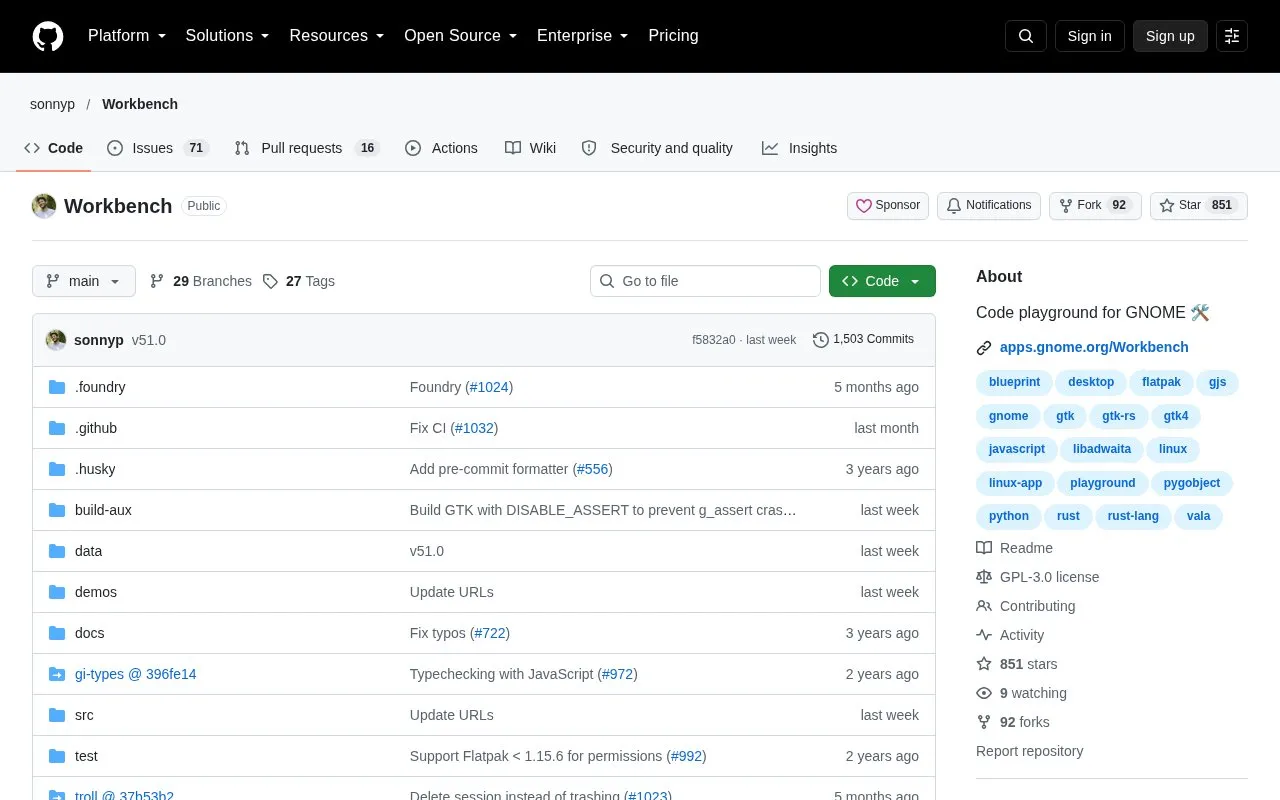
About Workbench
Workbench is a code playground for experimenting with GNOME technologies and prototyping GTK user interfaces. It is intended for both first-time experimentation and for building and testing a GTK user interface. Its listed features include a live GTK and CSS preview, a library of 100+ examples, support for JavaScript, Rust, Python, and Vala, autosave, sessions and projects, and code diagnostics, completion, and formatting.
Workbench is made possible by Flatpak, and only the Flathub version is supported. A prototype can be turned into an application by using GNOME Builder to start a project from the GNOME Application template and copying in the Workbench code. The project is open source under the GPLv3 license, and files under src/Library/demos are public domain under CC0 1.0.
Key features
- Live GTK and CSS preview of interface changes
- Library of more than 100 examples
- Code support for JavaScript, Rust, Python, and Vala
- Declarative user interface syntax
- Autosave, sessions, and projects
- Code diagnostics, completion, and formatter
Best for: GNOME and GTK developers, and people learning GTK, who want to experiment with interfaces and prototype them before building an application.
Good for
- Open source under the GPLv3 license
- Live preview of GTK and CSS while working
- Includes a library of more than 100 examples
Watch out for
- Only the Flathub version of Workbench is supported
Workbench at a glance
- Category
- Education & Learning › Learn to Code
- Type
- Open-source project
- Pricing
- Not confirmed. Check the site
- Open source
- Yes · Source code
- Language
- English
- Last checked
- Oct 6, 2026 · Online when checked
- Listed
- Oct 5, 2026
Workbench alternatives
Tools and sites you could use instead, ranked by how closely they match.

A Python learning playground and cheat sheet organizes example scripts by topic, with explanations for the code.
Open source
24 alternatives
This repository documents a 90-day cybersecurity study plan with topics for a staged learning schedule.
Open source
24 alternatives
Coding Problems provides solutions to coding and algorithm problems and multiple programming exercises.
Open source
24 alternatives
Jupyter notebooks implement and derive machine learning algorithms from first principles using NumPy.
Open source
24 alternatives
This tutorial walks through training and deploying a machine learning REST API that predicts cryptocurrency prices in ten steps.
Open source
24 alternativesPopular in Learn to Code
Well-known listings from the same topic.
Codelabscodelabs.developers.google.comScratchscratch.mit.eduTelegram Bot APIcore.telegram.org/botsStudent Developer Packeducation.github.com/packHacksplaininghacksplaining.comQB64SourceCodeqb64tutorial.com


Workbench FAQ
Which version of Workbench is supported?
The homepage states that only Flathub Workbench is supported, and that Workbench is made possible by Flatpak.
How can a Workbench prototype become an application?
Use GNOME Builder to start a new project with the appropriate GNOME Application template, then copy and paste your Workbench code into it.
What license does Workbench use?
Workbench is licensed under GPLv3. Files under src/Library/demos are in the public domain under the terms of CC0 1.0.
Is something wrong or out of date?
Tell us and an editor will check it.
Own this website?
Claim this listing
Claim the listing and suggest updates yourself. An editor checks every claim first.