

Eurybia tracks model drift and validates data during machine learning model deployment.
Open source
24 alternativesAdaptive Reliability Layer decides when to retrain a model based on drift signals and delayed labels.
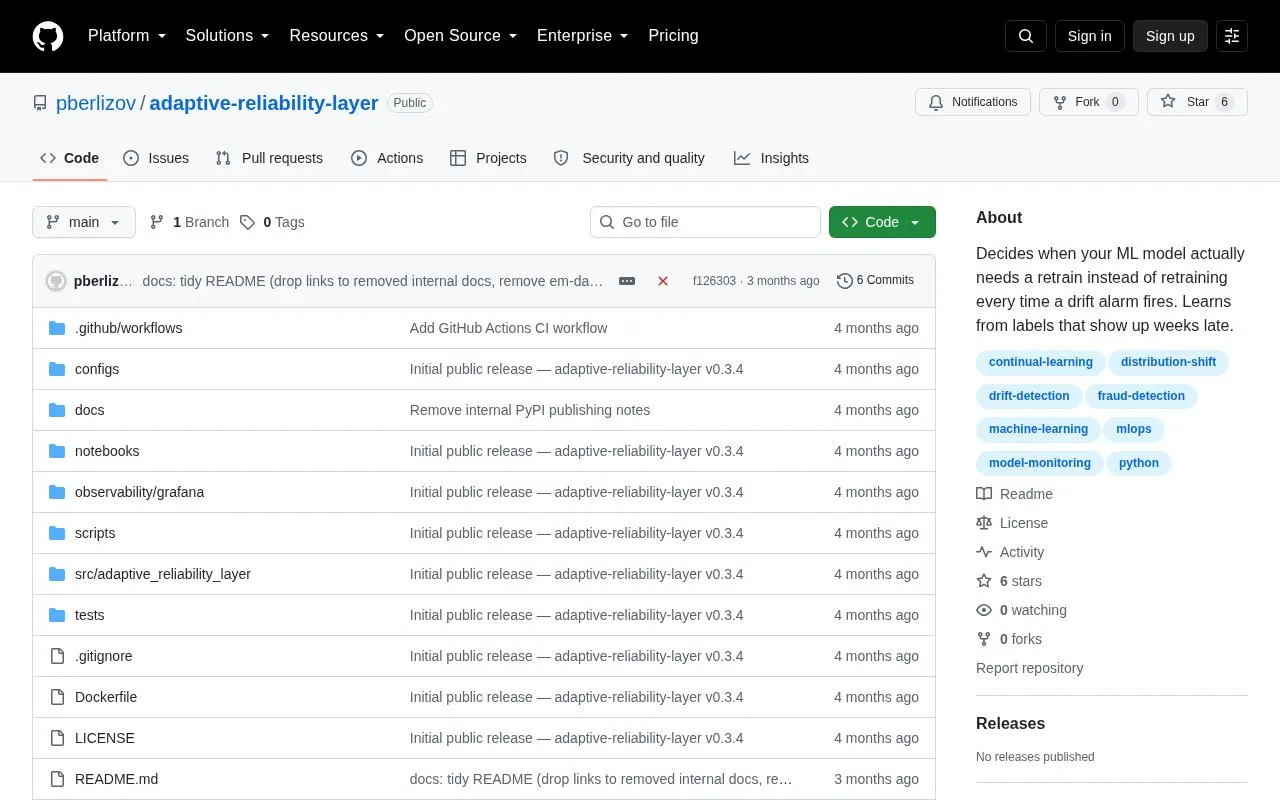
Adaptive Reliability Layer sits between an inference pipeline and a monitoring layer to detect distribution shift and decide whether adaptation is warranted. It learns from delayed revealed labels, such as chargebacks or disputes arriving weeks after inference, and applies a bounded steering step with correction first and explicit mutation only when needed. It logs every decision and does not replace the existing model.
It is described for use where retraining is costly, including dataset engineering, backtests, model-risk sign-off, and deployment. Reported evaluations cover public fraud streams with 12-step label delay and NASA CMAPSS data, where raw fraud accuracy remained flat and reported gains were operational metrics.
Tools and sites you could use instead, ranked by how closely they match.
Eurybia tracks model drift and validates data during machine learning model deployment.
Deepchecks tests and validates machine learning models and data, covering workflows from research through production.
Evidently evaluates, tests, and monitors machine learning systems and data pipelines.
OpenLLMetry provides OpenTelemetry-based observability for generative AI and large language model applications.
NannyML provides Python tools for post-deployment data science and monitoring model performance under data drift.
Edge Impulse provides MLOps workflows for developing, deploying, and monitoring edge and physical AI models.
Well-known listings from the same topic.
Tell us and an editor will check it.
Claim the listing and suggest updates yourself. An editor checks every claim first.


