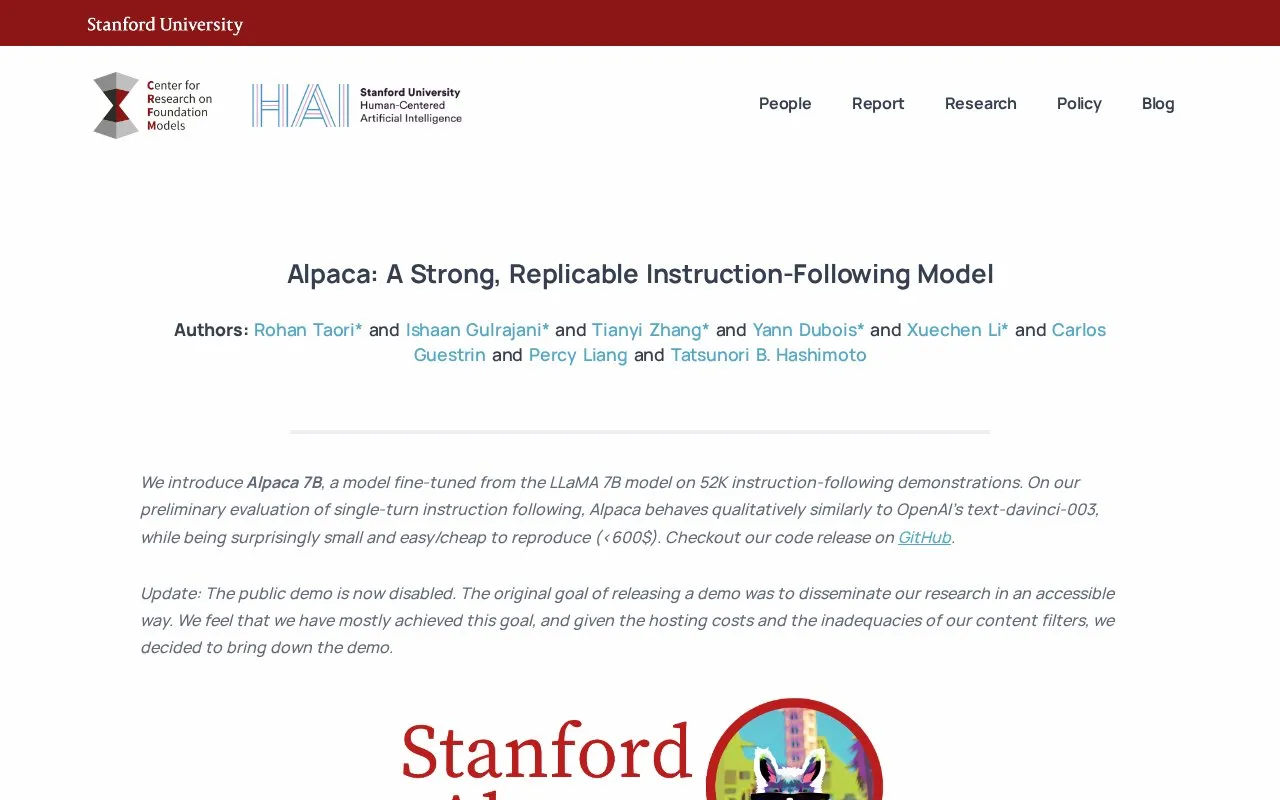
crfm.stanford.edu/2023/03/13/alpaca.html
About Alpaca
Alpaca is a Stanford CRFM research project describing a 7B instruction-following language model fine-tuned from Meta's LLaMA 7B on 52K demonstrations generated with OpenAI's text-davinci-003. The site publishes the training recipe, data generation method, code release, and preliminary single-turn evaluation.
The public demo is disabled. The project states the work is for academic research only with commercial use prohibited, and notes the model lacks adequate safety measures and can produce false, stereotyped, or toxic outputs.
Key features Describes fine-tuning LLaMA 7B on 52K instruction demonstrations Explains self-instruct style data generation using text-davinci-003 Shares training cost and compute details for reproduction Provides preliminary single-turn instruction-following evaluation Publishes code release via GitHub Discusses risks and considerations for open release Best for: Academic researchers studying instruction-following models and low-cost training methods.
Releases training recipe and data to support replication Documents data generation and fine-tuning costs and methods Reports preliminary evaluation on single-turn instruction following Public demo is disabled due to hosting costs and content filter inadequacies Restricted to academic research; commercial use is prohibited Can generate false information, stereotypes, and toxic language Alpaca at a glance
Type Website
Pricing Not confirmed. Check the site
Platforms Web
Open source Not stated
Language English
Last checked
Listed Oct 5, 2026
Alpaca alternatives Tools and sites you could use instead, ranked by how closely they match.
All 24 alternatives github.com/tatsu-lab/stanford_alpaca
Code and documentation to train Stanford's Alpaca models, and generate the data.
C nlp.stanford.edu/software/corenlp.shtml
Stanford CoreNLP provides natural language analysis tools that process raw text into linguistic annotations.
W wordasimage.github.io/Word-As-Image-Page
This research paper presents Word-As-Image, a method for incorporating semantic meaning into typography.
github.com/deepseek-ai/DeepSeek-R1
The DeepSeek-R1 repository links to its reasoning research paper and provides related model materials.
hai.stanford.edu/ai-index
The Stanford AI Index gathers data about artificial intelligence for researchers, policymakers, journalists, and the public.
huggingface.co/blog/smolvla
Use SmolVLA, a vision-language-action model trained on data from the LeRobot community, for robotics research.
Popular in Models & ML Research Well-known listings from the same topic.
All 69 Is the Alpaca demo available? No, the public demo is disabled due to hosting costs and inadequacies of content filters.
Can Alpaca be used commercially? No, it is intended only for academic research and commercial use is prohibited.
How was Alpaca trained? It was fine-tuned from LLaMA 7B on 52K instruction-following demonstrations generated using text-davinci-003.
Is something wrong or out of date? Tell us and an editor will check it.
Own this website? Claim the listing and suggest updates yourself. An editor checks every claim first.
Claim this listing
Listing maintained by Chris McClure and the WebIndexly editors · Updated Oct 9, 2026 · How we rank