

Deep learning in Rust, with shape checked tensors and neural networks.
burn
Burn provides a flexible, efficient, and portable tensor library for building deep learning applications.
About burn
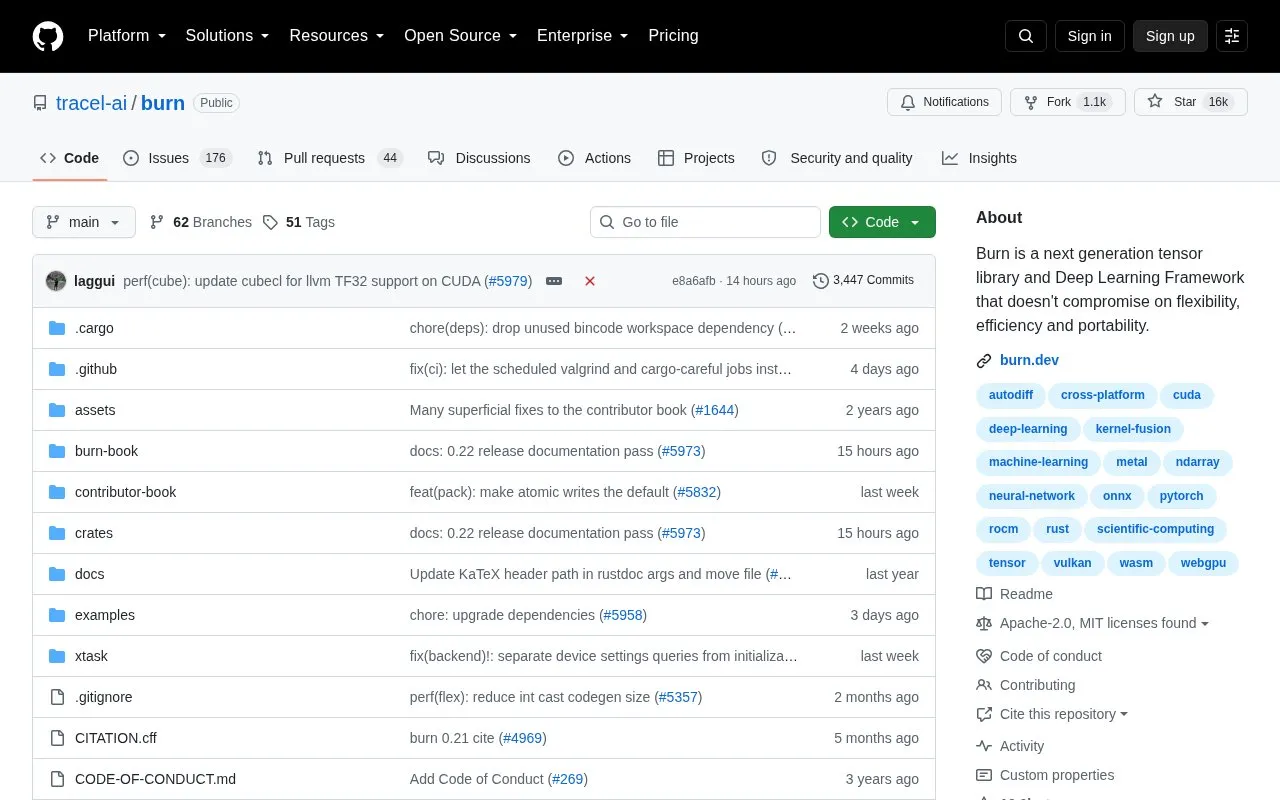
Burn is an open-source Rust tensor library and deep learning framework for numerical computing, training and inference. It aims to unify the two halves of a typical workflow: rather than training in one language and exporting to a separate format or runtime, the same tensor code used for training is intended to run in production, which the project says helps with workloads such as on-device personalization and federated learning. It keeps dynamic shapes and graphs while JIT-compiling streams of tensor operations with automatic kernel fusion.
Burn ships with an ecosystem of companion crates, including ONNX model import, weight storage and loading of PyTorch and Safetensors weights, vision and reinforcement learning building blocks, dataset loading, and backend benchmarking. Acceleration is provided through CubeCL backends for CUDA, ROCm, Metal, Vulkan, WebGPU and CPU, which compose with autodiff, fusion and remote-execution decorators; the pure-Rust Flex CPU/no_std backend composes with autodiff only. The repository is licensed under Apache and MIT terms. Pricing is not stated.
Key features
- Combined tensor library and deep learning framework for training and inference
- Same code path for training and production, avoiding model export steps
- JIT compilation of tensor operation streams with automatic kernel fusion
- CubeCL backends for CUDA, ROCm, Metal, Vulkan, WebGPU and CPU
- Incremental compilation said to rebuild modified model code in under 5 seconds
- Companion crates for ONNX import, weight storage, vision, RL and datasets
Best for: Rust developers and teams who want a single codebase for model training and deployment across several GPU and CPU backends.
Good for
- Open source under Apache and MIT licenses
- Unified API intended to avoid brittle or lossy training-to-production export steps
- Accelerated backends span CUDA, ROCm, Metal, Vulkan, WebGPU and CPU
Watch out for
- The pure-Rust Flex CPU/no_std backend composes with autodiff only, not the other decorators
- Community crates listed alongside the ecosystem are not maintained by Tracel
- Pricing and supported platform list are not stated in the source
burn at a glance
- Website
- github.com/tracel-ai/burn
- Type
- Open-source project
- Pricing
- Not confirmed. Check the site
- Open source
- Yes · Source code
- Language
- English
- Last checked
- Oct 6, 2026 · Online when checked
- Listed
- Oct 5, 2026
burn alternatives
Tools and sites you could use instead, ranked by how closely they match.

dstack provides an open framework for confidential AI computing and deployments.
Open source
24 alternatives
FlexML offers an easy to use and flexible automated machine learning library for Python.
Open source
24 alternatives
Flexible, high-performance serving system for machine learning models.
Open source
24 alternatives
Catniff provides JavaScript developers with a Torch-like deep learning framework.
Open source
24 alternatives
QKeras provides quantization tools for deep learning with TensorFlow Keras.
Open source
24 alternativesPopular in AI Infrastructure & MLOps
Well-known listings from the same topic.
Guild AIguild.aiFlow AIflow-ai.comsystemprompt.iosystemprompt.ioCoreWeavecoreweave.comKili Technologykili-technology.comAPI docsdocs.x.ai


burn FAQ
What hardware backends can Burn run on?
CubeCL backends cover CUDA, ROCm, Metal, Vulkan, WebGPU and CPU, and compose with autodiff, fusion and remote-execution decorators. The pure-Rust Flex CPU/no_std backend composes with autodiff only.
What language is Burn written in?
Burn is a Rust library and framework, designed around incremental compilation; the project says modifying model code recompiles in under 5 seconds, even in release mode.
Can existing models and weights be brought into Burn?
Yes. burn-onnx imports ONNX models into Burn as native Rust code, and burn-store saves, loads and imports model weights, including PyTorch and Safetensors formats.
Is something wrong or out of date?
Tell us and an editor will check it.
Own this website?
Claim this listing
Claim the listing and suggest updates yourself. An editor checks every claim first.