

Enterprise teams can build AI agents, automate workflows, and connect data through the Odin AI platform.
Celigo
Celigo connects apps, data, and AI workflows to build, operate, and govern business automation and integrations.
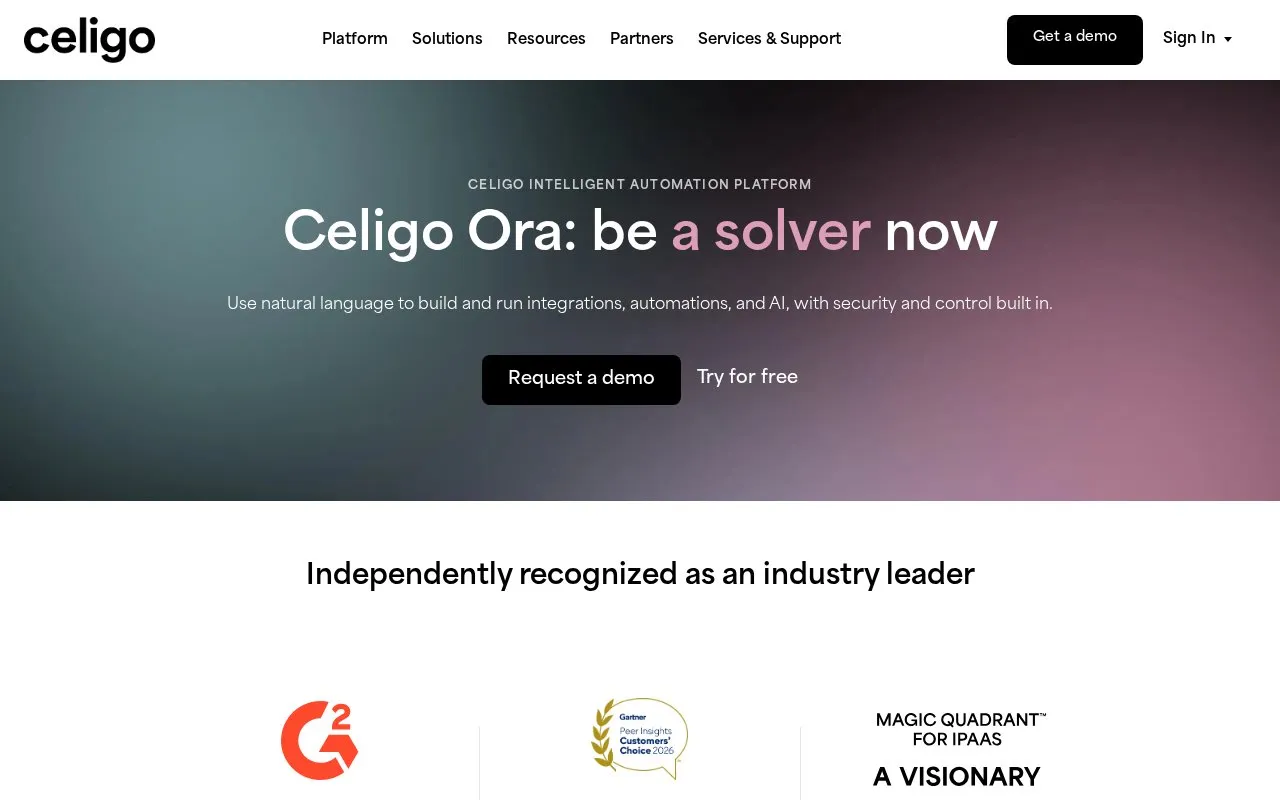
About Celigo
Celigo is a platform for building, operating, and governing automation and integrations across apps, data, and AI workflows. Teams can build in a UI, with natural language using Ora, or with code, and set each workflow to use deterministic rules, a mix of rules and AI, or more autonomous agents.
It combines application integrations, lifecycle API management, EDI and B2B connections, and AI agents on one system with automatic action tracking and audit visibility. It provides an Integration Marketplace with connectors for ecommerce, ERP, CRM, and other business apps.
Key features
- Build integrations in UI, natural language with Ora, or code
- Set workflow autonomy from deterministic rules to agentic behavior
- Run application integrations, API management, EDI and B2B connections together
- Track actions automatically with audit visibility and controls
- Manage and version integrations from terminal with CLI
- Use Integration Marketplace connectors for common business apps
Best for: Business and IT teams in areas like ecommerce, finance, IT, and support that need to build and govern automation across many apps.
Good for
- Offers UI, natural-language, code, and CLI building options
- Combines integrations, API management, EDI/B2B, and AI agents on one system
- Applies AI per workflow based on process needs with human oversight
Celigo at a glance
- Website
- celigo.com
- Category
- AI & Machine Learning › AI Workflow Automation
- Type
- Website
- Pricing
- Not confirmed. Check the site
- Platforms
- Web
- Open source
- Not stated
- Language
- English
- Last checked
- Oct 5, 2026 · Online when checked
- Listed
- Oct 5, 2026
Celigo alternatives
Tools and sites you could use instead, ranked by how closely they match.

Samey AI connects business tools and data to automate workflows and answer questions across organizational systems.

AITable.ai combines a visual database with workflow automation and connections to apps through integrations such as Zapier and Make.

Boltic provides AI workflow automation for business operations, with integrations across finance, ecommerce, healthcare, and support.

AI-Flow connects multiple AI models through a visual interface for building workflows.
Freemium
24 alternatives
Box provides content management tools for workflow automation, collaboration, and protection of business files and documents.
Popular in AI Workflow Automation
Well-known listings from the same topic.


Celigo FAQ
What is Celigo?
Celigo is an automation platform for building, running, and governing workflows from deterministic, rules-based processes to AI agents on one centrally governed system, keeping people in the loop where judgment is required.
How does Celigo decide how much AI to use in a workflow?
It follows a “least agency” principle where each workflow uses only as much AI as the process needs, from deterministic rules to blended rules and AI to more autonomous agents, kept visible and controllable.
Is Celigo an iPaaS, or something more?
It started as an iPaaS for connecting applications and data and now also runs lifecycle API management, EDI and B2B connections, and AI agents on the same system with the same governance.
Is something wrong or out of date?
Tell us and an editor will check it.
Own this website?
Claim this listing
Claim the listing and suggest updates yourself. An editor checks every claim first.