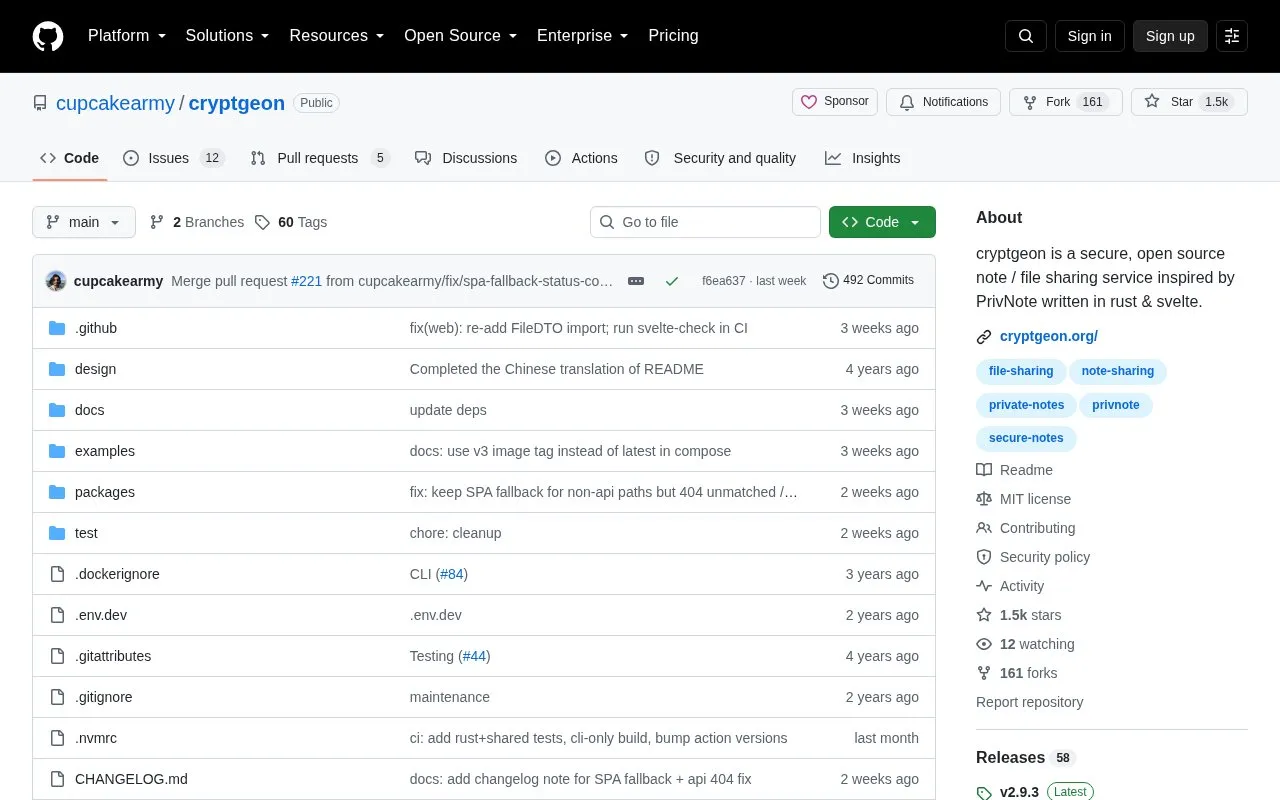
cryptgeon is an open-source note and file sharing service inspired by PrivNote, built with Rust and Svelte. It includes a server, a web page, and a CLI client, with a demo at cryptgeon.org.
Notes are encrypted client-side with XChaCha20-Poly1305 before upload, stored in memory without disk persistence, and can have view-count or time limits. Operators can self-host it with Docker and a Redis or Valkey cache, and HTTPS is required for browser cryptographic functions.
Key features
Share text notes or files via web page
Create notes from command line via CLI client
Encrypt notes client-side with XChaCha20-Poly1305
Limit access by view count or expiration time
Self-host with Docker using Redis or Valkey cache
Send notes through official Raycast extension
Best for: People who want to self-host a PrivNote-style service for sending notes and files with expiration limits.
Good for
Open source with server, web interface and CLI client
Client-side encryption means server stores only encrypted data without the key
Data is held in memory and not persisted to disk
Watch out for
View counts are only guaranteed with a single instance; shared-cache setups can allow extra retrievals
Requires HTTPS, otherwise browsers will not support the cryptographic functions
Notes kept in memory can be evicted and are not persisted
Each note has a 256-bit id for retrieval and a 256-bit key. The client encrypts the note with XChaCha20-Poly1305 before sending it, and the server never receives the key.
How can I self-host cryptgeon?
Docker is the documented method, using a Valkey or Redis cache. HTTPS is required for the browser cryptography to work, and a health endpoint is available at /healthz.
Are view limits exact?
View counts are guaranteed with one running instance. Multiple instances connected to the same cache can have race conditions where a note is retrieved more times than allowed.
Is something wrong or out of date?
Tell us and an editor will check it.
Own this website?
Claim the listing and suggest updates yourself. An editor checks every claim first.