Es
es provides an extensible shell derived from Plan 9’s rc shell and influenced by functional programming languages.
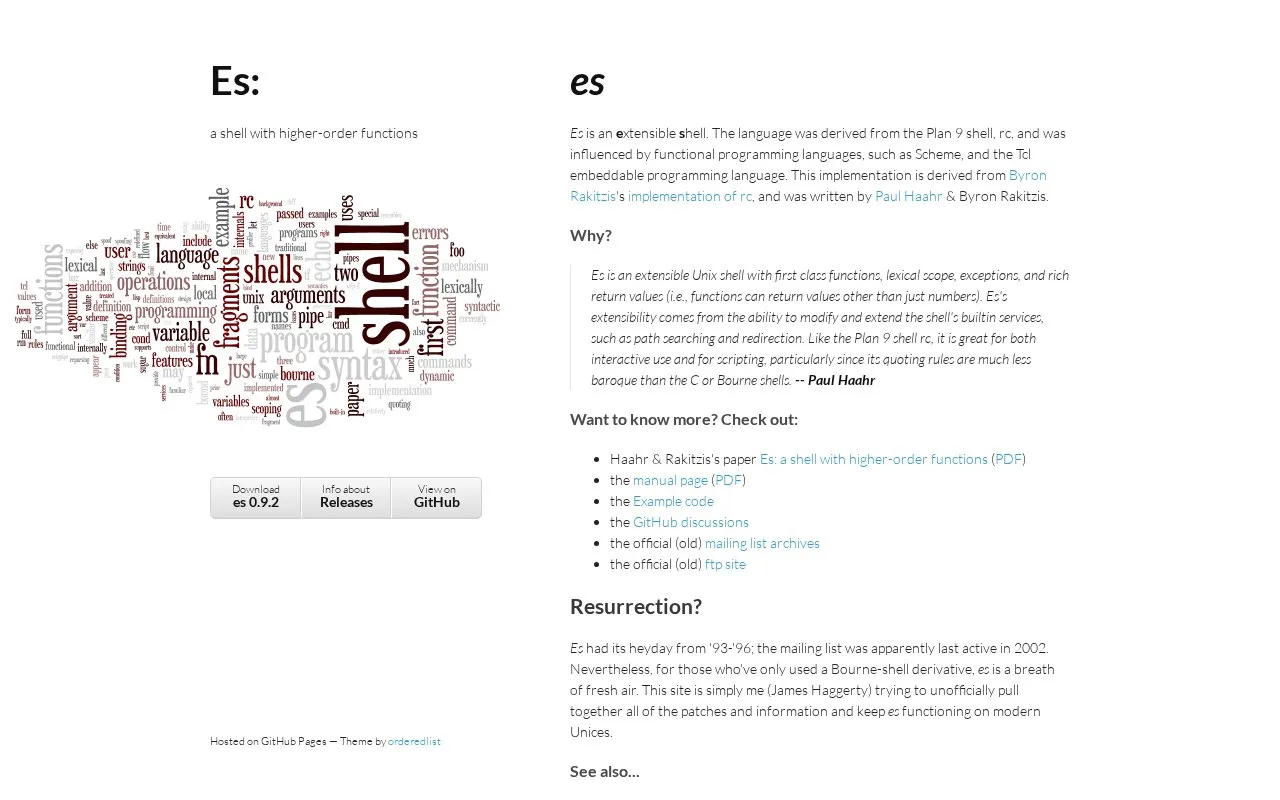
About Es
Es is an extensible Unix shell whose language was derived from the Plan 9 shell rc, with influence from functional programming languages such as Scheme and the Tcl embeddable language. It provides first-class functions, lexical scope, exceptions and return values other than numbers, and its builtin services, including path searching and redirection, can be modified and extended. It is intended for both interactive use and scripting, and its quoting rules are described as less baroque than those of the C or Bourne shells.
The implementation descends from Byron Rakitzis's rc implementation and was written by Paul Haahr and Byron Rakitzis. Es is in the public domain, with no copyrights or patents on the source and no restrictions on distribution, though recipients are asked to credit the authors. Development had its heyday from 1993 to 1996 and the mailing list was last active around 2002; this site is an unofficial effort by James Haggerty to collect patches and keep es working on modern Unices, and separate efforts include a C++ version with language changes, a job control version, macOS changes and a Google Code project.
Key features
- First-class functions and lexical scope in the shell language
- Exceptions and functions that return values beyond numbers
- Extensible builtin services such as path searching and redirection
- Quoting rules described as less complex than C or Bourne shells
- Designed for both interactive use and scripting
- Public domain source with no distribution restrictions
- Released into the public domain with no copyrights, patents or distribution restrictions
- Language includes first-class functions, lexical scope, exceptions and rich return values
- Quoting rules are described as much less baroque than C or Bourne shells
- Development heyday was 1993 to 1996, and the mailing list was last active around 2002
- Maintenance is unofficial, carried out by one person gathering patches to keep es working on modern Unices
- Several separate continuation efforts exist, including a C++ version with language changes and a job control version
Es at a glance
- Website
- wryun.github.io/es-shell
- Category
- Software & Utilities › Linux & Mac Apps
- Type
- Website
- Pricing
- Not confirmed. Check the site
- Platforms
- Web
- Open source
- Not stated
- Last checked
- Oct 6, 2026 · Online when checked
- Listed
- Oct 5, 2026
Popular in Linux & Mac Apps
Well-known listings from the same topic.


Es FAQ
What shell is es derived from?
Is es still maintained?
Can es be redistributed?
Tell us and an editor will check it.
Claim the listing and suggest updates yourself. An editor checks every claim first.