
Brazil’s Superior Electoral Court open data portal organizes election datasets by year, organization, group, and campaign finance topic.
Health Data Lab
Germany’s Health Data Lab statistics portal provides privacy-protected counts of statutory health insurance diagnoses by year and selected demographic groups.
About Health Data Lab
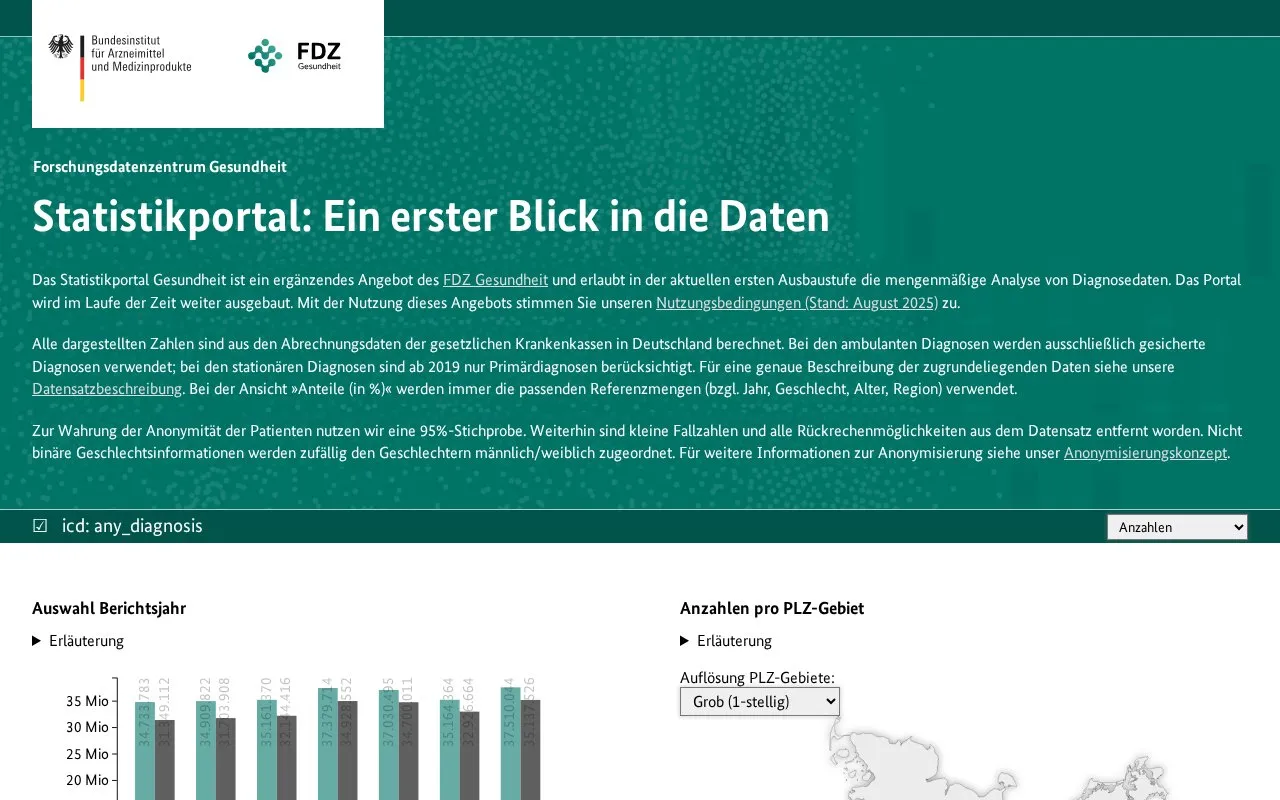
Health Data Lab is a German-language statistics portal, run by the FDZ Gesundheit, that reports counts of diagnoses from the data of Germany's statutory health insurance funds (gesetzliche Krankenversicherung). Users choose a reporting year, then a diagnosis or a group of diagnoses coded under ICD. The portal shows the number of people with at least one such diagnosis, either as counts or as percentages, and can break the results down by postal code region, age and sex.
The data covers 2016 onward and uses the FDZ data model 2. Diagnoses can be searched by name or code, or selected by browsing the ICD chapters and groups. The most detailed level is the three-character ICD code. Counts are protected for privacy: when case numbers are too small, results are shown only for coarser regions and age groups, or not at all. Changes to the ICD catalogue can mean that the same code describes a different context in different years. The portal states that this is rare and does not account for it. Links to the BfArM website give further information on ICD categories.
Key features
- Yearly counts of statutory health insurance diagnoses, from 2016 onward
- Search by diagnosis name or code, or browse ICD chapters and groups
- Results shown as absolute counts or as percentages
- Map of person counts by postal code region at one- or two-digit resolution
- Age and sex distribution in three coarse or ten-year fine age bands
- Comparison of a selected diagnosis across reporting years for all of Germany
Best for: Researchers, public health analysts and students who need aggregated, privacy-protected counts of diagnoses in German statutory health insurance data.
Good for
- Reports aggregated counts and states that patient data privacy is protected
- Allows breakdowns by postal code region, age group and sex where case numbers are large enough
- Provides yearly data from 2016 onward for comparing trends over time
Watch out for
- The most detailed diagnosis level is the three-character ICD code
- Small case numbers lead to coarser regions and age groups, or to no data being shown
- Changes to the ICD catalogue may affect comparability between years, which the portal does not account for in rare cases
Health Data Lab at a glance
- Category
- Research & Data › Open Data & Datasets
- Type
- Website
- Pricing
- Not confirmed. Check the site
- Platforms
- Web
- Open source
- Not stated
- Language
- German
- Last checked
- Oct 6, 2026 · Online when checked
- Listed
- Oct 5, 2026
Health Data Lab alternatives
Tools and sites you could use instead, ranked by how closely they match.

Protected Planet provides data on protected areas and conservation measures, with global statistics updated from submitted records.

The Canton of Bern’s statistics portal organizes public statistics by themes including population, economy, health, finance, and environment.
Gdansk’s open data portal publishes city data on topics including municipal finance, public transport schedules, and demographics.
Marine Scotland’s data publishing portal lets visitors search or browse groups to locate marine datasets.

The German pension insurance Research Data Center provides datasets on rehabilitation, insured people, and pension start, payment, and termination.
Popular in Open Data & Datasets
Well-known listings from the same topic.
data.worlddata.worldNASA APIapi.nasa.govCosmoSimcosmosim.orgdata.meudon.frdata.meudon.frESS-DIVEess-dive.lbl.govState of Hawaiidata.hawaii.gov


Health Data Lab FAQ
What is the most detailed level of diagnosis available?
Diagnoses can be selected down to the three-character ICD code. Finer subdivision is not possible in order to keep case numbers large enough.
Why does the portal show no data for some selections?
Because of privacy rules, no data is shown when case numbers are too small. The portal asks users to choose a coarser selection, such as fewer age groups or larger regions.
Which years are covered?
The portal contains data from 2016 onward, based on the FDZ data model 2. Users first select the reporting year before choosing a diagnosis.
Is something wrong or out of date?
Tell us and an editor will check it.
Own this website?
Claim this listing
Claim the listing and suggest updates yourself. An editor checks every claim first.