

The Hugging Face Diffusion Models Course provides course materials for studying diffusion theory and image generation.
Open source
24 alternativesThe Hugging Face LLM Course teaches large language model concepts through documentation and related learning resources.
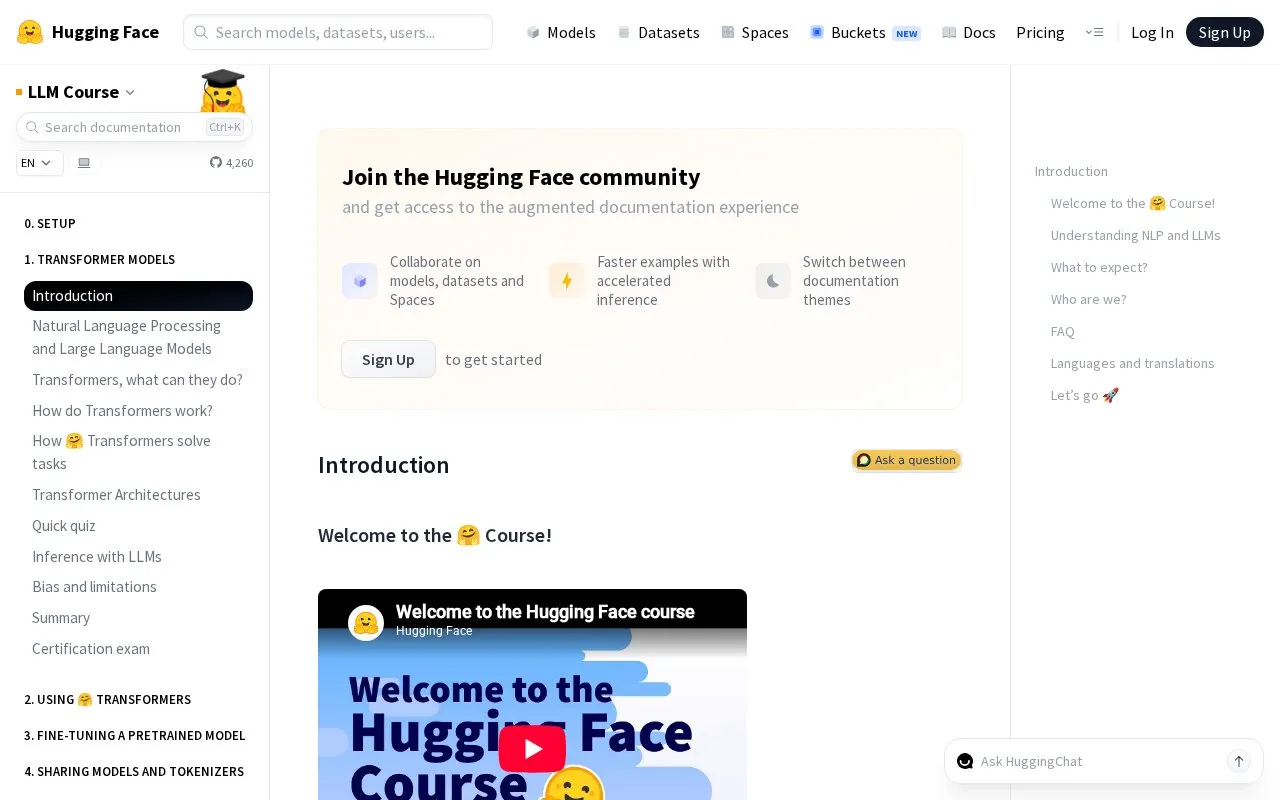
The Hugging Face LLM Course teaches large language models and natural language processing using Transformers, Datasets, Tokenizers, Accelerate, and the Hugging Face Hub, along with selected libraries outside the Hugging Face ecosystem. Chapters move from Transformer basics, using models and fine-tuning, through Datasets, Tokenizers and common language tasks, to building demos and advanced topics such as dataset curation and reasoning models.
It requires good knowledge of Python and is intended to be taken after an introductory deep learning course. Prior PyTorch or TensorFlow knowledge is not expected, though some familiarity helps.
Tools and sites you could use instead, ranked by how closely they match.
The Hugging Face Diffusion Models Course provides course materials for studying diffusion theory and image generation.
Full Stack Deep Learning shares news, community resources, and courses for people who build products using AI.
LabLab’s technology index links AI topic pages with tutorials, hackathons, frameworks, and starter code.
This interactive visualization teaches how transformer language models work.
Frink’s web interface accepts Frink expressions for lookup and calculation, with links to documentation, examples, and related tools.
Information Theory, Inference, and Learning Algorithms is a textbook with related resources by David MacKay.
Well-known listings from the same topic.
Tell us and an editor will check it.
Claim the listing and suggest updates yourself. An editor checks every claim first.


