

RocketPy describes itself as a six-degree-of-freedom trajectory simulator for high-power rocketry.
Open source
24 alternativesThis Unsloth guide introduces the basics and best practices of fine-tuning language models.
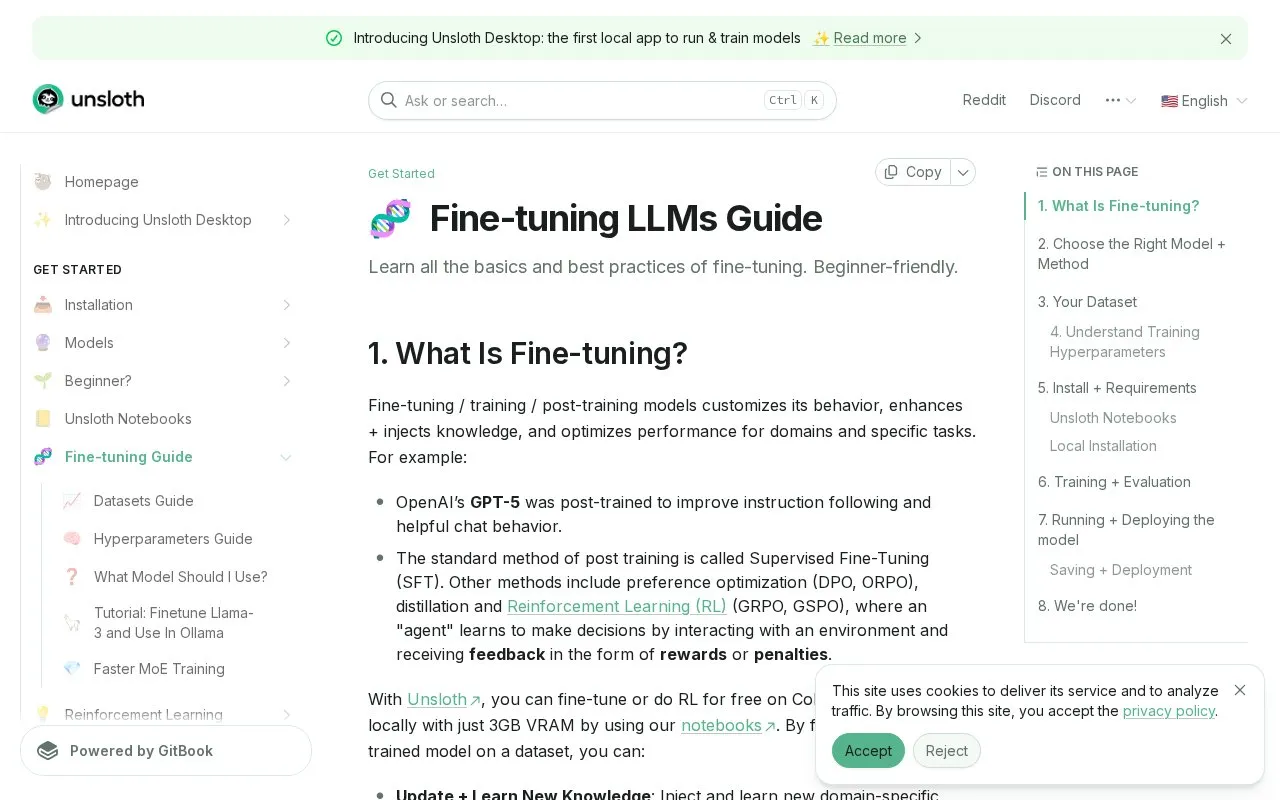
This Unsloth documentation page introduces fine-tuning language models, including supervised fine-tuning, preference optimization, distillation and reinforcement learning. It explains how training on a dataset can add domain-specific knowledge, adjust tone or behavior, and improve accuracy for specific tasks, with examples such as headline sentiment, customer responses and legal texts. It also explains LoRA and QLoRA adapter training and gives guidance on choosing a model and method, suggesting beginners start with a small instruct model such as Llama 3.1 (8B).
Tools and sites you could use instead, ranked by how closely they match.
RocketPy describes itself as a six-degree-of-freedom trajectory simulator for high-power rocketry.
The OpenRocket wiki provides collaboratively written documentation for the open-source model rocket simulator.
OpenDroneMap processes drone imagery to generate maps, point clouds, and 3D models.
Manager uses BOINC volunteer computing to let participants contribute computing resources to projects.
The Hugging Face Diffusion Models Course provides course materials for studying diffusion theory and image generation.
ChemOCR uses a lightweight model to recognize chemical structures from images and convert them into other formats.
Well-known listings from the same topic.
Tell us and an editor will check it.
Claim the listing and suggest updates yourself. An editor checks every claim first.


