

Learn data structures and algorithms through open-source implementations in multiple programming languages.
ChemOCR
ChemOCR uses a lightweight model to recognize chemical structures from images and convert them into other formats.
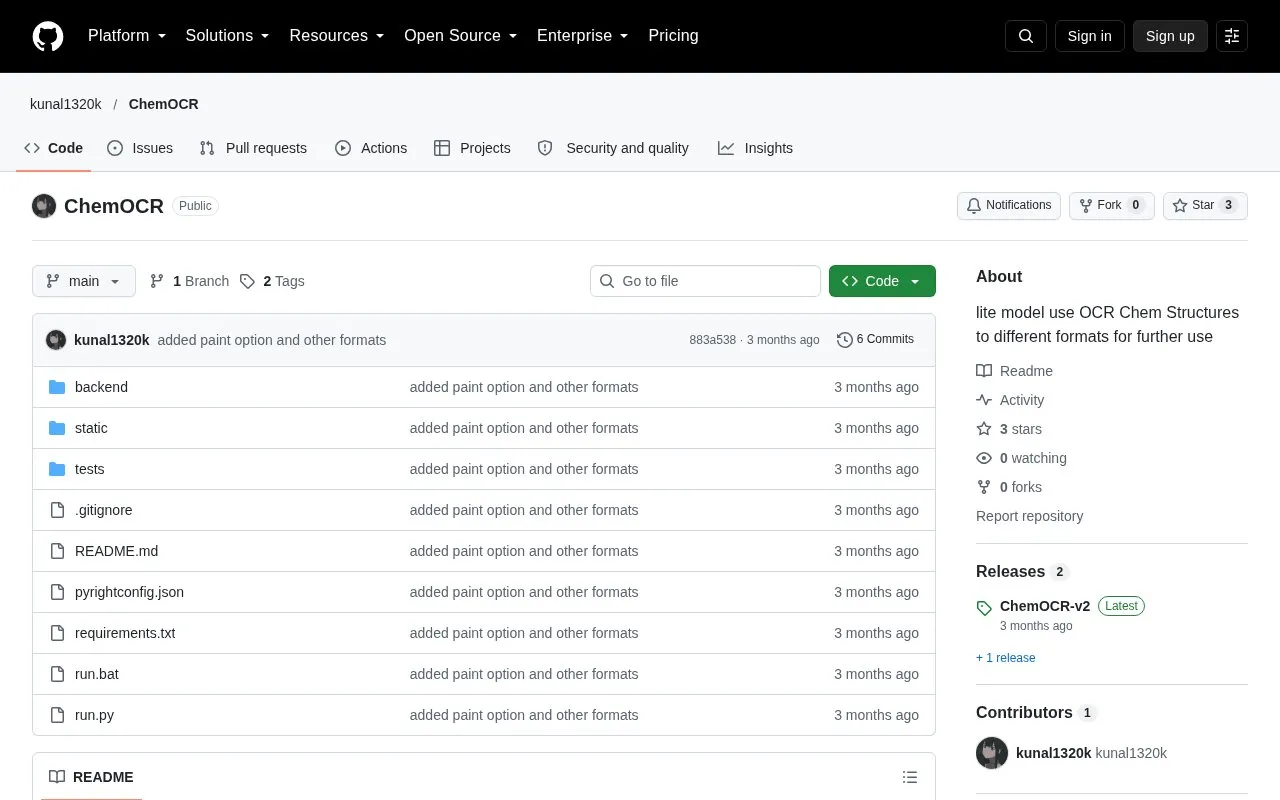
About ChemOCR
ChemOCR is a web-based tool that reads images of chemical structures, such as hand-drawn or published diagrams, and converts them into text formats. It uses the MolScribe model to predict a SMILES string from the image, then uses RDKit to validate the result, convert it to other formats, and render a clean diagram. The results include formats such as InChI, InChIKey, MOL, SDF, PDB, XYZ, and SELFIES, along with molecular formula, weight, and exact mass.
The project is designed to run locally. The recommended setup on Windows is an automated script that creates a virtual environment, installs dependencies, and downloads the model checkpoint on first run. Manual installation is documented for Linux, macOS, and custom environments. GPU acceleration is used when CUDA is detected, with CPU fallback otherwise. The source does not state how the tool performs on particular kinds of images beyond describing optional preprocessing for noisy or scanned inputs.
Key features
- Recognizes chemical structures from uploaded PNG or JPG images
- Exports to SMILES, InChI, MOL, SDF, MOL2, PDB, XYZ, CML, SELFIES, and JSON
- Computes molecular formula, weight, and exact mass using RDKit
- Processes multiple images at once with combined SDF, CSV, or JSON export
- Offers a command-line interface for offline batch recognition
- Provides an optional brush for cleaning up image artifacts before recognition
Best for: Students, researchers, and developers who want to convert images of chemical diagrams into machine-readable formats on their own computer.
Good for
- Includes an automated setup script for Windows that requires no manual environment configuration
- Uses GPU acceleration when CUDA is detected and falls back to CPU otherwise
- Validates recognized SMILES with RDKit and renders the result as SVG or PNG
Watch out for
- Manual installation on Linux, macOS, or custom environments involves several additional steps
- The first run downloads a model checkpoint of about 380MB from Hugging Face
- Manual installs require updating the MolScribe torch pin to allow torch 2.x
ChemOCR at a glance
- Type
- Open-source project
- Pricing
- Not confirmed. Check the site
- Open source
- Not stated
- Language
- English
- Last checked
- Oct 6, 2026 · Online when checked
- Listed
- Oct 5, 2026
ChemOCR alternatives
Tools and sites you could use instead, ranked by how closely they match.

The Hugging Face Diffusion Models Course provides course materials for studying diffusion theory and image generation.
Open source
24 alternativesThe OpenRocket wiki provides collaboratively written documentation for the open-source model rocket simulator.

This Unsloth guide introduces the basics and best practices of fine-tuning language models.

OpenDroneMap processes drone imagery to generate maps, point clouds, and 3D models.

Follow a 100-day sequence of machine-learning coding exercises in this repository.
Open source
24 alternativesPopular in Science, Math & Technology
Well-known listings from the same topic.
MathNetmathnet.mit.eduOneZoomonezoom.orgThrustCurvethrustcurve.orgWikispeciesspecies.wikimedia.orgHot Nozzle Societyhotnozzlesociety.orgA-Z Animala-z-animals.com


ChemOCR FAQ
What image formats can be uploaded?
The web interface accepts PNG or JPG images of chemical structures.
Is a GPU required to run ChemOCR?
No. GPU acceleration is used when CUDA is detected, and the software falls back to CPU otherwise.
Is something wrong or out of date?
Tell us and an editor will check it.
Own this website?
Claim this listing
Claim the listing and suggest updates yourself. An editor checks every claim first.