
The US Job Market Visualizer charts 342 occupations and 143 million US jobs, with metrics for projected growth, pay, education, and AI exposure.
Jobs
This interactive visualization explores Bureau of Labor Statistics Occupational Outlook Handbook data, including employment, pay, and education information.
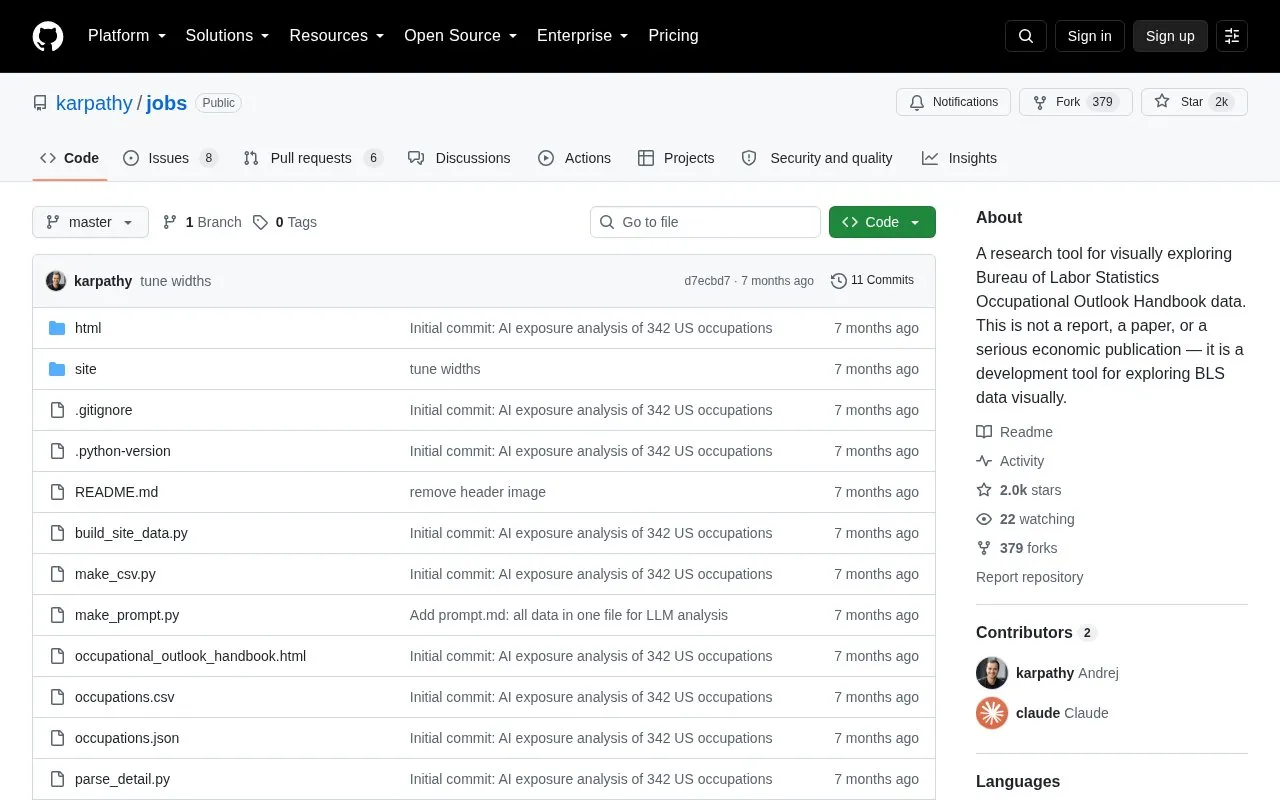
About Jobs
Jobs is a GitHub repository containing an interactive treemap for exploring Bureau of Labor Statistics (BLS) Occupational Outlook Handbook data. It covers 342 US occupations. Each rectangle's area is proportional to total employment, and the color shows a selected metric: BLS projected growth outlook, median pay, education requirements, or Digital AI Exposure. A live demo is available at karpathy.ai/jobs.
The repository includes scrapers, parsers, and a pipeline for writing custom LLM prompts that score and color occupations by other criteria. The Digital AI Exposure layer comes from rough LLM estimates (Gemini Flash via OpenRouter) that rate each occupation from 0 to 10. The author states that these scores do not predict that a job will disappear, and that the project is a development tool rather than a report, paper, or economic publication.
Key features
- Treemap where rectangle area reflects total employment and color shows the selected metric.
- Color layers for BLS growth outlook, median pay, education, and AI exposure.
- Covers 342 occupations with pay, education, job count, and growth projections.
- Per-occupation AI exposure scores from 0 to 10, each with a written rationale.
- Pipeline for writing custom LLM prompts to score and recolor occupations by any criteria.
- Single prompt file bundling all data for pasting into an LLM (about 45K tokens).
Best for: Researchers and developers who want to explore BLS occupational data visually or test their own LLM-based scoring criteria.
Good for
- Brings BLS pay, education, and projection data for 342 occupations into one visual view.
- Users can write their own prompts to recolor occupations by other criteria.
- States its limits clearly, including that it is not a report or serious economic publication.
Watch out for
- AI exposure scores are rough LLM estimates, not rigorous predictions.
- The scores do not account for demand elasticity, latent demand, regulatory barriers, or social preferences for human workers.
- The scraper must run in non-headless mode because BLS blocks bots.
Jobs at a glance
- Website
- github.com/karpathy/jobs
- Category
- Business & Careers › Job Boards & Careers
- Type
- Open-source project
- Pricing
- Not confirmed. Check the site
- Open source
- Not stated
- Language
- English
- Last checked
- Oct 6, 2026 · Online when checked
- Listed
- Oct 5, 2026
Jobs alternatives
Tools and sites you could use instead, ranked by how closely they match.

Search statistics, consumer surveys and industry studies across more than 60,000 topics, drawing on sources from many countries.

This Codeberg repository contains the official source project for KYCnot.me.

CyberSeek provides interactive tools and data to support cybersecurity career exploration and address workforce needs.
Popular in Job Boards & Careers
Well-known listings from the same topic.
AWS re/Startaws.amazon.com/training/restartData.gov Resourcesresources.data.govLevels.fyilevels.fyiNarrow AIgetnarrow.aiHimalayashimalayas.appRX Resumerxresu.me


Jobs FAQ
Does the AI exposure score predict that a job will disappear?
No. The project states that the score does not predict job loss. It estimates how much current AI, which is primarily digital, will reshape each occupation. The author notes that many high-exposure jobs will be reshaped rather than replaced.
How are the AI exposure scores generated?
They are rough estimates from an LLM (Gemini Flash via OpenRouter). The scoring script sends each occupation's description and a rubric to the model, which returns a score from 0 to 10 with a rationale.
Can I use the project to score occupations by a different criterion?
Yes. You can write your own prompt and re-run the pipeline to color the treemap by other criteria, such as offshoring risk or climate impact. The scoring logic is in score.py.
Is something wrong or out of date?
Tell us and an editor will check it.
Own this website?
Claim this listing
Claim the listing and suggest updates yourself. An editor checks every claim first.