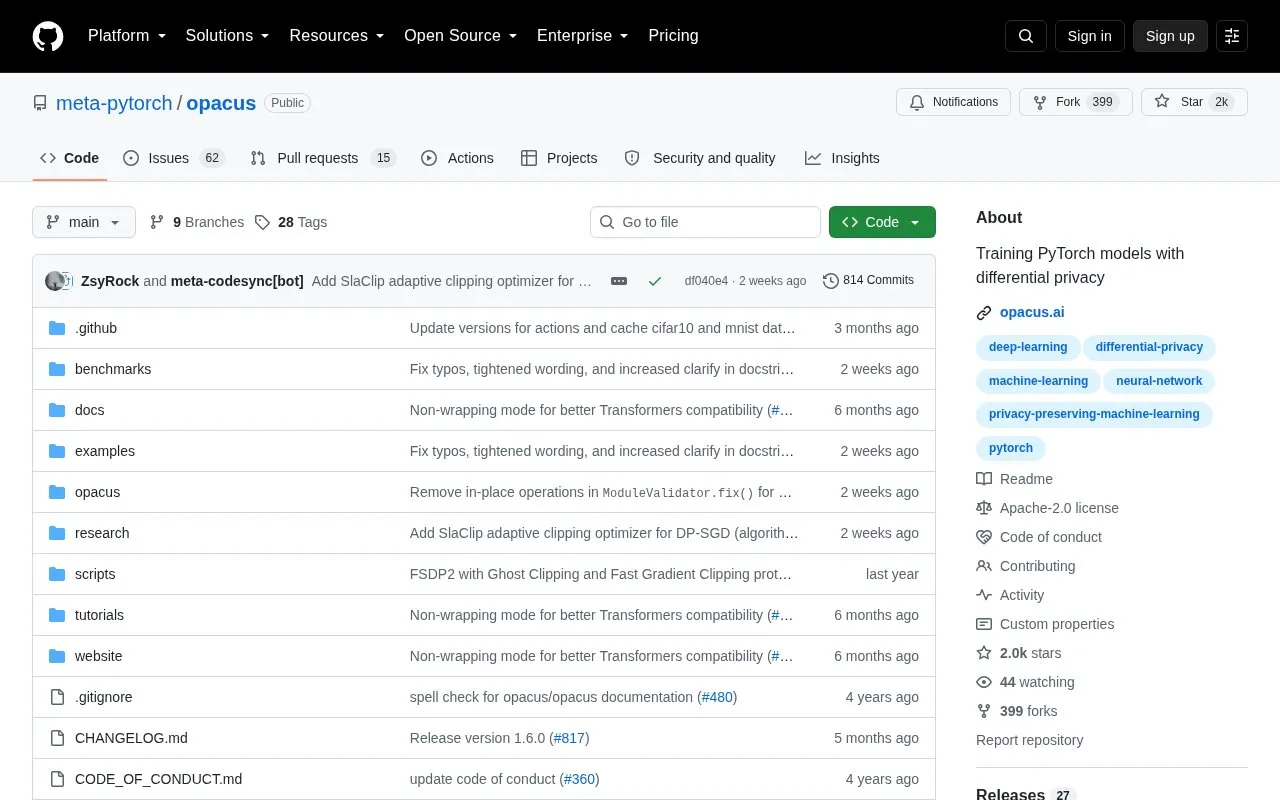
Opacus is an open-source library for training PyTorch models with differential privacy. Users create a PrivacyEngine and pass their model, optimizer, and data loader to its make_private() method with settings such as noise multiplier and maximum gradient norm.
It includes tracking of the privacy budget expended during training, support for Fast Gradient Clipping and Ghost Clipping, and examples and tutorials covering MNIST, BERT text classification, image classification, and LSTM name classification.
Key features
Train PyTorch models with differential privacy via PrivacyEngine
Convert model, optimizer, and data loader using make_private()
Track privacy budget expended during training
Support Fast Gradient Clipping and Ghost Clipping
Compatible with LoRA and peft library for DP-SGD training
Include examples for MNIST, BERT, image classifier, and LSTM
Best for: ML practitioners and differential privacy researchers who train PyTorch models with differential privacy.
Good for
Requires passing model, optimizer, and data loader to make_private()
Allows tracking of privacy budget expended during training
Provides examples and IPython-based tutorials for common model types
Watch out for
Installing directly from source may include quirks and occasional bugs