

The Classical Language Toolkit is a Python library for natural language processing of pre modern languages.
Open source
24 alternativesOpenSanctions provides an open database and code for working with international sanctions data, politically exposed persons, and related entities.
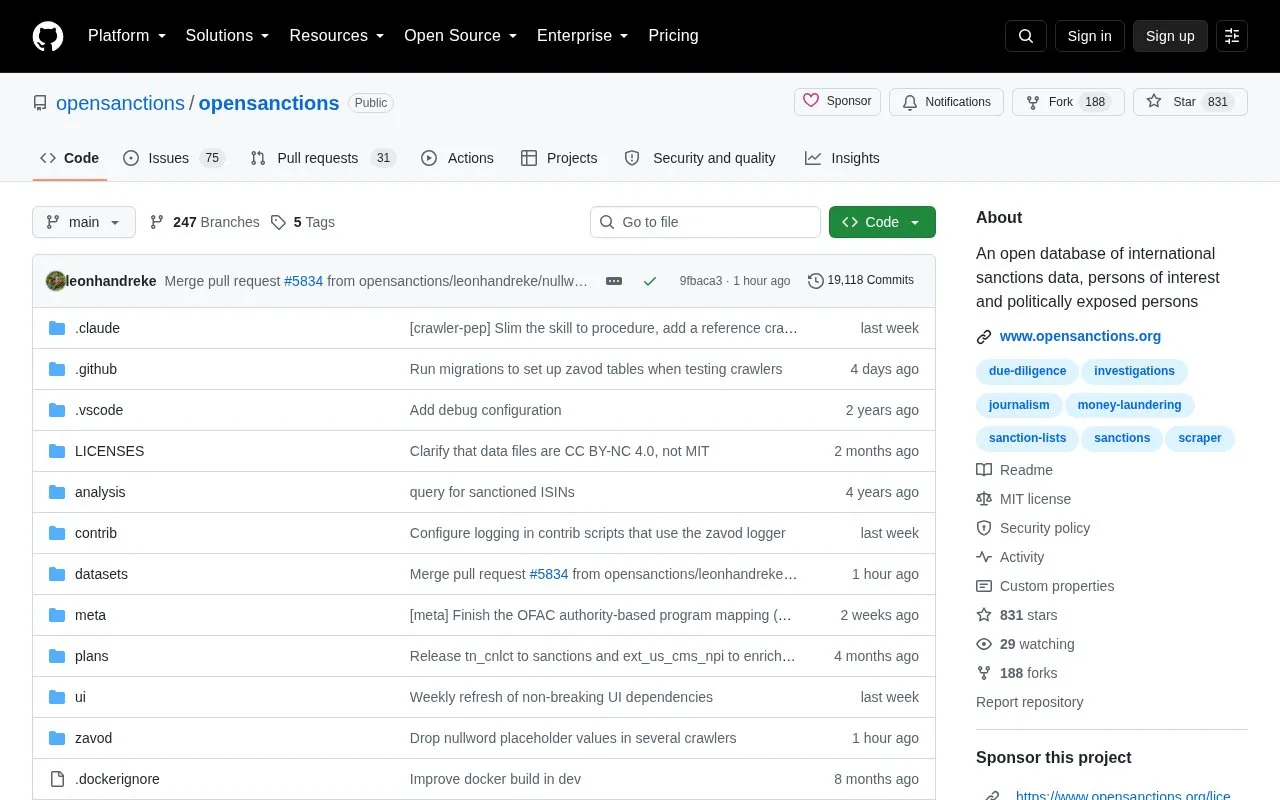
OpenSanctions is a GitHub repository for an open database of international sanctions data, politically exposed persons and related entities. Its codebase parses raw source data, cleans and standardises the resulting structures, deduplicates records to maintain data integrity, and exports data into a range of output formats, with CSV among the simplified formats offered. Crawlers are built on the Follow the Money JSON data model, and extracted data can be sent for human review through a bundled review UI.
The project is run most easily with Docker, while a local Python virtual environment is used for development. It is linked to companion repositories: nomenklatura, which stores data statements with lineage and integrates entity data with external databases such as OpenCorporates, and yente, an API for entity matching and searching. The code is MIT licensed, but data files produced by OpenSanctions are licensed CC BY-NC 4.0 and some files under datasets/ are unmodified third-party material the project cannot license, so commercial use is handled separately through its licensing page.
Tools and sites you could use instead, ranked by how closely they match.
The Classical Language Toolkit is a Python library for natural language processing of pre modern languages.
This project collects September 11 attack recordings and synchronizes them in a media player to present events in sequence.
A topic-organized repository curates public datasets for discovery and use.
Incarceration in Real Numbers visualizes incarceration data, with each icon representing an incarcerated person.
Well-known listings from the same topic.
Tell us and an editor will check it.
Claim the listing and suggest updates yourself. An editor checks every claim first.


