

Quivr provides retrieval augmented generation for integrating generative AI into apps, with support for multiple models and vector stores.
quivr
Quivr provides retrieval augmented generation for apps and supports multiple large language models and vector stores.
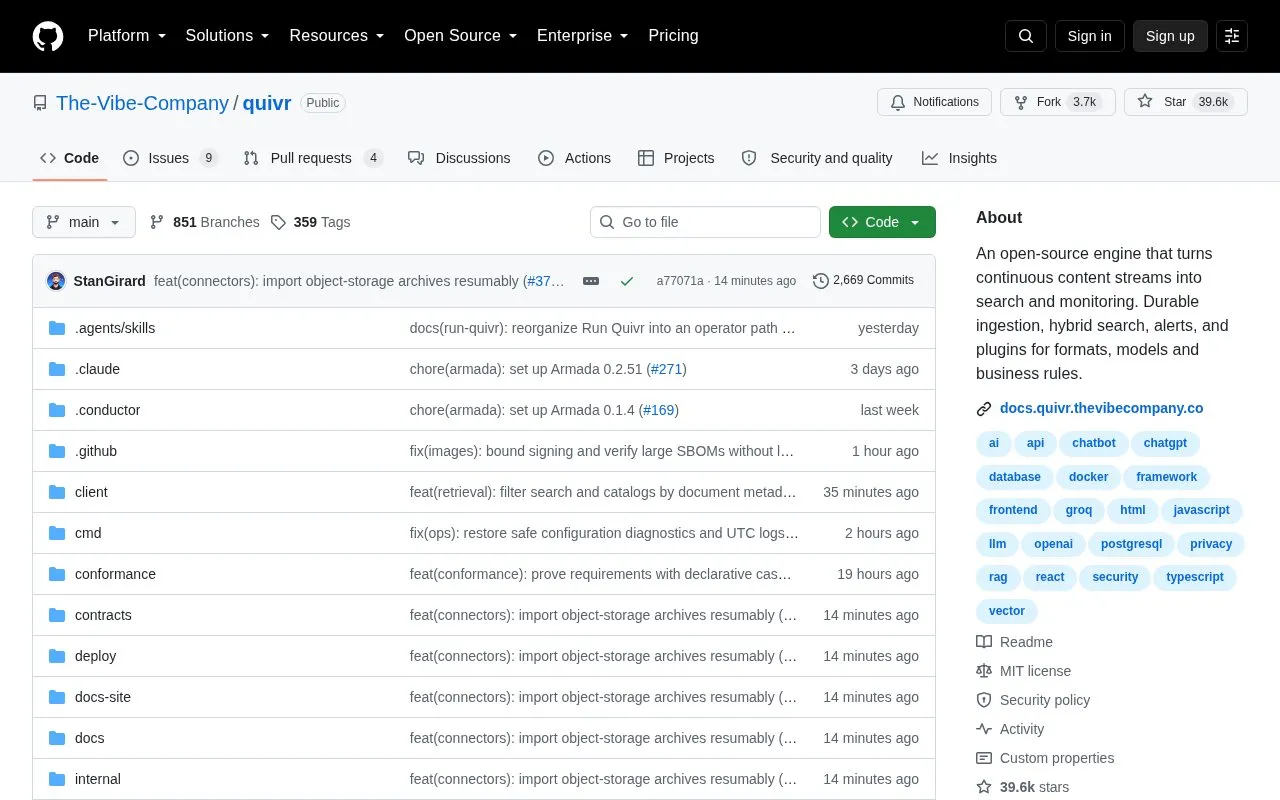
About quivr
Quivr V2 is described as an open-source engine that turns continuous content streams into search and monitoring. It ingests content durably, makes text lexically searchable within seconds of segmentation, enriches it in the background, and supports following a topic over time. Formats, AI models and business rules are kept out of the core as plugin capabilities, alongside connectors, normalizers, enrichers, retrievers and delivery channels.
The architecture is a Go modular monolith: a single quivr binary provides api, worker and migrate commands, with PostgreSQL 17 holding the catalog and receipts, S3-compatible storage for canonical bytes and artifacts, Temporal for durable orchestration, Weaviate for lexical and vector search, and local TEI serving pinned multilingual-e5-small embeddings. Local runtime uses Docker Compose and an OpenAPI 3.1 HTTP contract. Quivr V2 is at an evaluation stage: the API is v0 and may change without notice, and the project states it should not be run in production yet.
Key features
- Durable ingestion: writes acknowledged only once committed, so outages delay rather than lose content
- Idempotent writes; corrections create new immutable Versions instead of overwriting history
- Hybrid lexical and vector search, keeping keyword results while vectors are rebuilt
- Plugin capabilities for connectors, normalizers, enrichers, retrievers and delivery channels
- Search index is a rebuildable projection from PostgreSQL and S3-compatible storage
- Change delivery by polling or SSE, with an OpenAPI 3.1 HTTP contract (v0)
Best for: Developers and teams evaluating a self-hosted, plugin-extensible engine for search and monitoring over continuous content streams.
Good for
- Writes are acknowledged only after commit, and replayed writes return the same result by idempotency key
- Indexes can be rebuilt from canonical PostgreSQL and S3-compatible storage artifacts
- Search hits are rehydrated from canonical storage and re-authorized; a dependency outage returns an error rather than an empty success
Watch out for
- Evaluation stage: the API is v0, may change without notice, and the project advises against running it in production
- Local setup requires Go 1.27.2, Docker Compose v2, Python 3 with venv, Node.js 22+ and jq, with an initial download of pinned images and the E5 model (about 1 GB)
- Development setup is limited to Linux x86_64, or macOS on Apple Silicon for make dev
quivr at a glance
- Website
- github.com/StanGirard/quivr
- Category
- AI & Machine Learning › AI Agents & Automation
- Type
- Open-source project
- Pricing
- Not confirmed. Check the site
- Open source
- Not stated
- Language
- English
- Last checked
- Oct 6, 2026 · Online when checked
- Listed
- Oct 5, 2026
quivr alternatives
Tools and sites you could use instead, ranked by how closely they match.

EvoAgentX describes its project as an ecosystem of AI agents that can evolve over time.

Mem0 provides persistent memory infrastructure for AI agents and applications.
Open source
24 alternatives
The LangChain repository describes an agent engineering platform for building agent based software.
Open source
24 alternatives
An LLM-powered repository agent designed to assist developers and teams in generating documentation and understanding repositories quickly.
Open source
24 alternatives
Upsonic provides a Python framework for creating autonomous AI agents.
Open source
24 alternativesPopular in AI Agents & Automation
Well-known listings from the same topic.
Simsim.aiMaya AI.smartmaya.aiMakeformsmakeforms.ioAgent Skillsagentskills.ioGenFuse AIgenfuseai.comBeambeam.ai


quivr FAQ
Is Quivr V2 ready for production use?
No. It is at evaluation stage, the API is v0 and may change without notice, and the project says not to run it in production yet.
What is needed to run it locally?
Go 1.27.2, Docker with Compose v2, Python 3 with venv, Node.js 22+ and jq, on Linux x86_64 or macOS on Apple Silicon for make dev. The first run downloads pinned images and the E5 model, roughly 1 GB.
Can text be searched before embeddings are generated?
Yes. Text is lexically searchable as soon as it is segmented, and embeddings and other enrichments arrive afterwards without blocking that search.
Is something wrong or out of date?
Tell us and an editor will check it.
Own this website?
Claim this listing
Claim the listing and suggest updates yourself. An editor checks every claim first.