

Feature Engine provides Python tools for feature engineering and selection that are compatible with scikit-learn.
Open source
24 alternativesA tool to help you configure, organize, log and reproduce experiments.
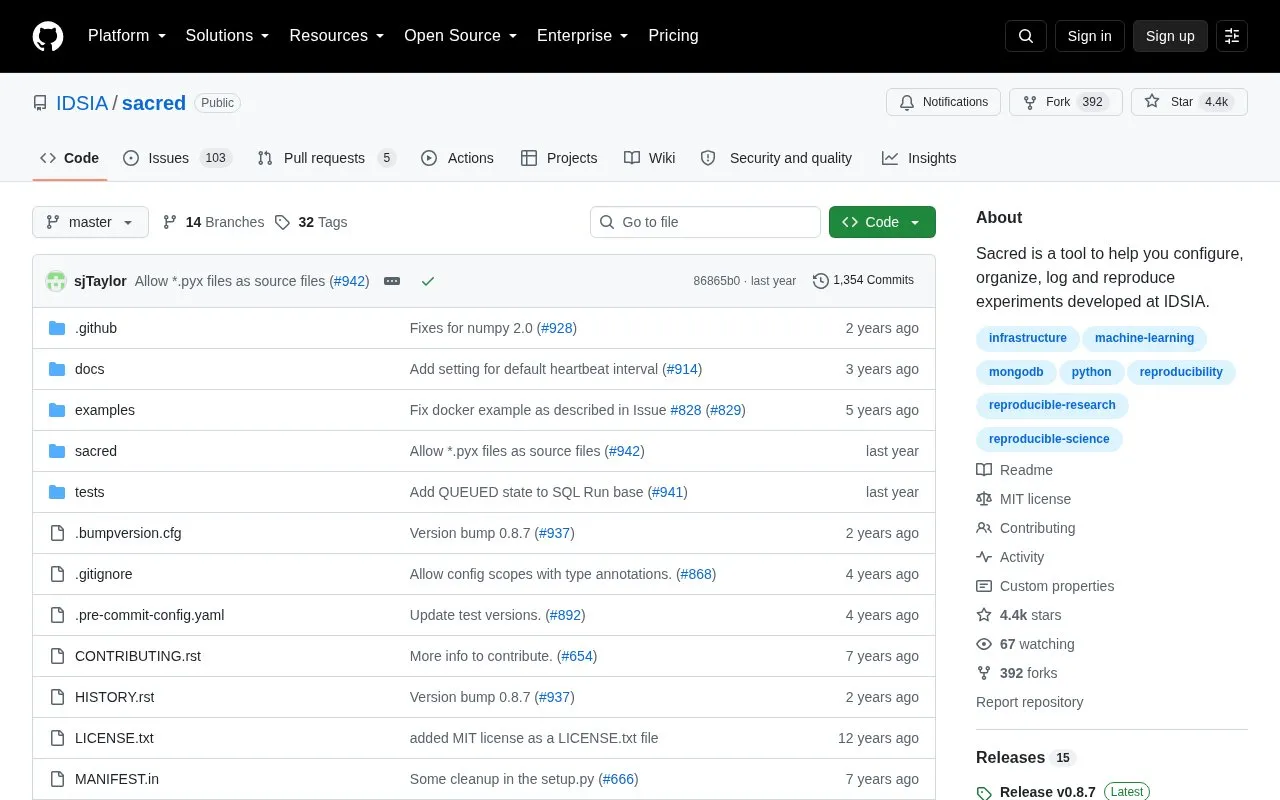
Sacred is a Python tool to configure, organize, log and reproduce experiments. It tracks experiment parameters, runs experiments with different settings, saves configurations for individual runs, and supports reproduction of results.
It uses config scopes to define parameters, injects parameters into functions by name, provides a command-line interface to change parameters and run variants, and uses observers to log dependencies, machine information and results to MongoDB. It also uses automatic seeding to control randomness. It installs via pip, with numpy and pymongo as optional dependencies.
Tools and sites you could use instead, ranked by how closely they match.
Feature Engine provides Python tools for feature engineering and selection that are compatible with scikit-learn.
NALP covers Natural Adversarial Language Processing through a dedicated library.
neuropredict evaluates predictive performance using neuroimaging features.
nilearn provides Python tools for machine learning and neuroimaging analysis.
pytorch tabular provides a unified framework for deep learning models on tabular data.
AutoViz automatically creates visualizations for datasets of different sizes from a single line of code.
Well-known listings from the same topic.
Tell us and an editor will check it.
Claim the listing and suggest updates yourself. An editor checks every claim first.


