
The ROSAT Mission
The ROSAT mission page describes the German-US-UK X-ray observatory and its imaging telescopes operating in X-ray and extreme ultraviolet ranges.
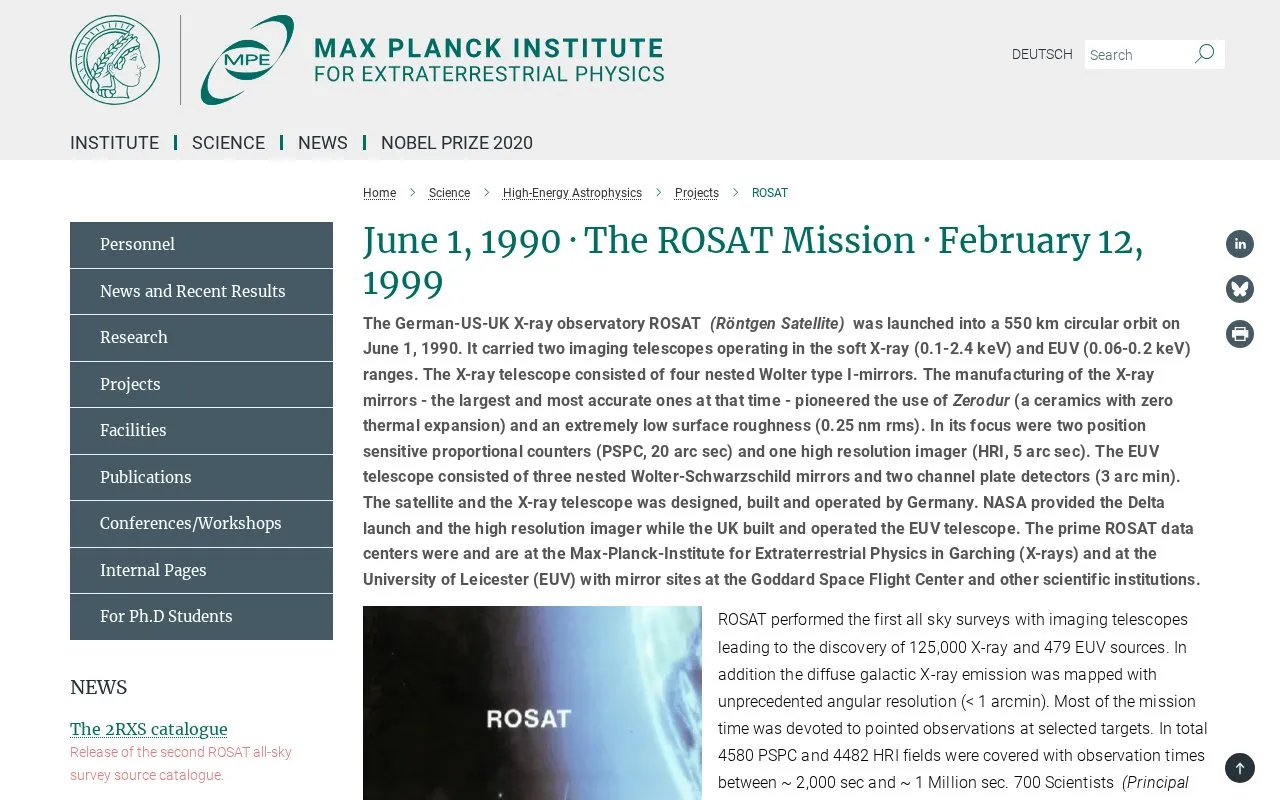
About The ROSAT Mission
The ROSAT mission page documents the German-US-UK Röntgen Satellite X-ray observatory, launched on June 1, 1990 into a 550 km circular orbit. It carried two imaging telescopes for soft X-ray (0.1-2.4 keV) and EUV (0.06-0.2 keV) observations.
ROSAT performed the first all-sky surveys with imaging telescopes, identifying 125,000 X-ray and 479 EUV sources, and also carried out pointed observations covering 4,580 PSPC and 4,482 HRI fields. The mission was switched off in February 1999 after 8.5 years; all ROSAT data are calibrated and available through an online archive.
Key features
- Two imaging telescopes for soft X-ray and EUV observations
- Soft X-ray range: 0.1-2.4 keV
- EUV range: 0.06-0.2 keV
- All-sky surveys found 125,000 X-ray and 479 EUV sources
- Pointed observations covered 4,580 PSPC and 4,482 HRI fields
- Calibrated data available via an online archive
- All ROSAT data are calibrated and available via an on-line archive.
- Covers all-sky surveys, pointed observations, and source counts.
- Provides mission, instrument, and data center details.
- Mission ended in February 1999; no ongoing observations are described.
- Publication count is dated August 2001, so it is not current.
The ROSAT Mission at a glance
- Website
- mpe.mpg.de/ROSAT
- Category
- Research & Data › Geographic & Mapping Data
- Type
- Website
- Pricing
- Not confirmed. Check the site
- Platforms
- Web
- Open source
- Not stated
- Language
- English
- Last checked
- Oct 6, 2026 · Online when checked
- Listed
- Oct 5, 2026
Popular in Geographic & Mapping Data
Well-known listings from the same topic.



The ROSAT Mission FAQ
When was ROSAT launched and when did it stop operating?
What were ROSAT's main instruments?
Are ROSAT data available for use?
Tell us and an editor will check it.
Claim the listing and suggest updates yourself. An editor checks every claim first.