

torchaudio
torchaudio provides data manipulation and transformation tools for audio signal processing with PyTorch.
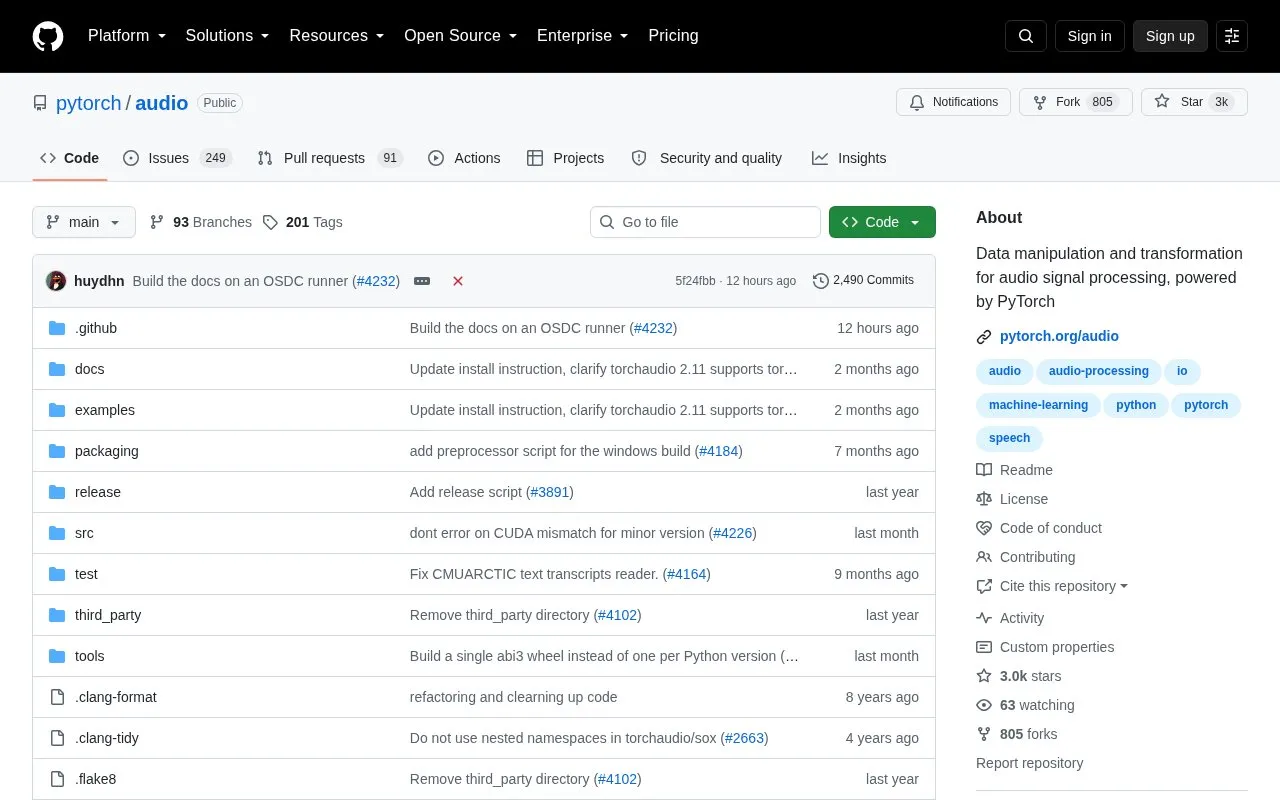
About torchaudio
torchaudio is an open-source Python library that applies PyTorch to audio and speech data. It provides dataloaders for common audio datasets, audio and speech processing functions such as forced_align, and common transforms including Spectrogram, AmplitudeToDB, MelScale, MelSpectrogram, MFCC, MuLawEncoding, MuLawDecoding and Resample. It also offers compliance interfaces for running PyTorch code that aligns with other libraries, such as Kaldi spectrogram, fbank and mfcc outputs.
Because all computations run through PyTorch operations, the library supports GPU acceleration and trainable features through the autograd system, and follows PyTorch conventions for tensor and dimension names. The project states that it is primarily a machine learning library rather than a general signal processing library, and that it has moved into a maintenance phase: user-facing features deprecated from TorchAudio 2.8 were removed in 2.9. It is a utility library that downloads and prepares public datasets but does not host or distribute them, and does not vouch for their quality or fairness.
Key features
- Dataloaders for common audio datasets
- Transforms: Spectrogram, MelScale, MelSpectrogram, MFCC, Resample, MuLaw encoding
- Speech processing functions including forced_align
- All computations run as PyTorch operations, enabling GPU acceleration
- Trainable features through the PyTorch autograd system
- Kaldi compatibility interfaces for spectrogram, fbank and mfcc
Best for: Machine learning developers and researchers building audio or speech models within the PyTorch ecosystem.
Good for
- Open-source and follows PyTorch conventions for tensor and dimension names
- TorchAudio 2.11 works with torch 2.11 and future torch releases without pinning torch to a specific version
- Supports GPU acceleration and trainable features via PyTorch operations and autograd
Watch out for
- The project has transitioned into a maintenance phase, and features deprecated from 2.8 were removed in 2.9
- Primarily a machine learning library, not a general signal processing library
- Does not host or distribute the datasets it downloads and prepares, and does not vouch for their quality or fairness
torchaudio at a glance
- Website
- github.com/pytorch/audio
- Category
- Development › Developer Tools
- Type
- Open-source project
- Pricing
- Not confirmed. Check the site
- Open source
- Yes · Source code
- Language
- English
- Last checked
- Oct 6, 2026 · Online when checked
- Listed
- Oct 5, 2026
Guides for Developer Tools


torchaudio alternatives
Tools and sites you could use instead, ranked by how closely they match.

Python developers can use Zipline’s event-driven library to backtest algorithmic trading strategies.
Open source
24 alternatives
Automatic machine learning, hyperparameter tuning, and pipeline abstractions are provided by the Neuraxle software library.
Open source
24 alternatives
Mars provides tensor-based tools for large-scale computation with NumPy, Pandas, and scikit-learn.
Open source
24 alternatives
jSciPy provides Java scientific computing tools for signal processing, FFT, filtering, power spectral density, and DCT.
Open source
24 alternatives
spaCy provides Python natural language processing tools for entity recognition, tagging, parsing, and word vectors.
Free
24 alternatives
Netron displays neural network, deep learning, and machine learning models across formats such as ONNX, TensorFlow, and PyTorch.
Open source
24 alternativesPopular in Developer Tools
Well-known listings from the same topic.
AppDevToolsappdevtools.comCommand Not Foundcommand-not-found.comTestFlighttestflight.apple.com/join/A8GwCnq8Sourcegraphabout.sourcegraph.comProject Wallaceprojectwallace.comCarbon Calculatorwebsitecarbon.com


torchaudio FAQ
Which version of PyTorch does torchaudio require?
TorchAudio 2.11 requires torch 2.11 or newer, including all future releases. Installing TorchAudio does not pin torch to a specific version.
Is torchaudio a general signal processing library?
No. The project describes itself as primarily a machine learning library focused on processing audio data for ML, applying PyTorch to the audio domain.
Does torchaudio provide or host the audio datasets it loads?
No. It is a utility library that downloads and prepares public datasets; it does not host or distribute them and does not vouch for their quality or fairness.
Is something wrong or out of date?
Tell us and an editor will check it.
Own this website?
Claim this listing
Claim the listing and suggest updates yourself. An editor checks every claim first.