

Jupyter Notebook
Jupyter Notebook combines live code, equations, explanatory text, visualizations, and interactive computing in a web platform.
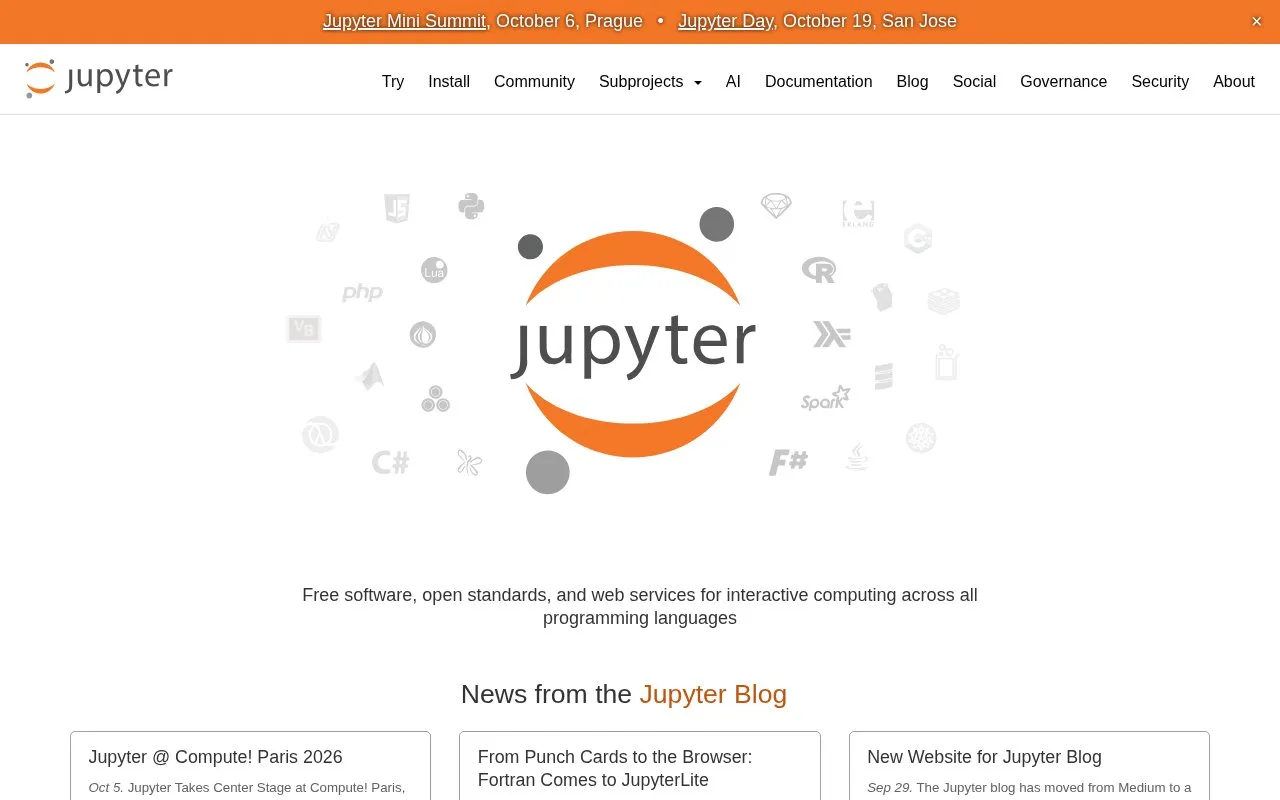
About Jupyter Notebook
Jupyter Notebook is a web-based interactive computing platform from Project Jupyter, designed to combine live executable code, mathematical equations, explanatory narrative text, data visualizations, and other rich media in a single shareable document. It operates on open standards for interactive computing, with notebook files stored as JSON documents that record full user session data including code, output, and narrative content.
The platform supports more than 40 programming languages, including Python, R, Julia, and Scala, and integrates with popular big data and machine learning tools such as Apache Spark, pandas, scikit-learn, and TensorFlow. Notebooks can be shared easily via email, Dropbox, GitHub, or the Jupyter Notebook Viewer, and can be transformed into standalone interactive web applications using the Voilà tool. For organizational use, JupyterHub offers a multi-user deployment option with centralized infrastructure, pluggable authentication, and support for Docker and Kubernetes scaling.
It is widely used by data scientists, researchers, students, and teams working in fields such as data science, scientific computing, machine learning, and computational journalism.
Key features
- Combines live code, equations, text, visualizations, and interactive output in web documents.
- Supports over 40 programming languages including Python, R, Julia, and Scala.
- Share notebooks via email, Dropbox, GitHub, or Jupyter Notebook Viewer.
- Integrates with big data tools like Apache Spark, pandas, and TensorFlow.
- Offers JupyterHub for multi-user organizational deployments with centralized infrastructure.
- Transforms notebooks into standalone shareable web apps via Voilà.
Best for: It is best suited for data scientists, researchers, students, and teams working in data science, machine learning, scientific computing, and computational journalism.
Good for
- Open JSON-based notebook format that records full user session data.
- Modular, extensible JupyterLab interface supporting custom workflow arrangements.
- Integrates with a wide range of popular big data and machine learning tools.
- Supports both individual use and scalable multi-user organizational deployments.
Watch out for
- The platform is not listed as open source.
Jupyter Notebook at a glance
- Website
- jupyter.org
- Category
- Development › Developer Tools
- Type
- Website
- Pricing
- Not confirmed. Check the site
- Platforms
- Web
- Open source
- Not stated
- Language
- English
- Last checked
- Oct 5, 2026 · Online when checked
- Listed
- Oct 5, 2026
Guides for Developer Tools


Jupyter Notebook alternatives
Tools and sites you could use instead, ranked by how closely they match.
Jupyter Widgets provides interactive Python objects for notebook interfaces, including controls such as sliders and text boxes.

spaCy provides Python natural language processing tools for entity recognition, tagging, parsing, and word vectors.
Free
24 alternatives
Vaex provides out-of-core DataFrames for Python to explore and visualize large tabular datasets, with support for machine learning workflows.

MITIE provides a library and tools for extracting information from text.

Browse a gallery of interesting Jupyter notebooks on this project wiki, with examples from notebook users.
Open source
24 alternatives
Python developers can use Zipline’s event-driven library to backtest algorithmic trading strategies.
Open source
24 alternativesPopular in Developer Tools
Well-known listings from the same topic.
AppDevToolsappdevtools.comCommand Not Foundcommand-not-found.comTestFlighttestflight.apple.com/join/A8GwCnq8Sourcegraphabout.sourcegraph.comProject Wallaceprojectwallace.comCarbon Calculatorwebsitecarbon.com


Jupyter Notebook FAQ
What is Jupyter Notebook used for?
It is a web-based interactive computing platform used for data science, scientific computing, machine learning, and computational journalism, letting users combine live code, text, equations, and visualizations in a single document.
What programming languages does Jupyter Notebook support?
It supports over 40 programming languages, including Python, R, Julia, and Scala.
Can I share my Jupyter Notebook with others?
Yes, notebooks can be shared via email, Dropbox, GitHub, or the Jupyter Notebook Viewer.
What is JupyterHub?
JupyterHub is a multi-user version of the notebook designed for companies, classrooms, and research labs, with centralized deployment and pluggable authentication.
Is something wrong or out of date?
Tell us and an editor will check it.
Own this website?
Claim this listing
Claim the listing and suggest updates yourself. An editor checks every claim first.