

FastDatasets helps create training datasets for large language models.
Open source
24 alternativesAutomatic "Differentiation" via Text, using large language models to backpropagate textual gradients.
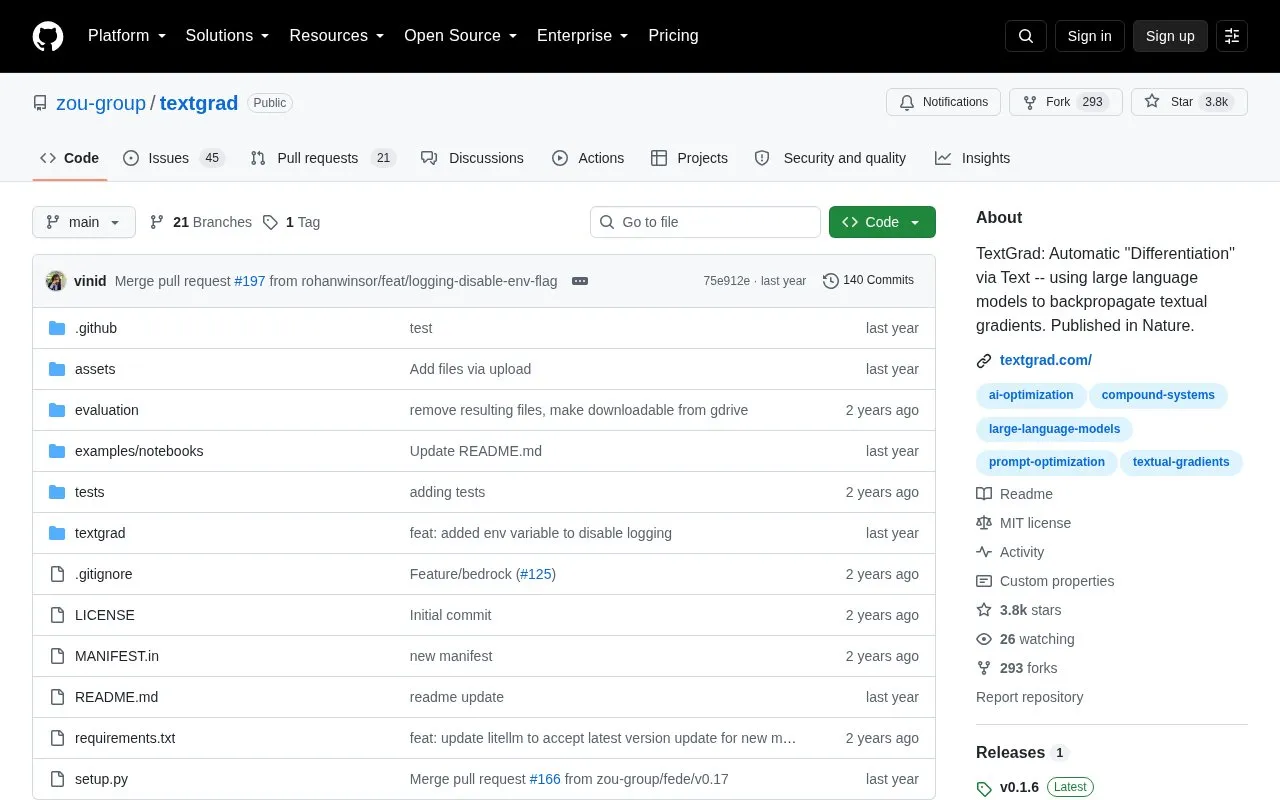
TextGrad is an open-source Python framework for automatic differentiation via text. It uses large language models to provide textual feedback, which the framework backpropagates to optimize variables such as an LLM's answer to a question. The project's README states that it was published in Nature on 19 March 2025. Its API is modeled on PyTorch: users define a loss function in natural language, then optimize variables with a textual gradient descent optimizer (TGD).
The repository includes example Jupyter notebooks in its examples folder. A newer engine built on LiteLLM allows use of any model that LiteLLM supports, and the README names Bedrock, Together, and Gemini as examples. It also offers an option to enable or disable caching in these engines. The README describes this LiteLLM engine as experimental, and states that the older engines are planned for deprecation.
Tools and sites you could use instead, ranked by how closely they match.
FastDatasets helps create training datasets for large language models.
LLMeBench provides a flexible framework for benchmarking large language models.
An open-source visual programming environment for battle-testing prompts to LLMs.
The Hugging Face Open LLM Leaderboard compares language models across evaluation tests including IFEval, MATH, and MMLU-Pro.
SpeechMap.AI compares language models’ refusal rates on controversial speech topics.
This NBER paper studies language models as both researchers and subjects in automated social science.
Well-known listings from the same topic.
Tell us and an editor will check it.
Claim the listing and suggest updates yourself. An editor checks every claim first.


