

Zama Protocol enables confidential assets to be issued, traded, and managed on public blockchains with verifiability and programmable compliance.
CCIP
Chainlink CCIP connects public and private blockchains to move data and digital assets with compliance and security controls.
About CCIP
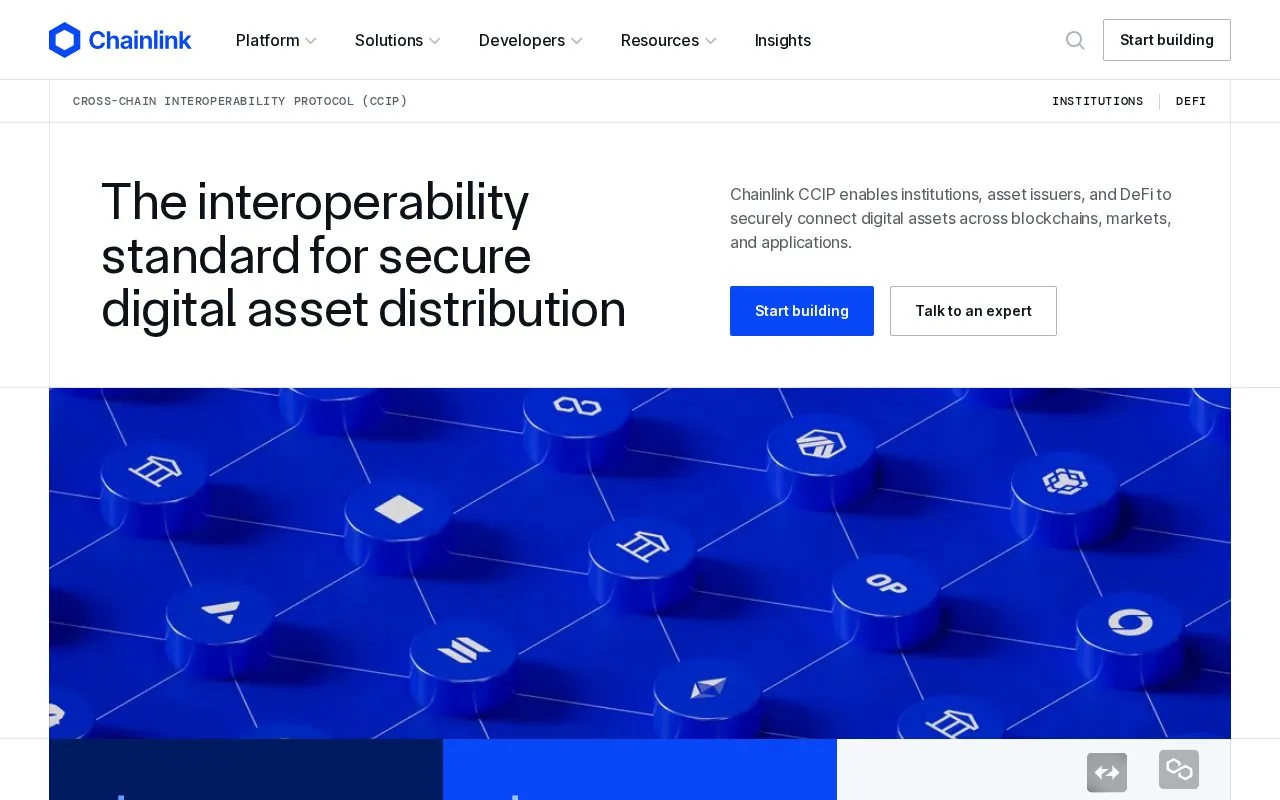
CCIP is a cross-chain interoperability protocol from Chainlink. It is designed to connect public and private blockchains so that data and digital assets can move between them. The homepage positions it mainly for institutions such as asset managers, custodians, banks, and DeFi asset issuers that need to distribute tokenized assets across several networks through one integration.
The homepage describes optional independent verification through Cross-Chain Verifiers (CCVs), which can be operated by the user's organization or by trusted third parties. It also describes the Automated Compliance Engine (ACE), which can enforce issuer-defined policies such as KYC, AML, sanctions screening, and transaction limits. Settlement timing can be set to full finality for high-value transfers or to shorter confirmation thresholds for eligible transfers. The homepage does not state pricing, and the excerpt provided does not describe geographic or usage limits.
Key features
- Connects public and private blockchains to move data and digital assets
- Optional independent verification through Cross-Chain Verifiers operated by the user or trusted third parties
- Full finality or shorter confirmation thresholds for eligible transfers
- Automated Compliance Engine enforcing KYC, AML, sanctions screening, and transaction limits
- Single integration for distributing tokenized assets across multiple blockchains
- Links blockchain workflows with existing custody, payment, and settlement systems
Best for: Institutions such as asset managers, custodians, banks, and DeFi asset issuers that need to move or distribute tokenized assets across multiple blockchains under defined compliance policies.
Good for
- Secure-by-default infrastructure is described as the base layer, with added verification as an option
- Compliance policies are defined by the issuer and applied to cross-chain transactions
- Supports connections to both public and private blockchains
Watch out for
- Shorter confirmation thresholds apply only to eligible transfers
- Independent verification through CCVs is an added option rather than a default
- The homepage excerpt does not state pricing
CCIP at a glance
- Website
- chain.link/cross-chain
- Category
- Crypto & Blockchain › DeFi Protocols
- Type
- Website
- Pricing
- Not confirmed. Check the site
- Platforms
- Web
- Open source
- Not stated
- Language
- English
- Last checked
- Oct 6, 2026 · Online when checked
- Listed
- Oct 5, 2026
CCIP alternatives
Tools and sites you could use instead, ranked by how closely they match.

Brickken provides institutions with tokenization infrastructure to issue, manage, and distribute digital assets with onboarding and compliance controls.

KAIO provides an appchain protocol for moving tokenized real-world assets and connecting institutional funds with DeFi liquidity.
Pareto provides on-chain fixed-income infrastructure for programmable institutional credit and real-time risk information.

Noon presents a stablecoin with yield and security features described on its page.
tzBTC publishes custody addresses and circulation data so users can review the Bitcoin backing its token supply.
Popular in DeFi Protocols
Well-known listings from the same topic.
Aave V3aave.com3F3f.xyz3Jane Lending3jane.xyzApostroapostro.xyzAvalon CeDeFiavalonfinance.xyzMetalX Lendinglending.metalx.com


CCIP FAQ
Can an organization enforce its own compliance rules on cross-chain transactions?
The homepage says the Automated Compliance Engine (ACE) can enforce KYC, AML, sanctions screening, transaction limits, and other issuer-defined policies for cross-chain transactions.
Can an organization add its own verification to transfers?
The homepage says users can add independent verification through Cross-Chain Verifiers (CCVs) operated by their organization or by trusted third parties.
Does the homepage state pricing?
No. The homepage excerpt provided does not state pricing, so pricing is listed as unknown.
Is something wrong or out of date?
Tell us and an editor will check it.
Own this website?
Claim this listing
Claim the listing and suggest updates yourself. An editor checks every claim first.