

ElasticSearch
Distributed search and analytics are provided by Elasticsearch, an open-source engine for indexed data.
About ElasticSearch
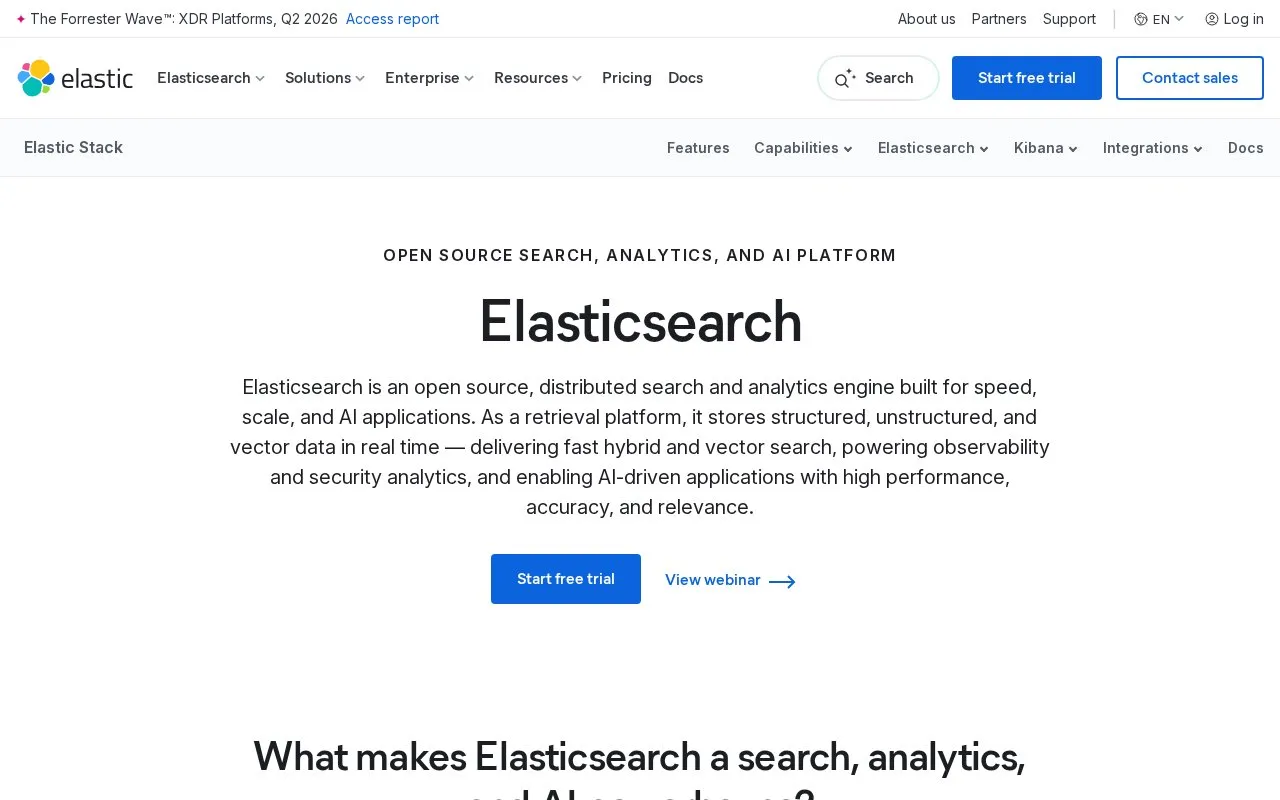
Elasticsearch is a distributed search and analytics engine that stores structured, unstructured, and vector data in real time. It supports full-text, semantic, hybrid, and geospatial search, along with real-time aggregation for observability, security analytics, and AI retrieval use cases.
Data can be ingested through APIs, language clients, connectors, and pipelines. It can run as an on-premises download, as hosted deployments on AWS, Google Cloud, and Azure, or as a managed serverless offering, with cross-cluster search and tiered storage including searchable snapshots on object storage.
Key features
- Store structured, unstructured, and vector data in one index
- Full-text, semantic, and hybrid search with ranking and reranking
- Real-time analytics and aggregation over high-cardinality data
- Geospatial search with distance, polygons, and spatial analytics
- Ingest via APIs, language clients, connectors, and pipelines
- Deploy on-premises, hosted cloud, or serverless with cross-cluster search
Best for: Developers building search, analytics, observability, security, or AI retrieval applications over mixed data types.
Good for
- Handles text, vectors, logs, time-series, and geospatial data in one platform
- Runs on-premises, on major clouds, and as managed serverless
- Offers clients for Java, Python, and Go plus APIs and 350+ integrations
ElasticSearch at a glance
- Category
- Development › APIs & Databases
- Type
- Online tool
- Pricing
- Free trial
- Platforms
- Web
- Open source
- Not stated
- Language
- English
- Good for
- Developers
- Last checked
- Oct 5, 2026 · Online when checked
- Listed
- Oct 5, 2026
Guides for APIs & Databases
ElasticSearch alternatives
Tools and sites you could use instead, ranked by how closely they match.

Distributed vector search is provided by Vald, an engine designed to scale across deployments.
Open source
24 alternatives
Vector similarity search is provided by Qdrant, an open-source search engine written in Rust.

AI search and serving structured data are provided by Vespa, an open-source software platform.
Open source
24 alternatives
Search sites and applications with Meilisearch, an API-based search engine offering hybrid search.

ParadeDB adds full text search, vector retrieval, and aggregations to PostgreSQL.
Open source
24 alternatives
Vector search and storage are the focus of VectorDB, a Python vector database project.
Open source
24 alternativesPopular in APIs & Databases
Well-known listings from the same topic.
API3api3.orgTwiliotwilio.comDB Browsersqlitebrowser.orgPocketBasepocketbase.ioBrunousebruno.comGelgeldata.com


ElasticSearch FAQ
Where can I run Elasticsearch?
On-premises by download, as hosted deployments on AWS, Google Cloud, and Azure, or as Elastic Cloud Serverless.
What types of data can it store?
Structured, unstructured, time-series, logs, events, geospatial, and vector data.
How do applications connect and send data?
Through APIs, clients for languages including Java, Python, and Go, plus connectors and ingest pipelines.
Is something wrong or out of date?
Tell us and an editor will check it.
Own this website?
Claim this listing
Claim the listing and suggest updates yourself. An editor checks every claim first.