The FANTOM web resource describes functional annotations and tools for exploring mammalian noncoding genomes, including long noncoding RNA data.
Dataset
Fly-FISH documents the subcellular expression patterns of Drosophila coding and noncoding RNAs across specified life stages and tissues.
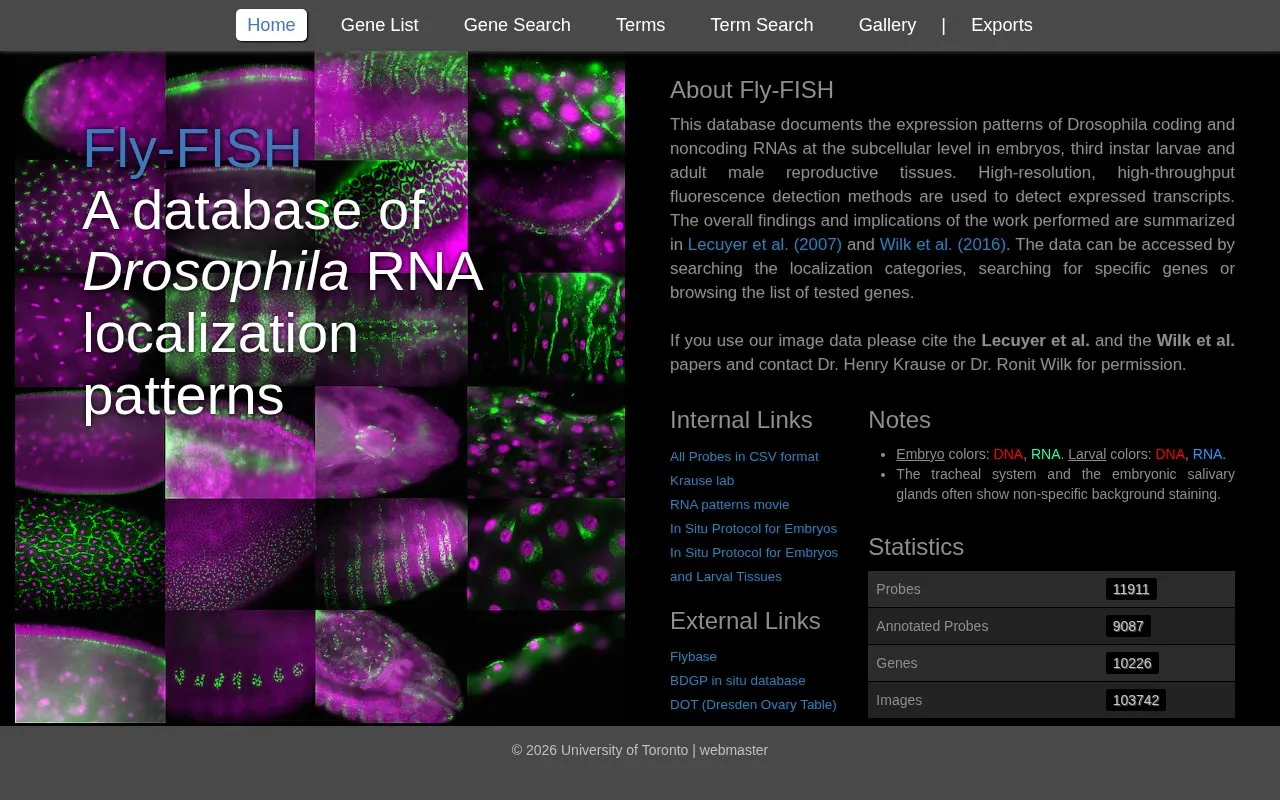
Fly-FISH is a database of subcellular RNA expression patterns for Drosophila coding and noncoding RNAs. The patterns cover embryos, third instar larvae and adult male reproductive tissues. Detection uses high-resolution, high-throughput fluorescence methods. Visitors can search by localization category or by gene, and they can browse the list of tested genes.
Pricing is not clearly stated.
Other listings in Open Data & Datasets with the most in common.
The FANTOM web resource describes functional annotations and tools for exploring mammalian noncoding genomes, including long noncoding RNA data.
The Life Science Database Archive preserves datasets generated by life scientists in Japan for long-term storage and access.
Stemformatics lets users explore and visualize gene expression datasets and samples.
Virtual Fly Brain lets researchers explore Drosophila neuroanatomy, connectivity, gene expression, and imaging data in an interactive atlas.
The Critical Zone Observatories page documents a U.S. National Science Foundation program that was succeeded by the Critical Zone Collaborative Network in 2020.
Carolina is a general corpus of contemporary Brazilian Portuguese with provenance, typology and versioning information. Released versions can be downloaded and accessed through Portulan and HuggingFace. Individual documents have their own licenses, which range from public domain to sharing terms that restrict commercial use.
Well-known listings from the same topic.
Tell us and an editor will check it.
Claim the listing and suggest updates yourself. An editor checks every claim first.


