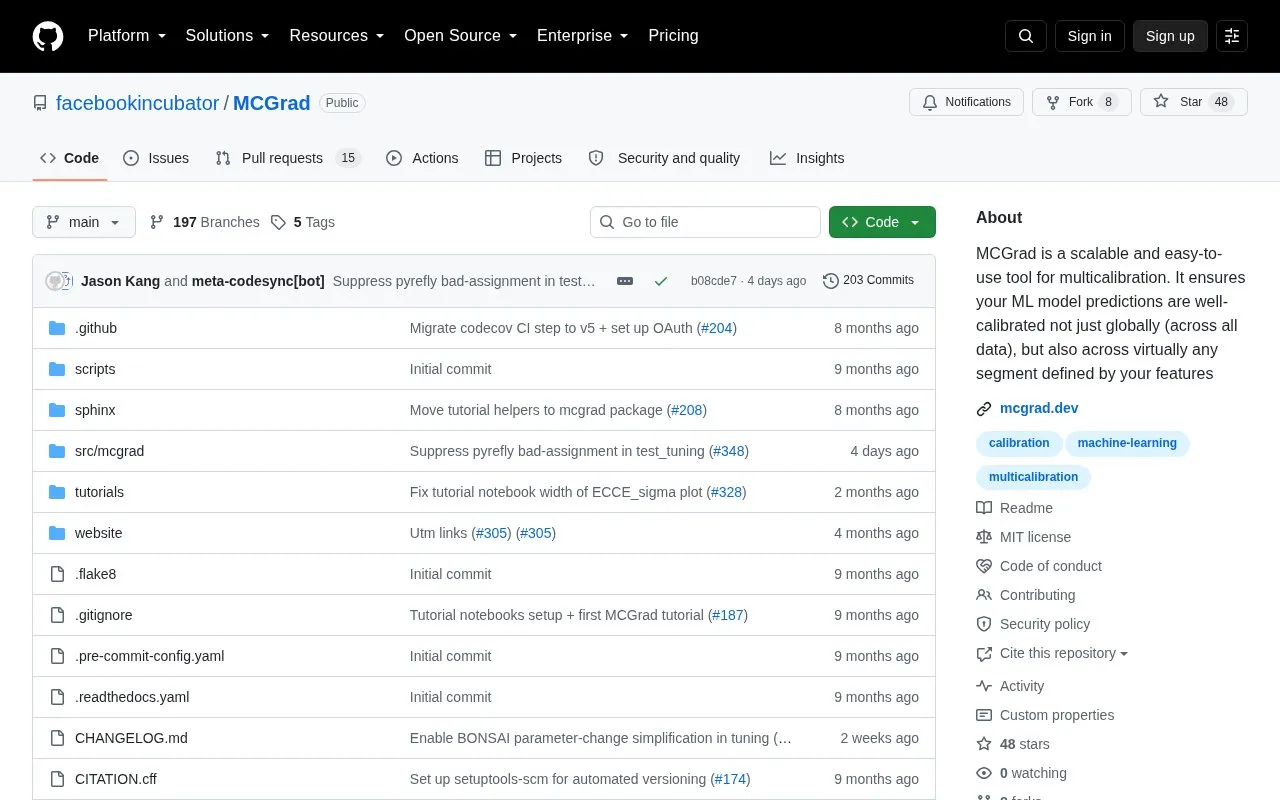
MCGrad is an open-source Python tool for multicalibration of machine learning model predictions. Traditional calibration methods such as Isotonic Regression and Platt Scaling ensure calibration only across all data. MCGrad also aims to calibrate predictions across segments defined by input features, such as country or content type, without requiring the user to specify protected groups manually. Installation requires Python 3.10 or later and can be done with pip or conda. The README states that MCGrad has been deployed at Meta on hundreds of production models, and points to a research paper for detailed experimental results.
Key features
Calibrates predictions across all data and across segments defined by input features
Identifies calibration gaps in segments without manual specification of protected groups
Fit and predict methods that work on pandas DataFrames with named columns
Supports categorical feature columns such as country or content type
Validation-based early stopping for likelihood-improving updates
Interactive notebooks, including one on calibrating LLM confidence scores
Best for: Machine learning practitioners working in Python who need predicted probabilities to be well calibrated across subgroups of their data, not only overall.
Good for
Open source, with the code hosted in a public GitHub repository
Takes input features directly rather than predefined segment definitions
Documentation includes a quick start, methodology overview and API reference
Calibration means predicted probabilities match observed outcomes on average. MCGrad applies this across all data and across segments defined by features.
How can MCGrad be installed?
The stable release can be installed with pip install mcgrad, or with conda install mcgrad or mamba install mcgrad. Python 3.10 or later is required.
Where can questions or bugs be reported?
Questions and bugs can be reported by opening an issue on GitHub Issues.
Is something wrong or out of date?
Tell us and an editor will check it.
Own this website?
Claim the listing and suggest updates yourself. An editor checks every claim first.