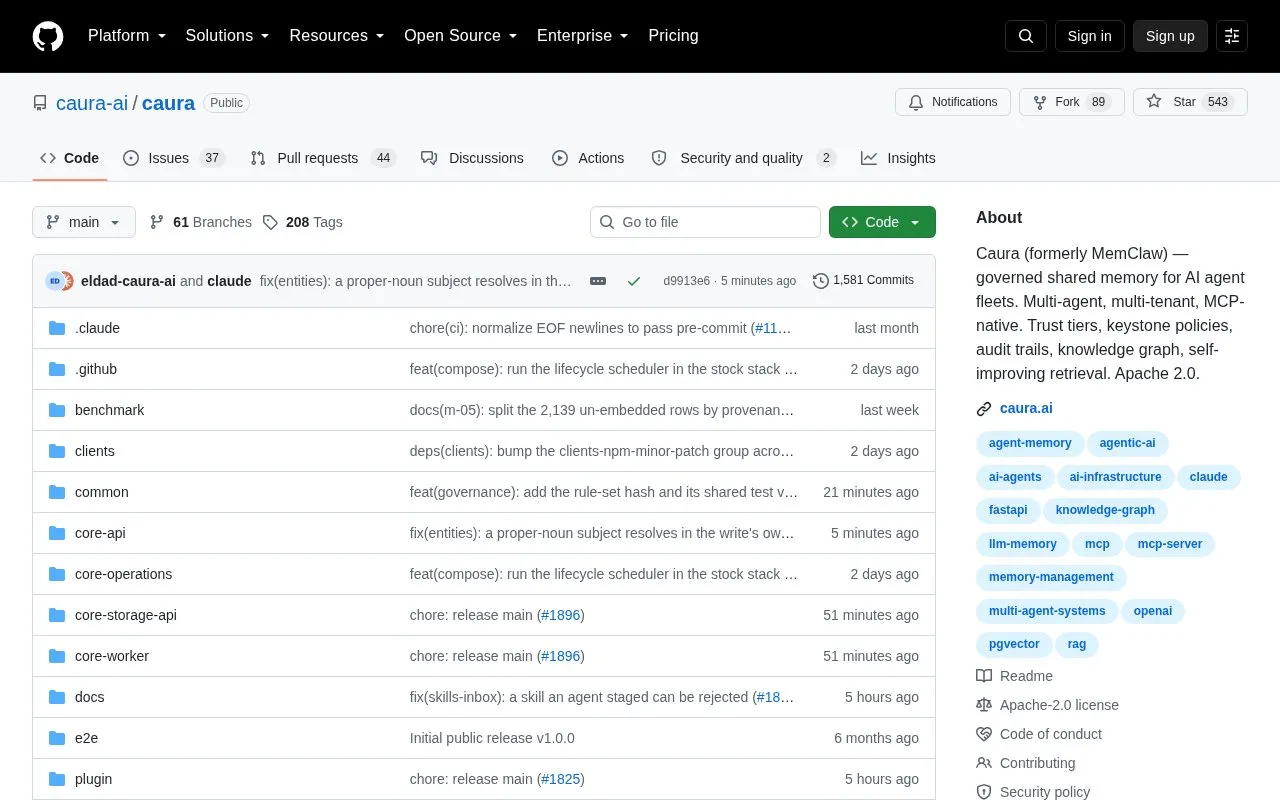
Caura, formerly MemClaw, is an open-source (Apache 2.0) memory layer for AI agent fleets. Agents write plain text, and Caura stores it as searchable, governed memory intended for multi-agent and multi-tenant use, with MCP-native integration, trust tiers, keystone policies, audit trails, a knowledge graph, and self-improving retrieval. The project describes its loop as write, recall, compound.
A local quick start runs through Docker with Postgres, pgvector, Redis, an API and a scheduler. Standalone mode is single-tenant with authentication bypassed and needs no API key; without an AI provider key, memories are stored without embeddings and found by keyword, while adding a provider key enables semantic search. The repository notes that public agent-memory benchmarks such as LoCoMo and LongMemEval measure a single agent, single user and one long conversation, so fleet governance and workload-specific latency still need validation in the environment where they matter. Pricing is not stated in the source.
Key features
Shared memory layer for multi-agent, multi-tenant AI fleets
MCP-native integration with trust tiers and keystone policies
Audit trails for stored agent memory
Knowledge graph with self-improving retrieval over agent-written text
Standalone local mode: single-tenant, authentication bypassed
Keyword search without a provider key; semantic search with one
Best for: Teams building or running multi-agent AI fleets that need shared, policy-scoped memory with audit trails, and developers who want to try it locally first.
Good for
Open source under Apache 2.0
Existing memclaw_* tool calls and MEMCLAW_* environment aliases continue to work after the rename to Caura
Local Docker quick start needs no API key or signup
Watch out for
Benchmark coverage cited is single-agent, single-user, long-conversation; fleet governance and workload-specific latency still need validation
Standalone mode bypasses authentication, and without an AI provider key memories are stored without embeddings and matched by keyword
The PyPI memclaw-client package is only a redirect shell with no memclaw_client import or MemClaw class, and the npm MemClaw client was never published
The product is now called Caura. Existing memclaw_* tool calls and supported MEMCLAW_* environment aliases still work, while new configuration should use caura_* names and the current Caura URLs.
Can I run Caura locally without an API key?
Yes. The Docker-based standalone mode runs single-tenant with authentication bypassed. Without an AI provider key, memories are stored without embeddings and found by keyword; a provider key adds semantic search.
What does the license allow?
The repository is published under Apache 2.0. No pricing is stated in the source.
Is something wrong or out of date?
Tell us and an editor will check it.
Own this website?
Claim the listing and suggest updates yourself. An editor checks every claim first.