
KubeStellar Console manages multiple Kubernetes clusters, workloads, and GPU resources.
Portainer
Portainer manages Kubernetes deployments across clusters through a single control plane.
About Portainer
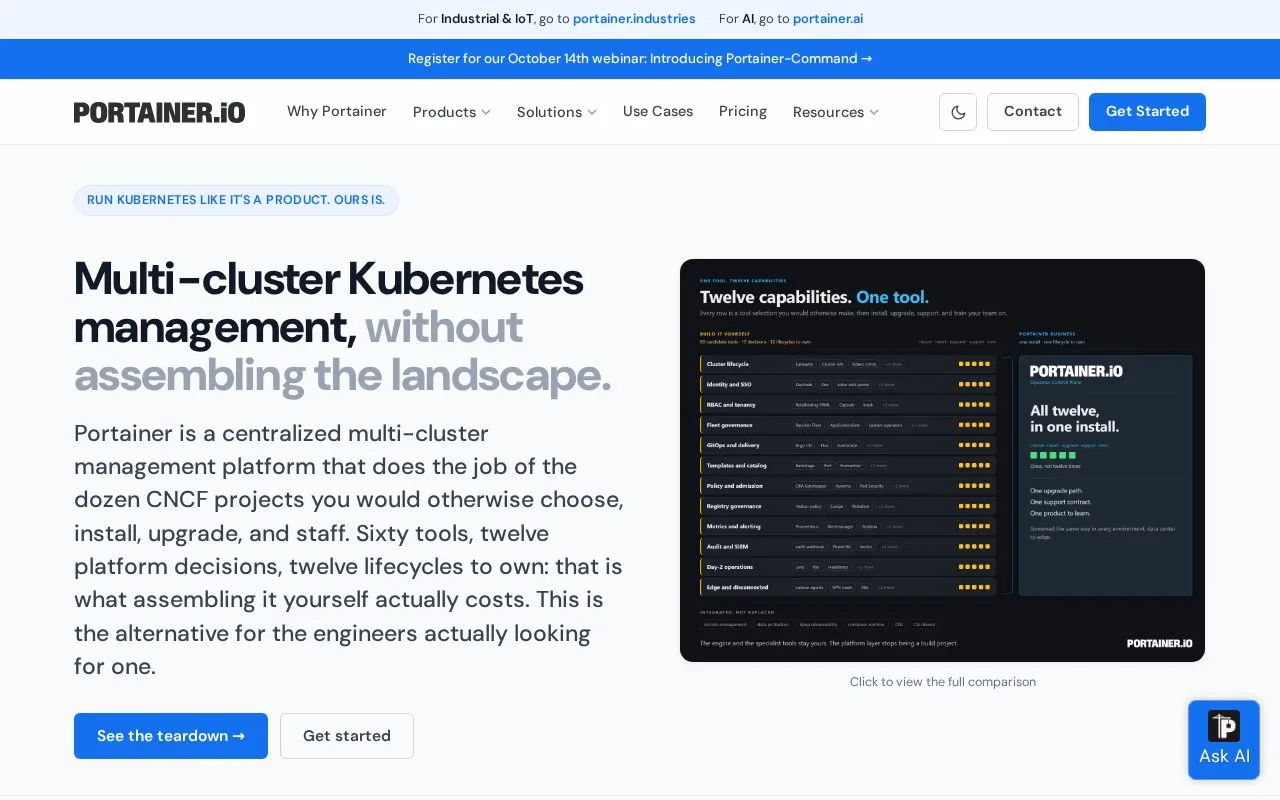
Portainer is a centralized multi-cluster management platform for Kubernetes and other container runtimes, providing a single control plane to deploy, secure, and govern workloads across clusters of any size, including on-premises, bare metal, and managed cloud services like EKS, AKS, and GKE. It also natively supports Docker, Docker Swarm, and Podman in the same console, removing the need to assemble and maintain dozens of separate open-source tools for container platform management.
Key features
- Centralized multi-cluster Kubernetes fleet management across all distributions
- Built-in GitOps engine for dev-to-prod promotion and rollback
- Self-service developer deployments with templates, resource quotas, and RBAC guardrails
- Centralized enterprise identity (SSO, LDAP, OIDC) with audit logging and SIEM export
- Unified console for Docker, Swarm, and Podman alongside Kubernetes
- Single product owner with defined release cadence and lifecycle support
Best for: It is best for engineering teams that want to avoid assembling and maintaining dozens of separate open-source tools for multi-cluster Kubernetes and container management, and prefer a single supported product with a clear owner.
Good for
- Eliminates the need to assemble, integrate, and maintain dozens of separate open-source CNCF projects for platform management.
- Provides a single console to govern Kubernetes, Docker, Swarm, and Podman workloads without requiring migration of existing Swarm estates.
- Offers a product with a single owner, defined release cadence, and full lifecycle support, rather than a custom assembled stack with no clear support path.
Watch out for
- Not designed for teams that want to build and maintain their own custom container platform stack.
- Free tier is limited to 3 managed nodes, with larger fleets requiring paid plans.
- Separate dedicated Portainer products exist for Industrial & IoT and AI use cases, which are not covered by the core platform.
Portainer at a glance
- Website
- portainer.io
- Category
- Development › DevOps & Containers
- Type
- Website
- Pricing
- Not confirmed. Check the site
- Platforms
- Web
- Open source
- Not stated
- Language
- English
- Last checked
- Oct 5, 2026 · Online when checked
- Listed
- Oct 5, 2026
Portainer alternatives
Tools and sites you could use instead, ranked by how closely they match.

Kaito provides an operator that manages AI toolchains on Kubernetes clusters.

Kueue schedules and manages queued workloads in Kubernetes clusters for resource management.
Open source
24 alternatives
Apache Spark is a multi-language engine for executing data engineering, data science, and machine learning on single-node machines or clusters.

Argo provides a workflow engine for running and coordinating jobs on Kubernetes clusters.
Open source
24 alternativesPopular in DevOps & Containers
Well-known listings from the same topic.
Hub Dockerhub.docker.comDockerdocker.comDesktop Appdocker.com/products/docker-desktopPodman Desktoppodman-desktop.ioSetupthanos.ioTrigger.devtrigger.dev


Portainer FAQ
What container runtimes and platforms does Portainer support?
Portainer supports Kubernetes (including EKS, AKS, GKE, bare metal, and on-premises distributions), Docker, Docker Swarm, and Podman in a single console.
Does Portainer include built-in GitOps capabilities?
Yes, Portainer includes a centralized GitOps engine on its server for deployment promotion and rollback, without requiring distributed Argo or Flux installations in each cluster.
Is Portainer suitable for teams that want to build their own custom container platform?
No, Portainer is intended for teams that want a pre-built, supported platform rather than assembling and maintaining their own stack of open-source tools.
Is something wrong or out of date?
Tell us and an editor will check it.
Own this website?
Claim this listing
Claim the listing and suggest updates yourself. An editor checks every claim first.