

LocalGPT lets users chat with documents on their local device using GPT models.
Open source
24 alternativesPrivateGPT provides an API layer for private AI applications using local models, retrieval, tools, and MCP.
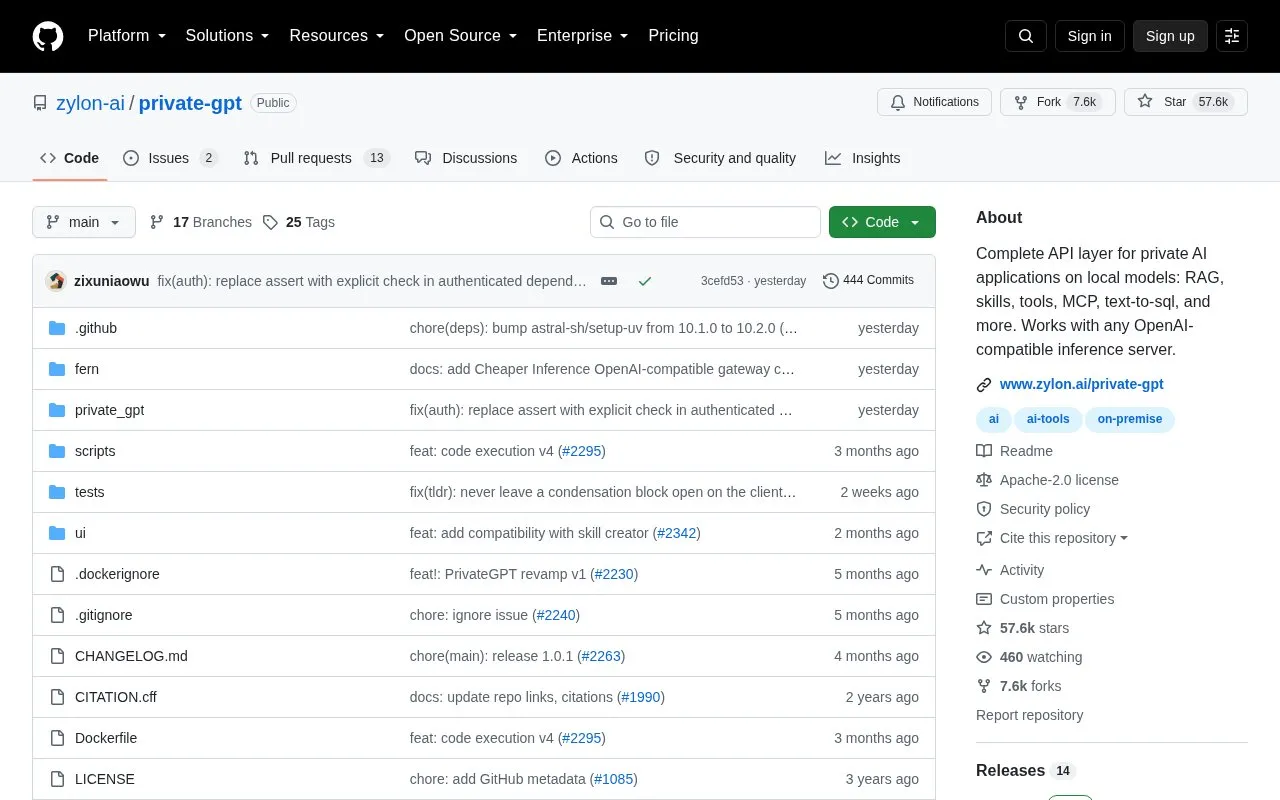
PrivateGPT is an open-source API layer for building AI applications on local models. It does not run models itself. Instead, it connects to an OpenAI-compatible inference server, such as Ollama, llama.cpp, or vLLM, through the OPENAI_API_BASE setting. Developers can use it to add retrieval, tools, file ingestion, and database access to an application without writing those backend components from scratch. The API follows the Anthropic API specification, and the built-in tools mirror the Claude API.
The project is designed to keep models local, but its privacy depends on how it is configured. Its built-in web search and web fetch tools access external web content, and it lists integrations with applications such as Claude Desktop, Claude for Microsoft 365, and n8n. Pricing is not stated in the source. The repository is listed as open source. Installation commands are given for macOS, Linux, and Windows.
Tools and sites you could use instead, ranked by how closely they match.
LocalGPT lets users chat with documents on their local device using GPT models.
py-vectara-agentic is a Python library for creating AI assistants with Vectara using agentic retrieval-augmented generation.
Intelli builds chatbots and agents from user-defined intents and model choices.
OpenChatKit provides an open-source base for creating specialized or general-purpose chat models.
Petals runs large language models across distributed computers and supports fine-tuning and inference.
GPT4All runs language models locally on a range of devices through open-source software.
Well-known listings from the same topic.
Tell us and an editor will check it.
Claim the listing and suggest updates yourself. An editor checks every claim first.


