

pyclugen
pyclugen implements the multidimensional cluster generation algorithm in Python.
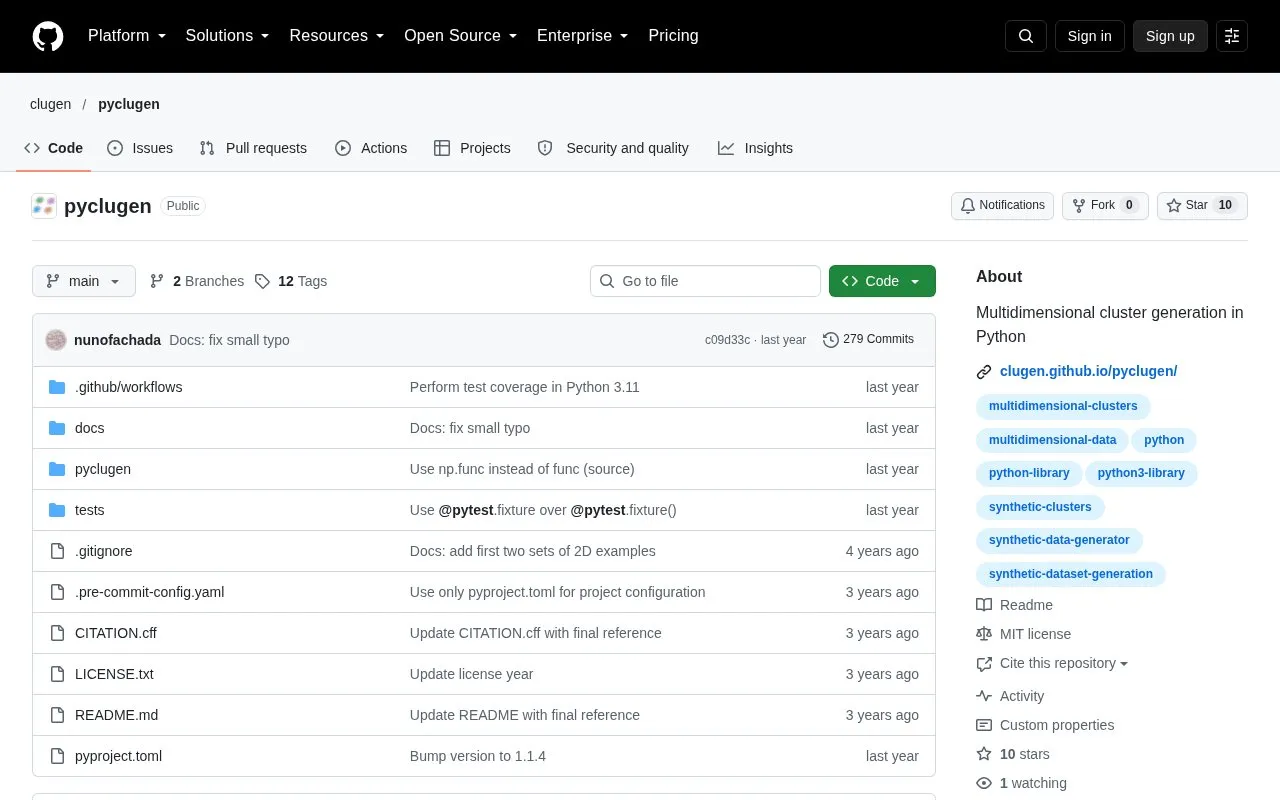
About pyclugen
pyclugen is a Python implementation of the clugen algorithm for generating multidimensional clusters with arbitrary distributions. Each cluster is supported by a line segment, and the segment's position, orientation and length determine where its points are placed.
The repository includes installation instructions for PyPI and GitHub, a short quick-start example that plots generated clusters in two and three dimensions, and links to documentation and examples. The source also lists related implementations of the same algorithm in Julia, R and MATLAB/Octave. The page does not describe specific limitations of the library.
Key features
- Generates multidimensional clusters with arbitrary distributions using the clugen algorithm
- Places cluster points based on the position, orientation and length of a supporting line segment
- Returns point coordinates and cluster labels for each generated dataset
- Installable from PyPI or directly from the GitHub repository
- Quick-start example plots generated clusters in two and three dimensions with matplotlib
- Released under the MIT License
Best for: Python users who need synthetic multidimensional clustered datasets for analysis or algorithm testing.
Good for
- Open source under the MIT License
- Can be installed with pip from PyPI
- Includes links to documentation and examples and a citation reference for the underlying method
pyclugen at a glance
- Website
- github.com/clugen/pyclugen
- Category
- Development › Developer Tools
- Type
- Open-source project
- Pricing
- Not confirmed. Check the site
- Open source
- Yes · Source code
- Language
- English
- Last checked
- Oct 6, 2026 · Online when checked
- Listed
- Oct 5, 2026
Guides for Developer Tools


pyclugen alternatives
Tools and sites you could use instead, ranked by how closely they match.

MOCluGen implements multidimensional cluster generation for MATLAB and Octave.
Open source
24 alternatives
CluGen implements an algorithm for generating multidimensional clusters in Julia.
Open source
24 alternatives
clugenr implements an algorithm for generating multidimensional clusters in R.

DSPy is a framework for programming language models, with algorithms to optimize prompts and model weights.
Open source
24 alternatives
pytesseract is a Python wrapper for Google Tesseract that provides optical character recognition.
Open source
24 alternatives
Search code locally by meaning with SeaGOAT, a local-first semantic code search engine.
Open source
24 alternativesPopular in Developer Tools
Well-known listings from the same topic.
AppDevToolsappdevtools.comCommand Not Foundcommand-not-found.comTestFlighttestflight.apple.com/join/A8GwCnq8Sourcegraphabout.sourcegraph.comProject Wallaceprojectwallace.comCarbon Calculatorwebsitecarbon.com


pyclugen FAQ
How can pyclugen be installed?
It can be installed from PyPI with pip install pyclugen, or directly from GitHub with pip install git+https://github.com/clugen/pyclugen.git#egg=pyclugen.
What should be cited when using pyclugen?
The repository asks users to cite Fachada, N. & de Andrade, D. (2023), Generating multidimensional clusters with support lines, Knowledge-Based Systems, 277, 110836.
Is something wrong or out of date?
Tell us and an editor will check it.
Own this website?
Claim this listing
Claim the listing and suggest updates yourself. An editor checks every claim first.