

ML.NET provides an open source, cross platform machine learning framework for .NET applications.
Open source
24 alternativesThe shimmytok project provides a pure Rust GGUF tokenizer compatible with llama.cpp and ready for WebAssembly.
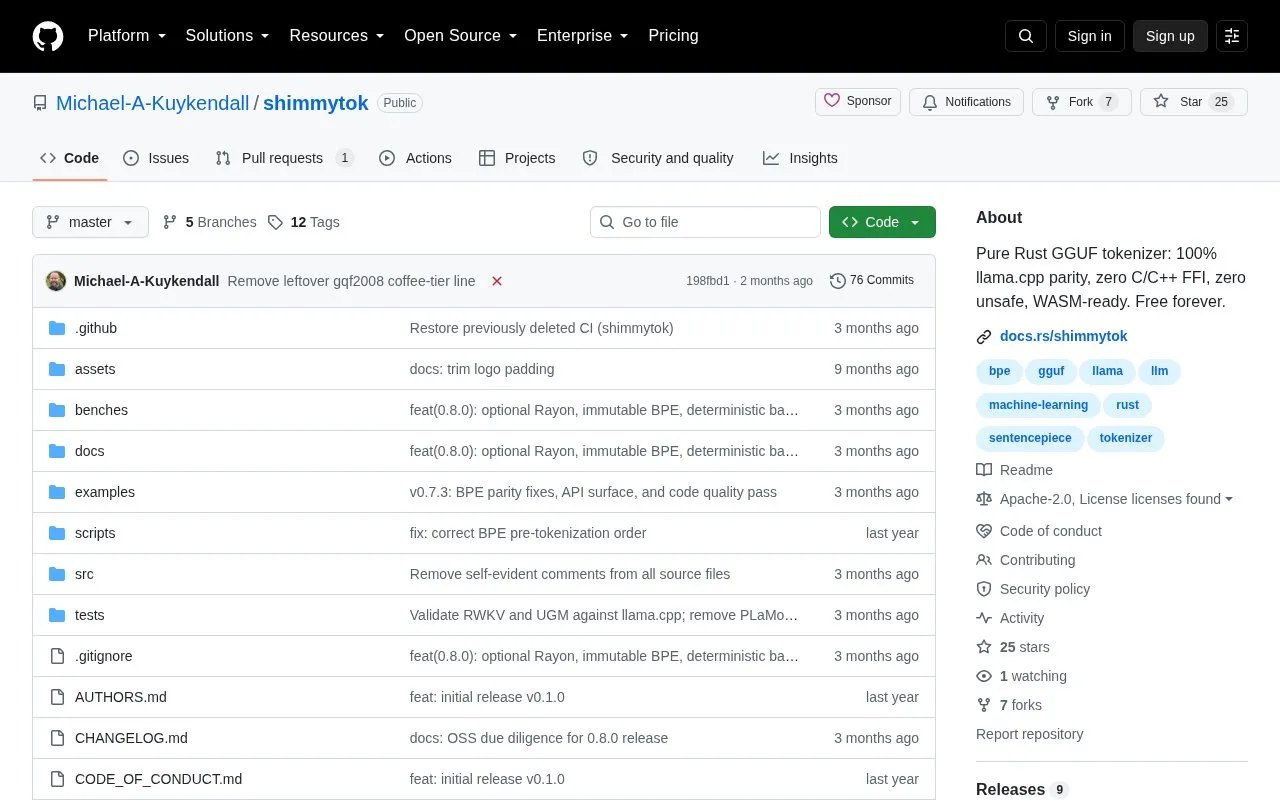
shimmytok is a Rust library that reads the tokenizer embedded in GGUF model files and encodes text to tokens and decodes tokens back to text, without Python, C++ bindings, or separate tokenizer files.
It handles SentencePiece, BPE, WordPiece, Unigram, and RWKV tokenizers, offers batch encoding with optional Rayon parallelism and token-by-token decoding, and supports WASM/WASI builds with a sequential backend. The project reports token-for-token matching output with llama.cpp for the models listed in its validation table.
Tools and sites you could use instead, ranked by how closely they match.
ML.NET provides an open source, cross platform machine learning framework for .NET applications.
Scalable, Portable and Distributed Gradient Boosting (GBDT, GBRT or GBM) Library.
rb-libsvm provides Ruby bindings for the LIBSVM machine learning library.
LMQL provides a programming language for interactions with large language models.
The MLJ project provides machine learning tools and a framework for Julia.
Treat supplies Ruby developers with a framework for natural language processing.
Well-known listings from the same topic.
Tell us and an editor will check it.
Claim the listing and suggest updates yourself. An editor checks every claim first.


