

The Cybertron Go package provides an interface for NLP technologies and pretrained Transformer models.
Open source
16 alternativesRust native ready-to-use NLP pipelines and transformer-based models (BERT, DistilBERT, GPT2,...).
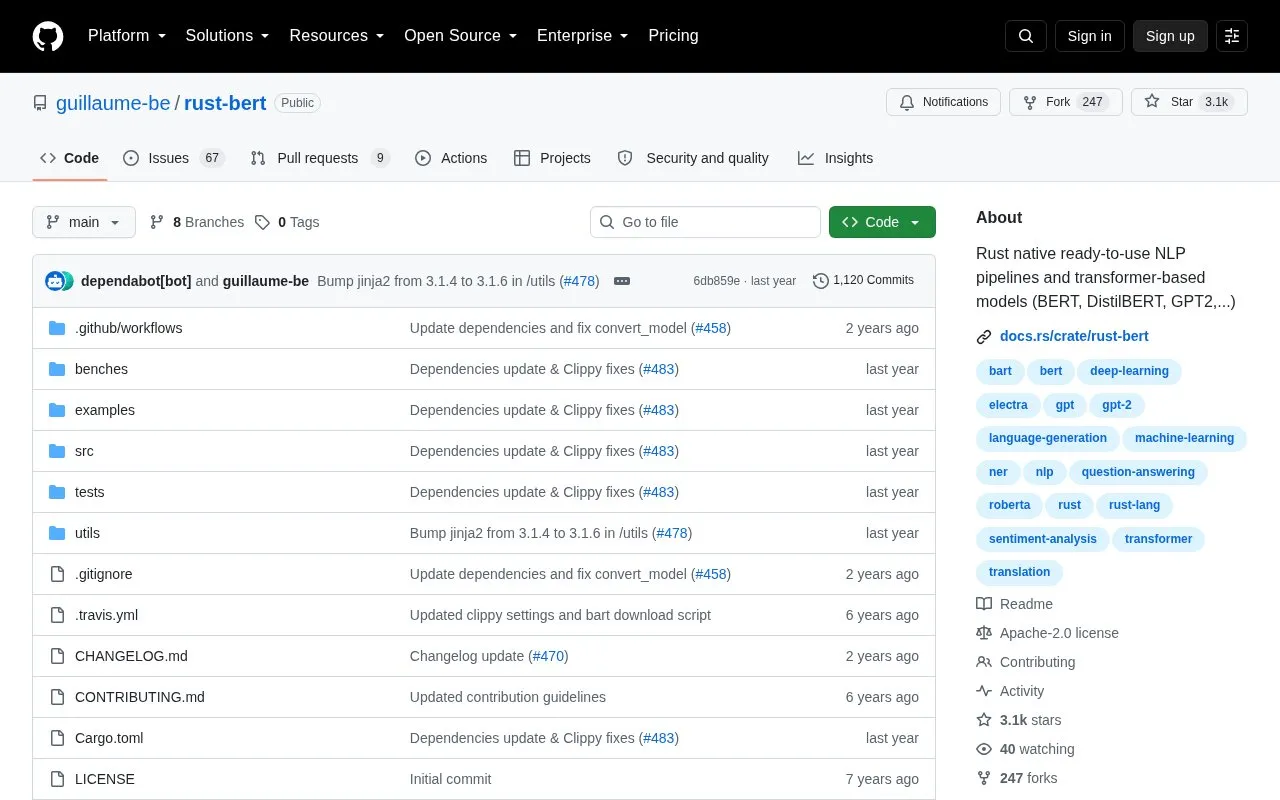
rust-bert is a Rust-native library providing pre-trained transformer models and ready-to-use NLP pipelines. It is a port of Hugging Face's Transformers library that uses tch-rs or onnxruntime bindings and pre-processing from rust-tokenizers, and it exposes the model base architecture, task-specific heads and end-to-end pipelines so common tasks can be run in a few lines of code.
Supported tasks include question answering, translation, summarization, multi-turn dialogue, zero-shot classification, sentiment analysis, named entity recognition, part-of-speech tagging, language generation, masked language modeling, sentence embeddings and keyword extraction. Model families covered include BERT, DistilBERT, RoBERTa, GPT, GPT2, GPT-Neo, GPT-J, BART, Marian, MBart, M2M100, NLLB, Electra, ALBERT, T5, LongT5, XLNet, Reformer, ProphetNet, Longformer, Pegasus, FNet, DeBERTa, MobileBERT and others, with each family supporting a subset of tasks. Setup requires the libtorch library, either installed manually or downloaded through the download-libtorch feature flag, and pretrained models are cached locally, with file sizes in the hundreds of megabytes to gigabytes.
Tools and sites you could use instead, ranked by how closely they match.
The Cybertron Go package provides an interface for NLP technologies and pretrained Transformer models.
The shimmytok project provides a pure Rust GGUF tokenizer compatible with llama.cpp and ready for WebAssembly.
Polyglot provides multilingual text processing tools for natural language processing.
The machinelearn.js project offers machine learning tools for web applications and Node.js.
ML.NET provides an open source, cross platform machine learning framework for .NET applications.
Scalable, Portable and Distributed Gradient Boosting (GBDT, GBRT or GBM) Library.
Well-known listings from the same topic.
Tell us and an editor will check it.
Claim the listing and suggest updates yourself. An editor checks every claim first.


