

SwarmVault
SwarmVault combines a local-first LLM wiki with a knowledge graph, RAG knowledge base, and agent memory store.
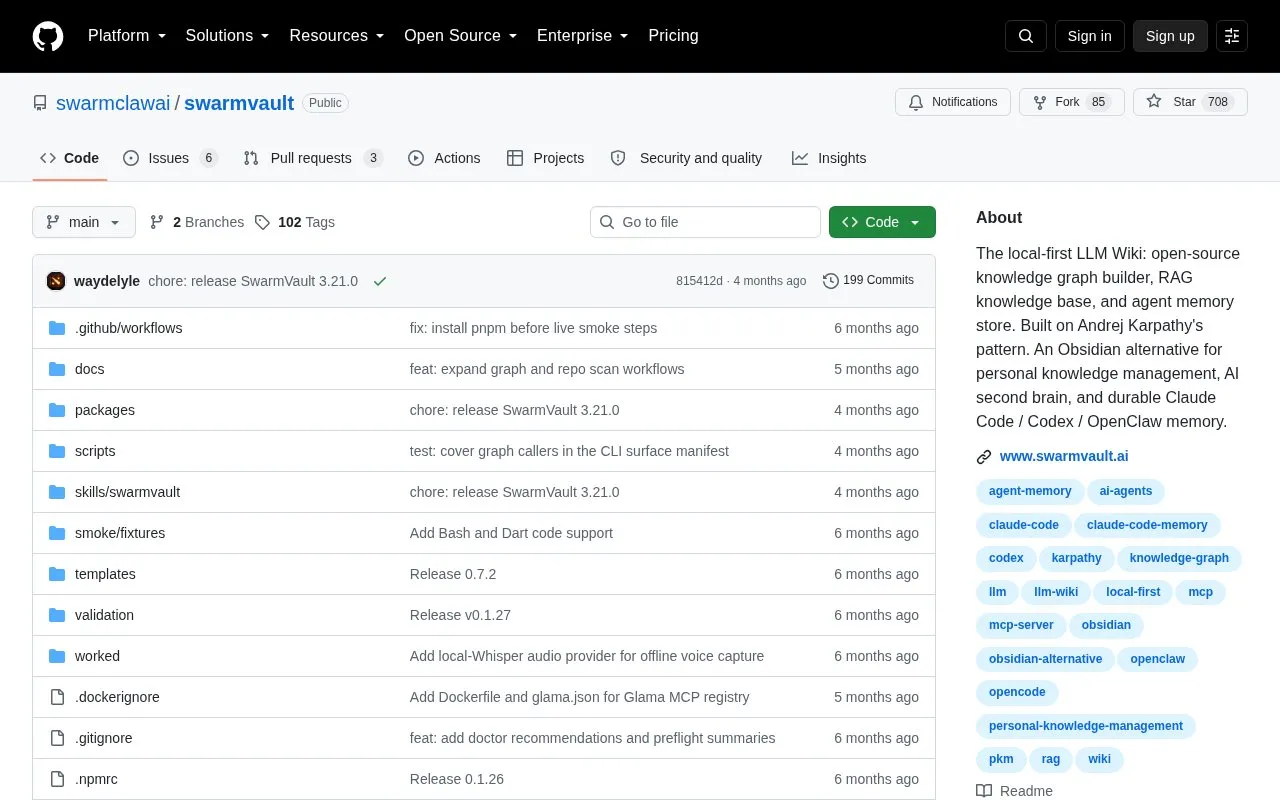
About SwarmVault
SwarmVault is an open-source, local-first toolchain for building a knowledge graph and a persistent markdown wiki from source material. It ingests documents, code, transcripts, notes, and URLs, then produces a wiki and a local graph that can be inspected, queried, and given to AI agents as memory. The project describes itself as an alternative to Obsidian for personal knowledge management and as a memory store for tools such as Claude Code, Codex, and OpenClaw.
The first run is designed to start with one command, swarmvault quickstart, which initializes a vault, ingests a local file, directory, or public GitHub repository, and compiles the wiki and graph. The built-in heuristic provider runs locally and offline, so no API keys are required for the first run. Model-backed synthesis is optional. Ingested raw sources are kept as immutable copies, and generated files are stored on disk.
Key features
- Ingests docs, code, transcripts, notes, and URLs into a markdown wiki
- Builds a machine-readable knowledge graph stored as state/graph.json
- Local search index for querying the compiled vault
- Local graph viewer opened by the quickstart command
- Review and candidate list commands for checking generated material
- Share card and share kit summaries of first-run results
Best for: Individuals and developers who want to organize accumulated research, notes, or project documentation into a local, inspectable wiki and graph, including those who use AI agents with persistent memory.
Good for
- No API keys are required for the first run, and the built-in provider runs locally and offline
- Open source, with the repository publicly available on GitHub
- Raw source files are stored as immutable copies that SwarmVault does not modify
Watch out for
- Documentation on the website is currently English-first, and translations may drift from the README
- The homepage does not describe which model providers are used for optional model-backed synthesis
SwarmVault at a glance
- Category
- Productivity › Notes & Knowledge Management
- Type
- Open-source project
- Pricing
- Not confirmed. Check the site
- Open source
- Yes · Source code
- Language
- English
- Last checked
- Oct 6, 2026 · Online when checked
- Listed
- Oct 5, 2026
Guides for Notes & Knowledge Management
SwarmVault alternatives
Tools and sites you could use instead, ranked by how closely they match.

Manage knowledge and collaborate with Logseq, an open-source platform described by its project as privacy-first.
Open source
24 alternatives
Trilium Notes supports building a personal knowledge base, as described by the project page.
Open source
24 alternatives
TidGi is a desktop knowledge-management and note app with automated Git backups, according to its repository description.
Open source
24 alternatives
SiYuan offers a self-hosted knowledge workspace described as open-source and privacy-first, with collaboration for people and AI agents.
Open source
24 alternatives
Docmost is open-source collaborative wiki and documentation software for teams.
Open source
24 alternatives
SigmaNote organizes PDFs, voice notes, webpages, and videos into a searchable knowledge base for AI-assisted learning and work.
Popular in Notes & Knowledge Management
Well-known listings from the same topic.
Elephaselephas.appSimplenotesimplenote.comMirahezemiraheze.orgJumble Journaljumblejournal.orgRecallrecall.itStandard Notesstandardnotes.com


SwarmVault FAQ
Do I need an API key to try SwarmVault?
No. The source states that no API keys are required for the first run, because the built-in heuristic provider runs locally and offline.
What files does SwarmVault create on disk?
The source lists raw/ for immutable copies of ingested material, wiki/ for generated markdown pages and outputs, state/graph.json for the knowledge graph, and state/retrieval/ for the local search index.
How do I start with SwarmVault?
Install the CLI with npm install -g @swarmvaultai/cli, then run swarmvault quickstart ./your-repo. The quickstart command initializes a vault, ingests the source, compiles the wiki and graph, and opens the local graph viewer.
Is something wrong or out of date?
Tell us and an editor will check it.
Own this website?
Claim this listing
Claim the listing and suggest updates yourself. An editor checks every claim first.