

WebDNA
Analyze a website’s branding and technology stack with WebDNA, which extracts logos, colors, frameworks, and libraries.
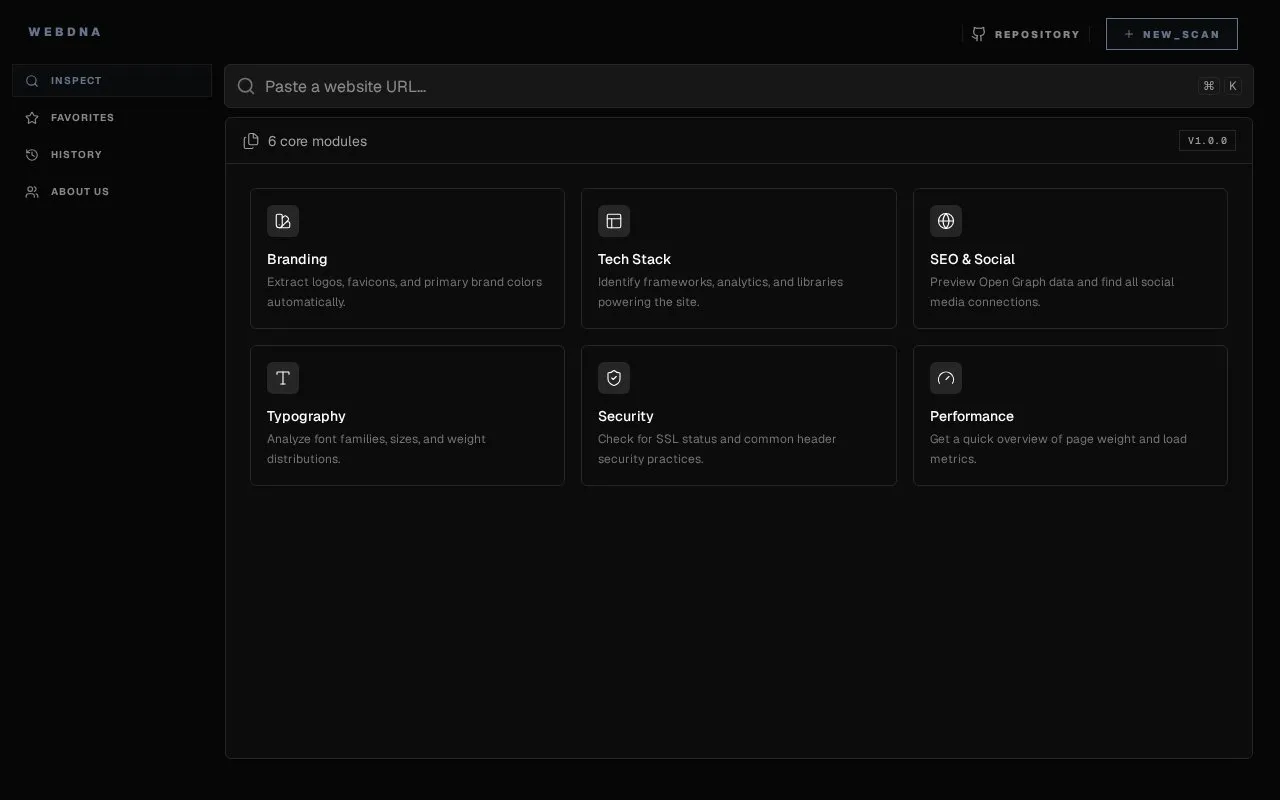
About WebDNA
WebDNA analyzes a website across six modules. It extracts logos, favicons and primary brand colors, identifies frameworks, analytics and libraries, and analyzes font families, sizes and weight distributions. It also previews Open Graph data and social media connections, checks SSL status and header security practices, and shows page weight and load metrics.
Key features
- Extract logos, favicons, and primary brand colors
- Identify frameworks, analytics, and libraries powering a site
- Preview Open Graph data and social media connections
- Analyze font families, sizes, and weight distributions
- Check SSL status and header security practices
- Show page weight and load metrics overview
Best for: People who need to check a website's branding, technology stack, and basic performance and security signals.
WebDNA at a glance
- Website
- webdna.xtra.wtf
- Category
- Development › Developer Tools
- Type
- Website
- Pricing
- Not confirmed. Check the site
- Platforms
- Web
- Open source
- Not stated
- Language
- English
- Last checked
- Oct 5, 2026 · Online when checked
- Listed
- Oct 5, 2026
Guides for Developer Tools

WebDNA alternatives
Tools and sites you could use instead, ranked by how closely they match.

Accord.NET combines machine learning with audio and image processing libraries in a C# framework.

Libraries.io helps developers discover open-source packages, modules, and frameworks across software ecosystems.
Free
24 alternatives
Grafana Cloud unifies metrics, logs, and traces for full-stack observability and AI workloads.
Free
24 alternativesCode syntax highlighting is provided by Shiki, a library that colors code by programming language.

PageRip extracts HTML and CSS from selected webpage elements or saves full pages as single-file HTML and JSX for code reuse.
Free
24 alternatives
dlib provides C++ libraries for image processing, machine learning, and related algorithms.
Popular in Developer Tools
Well-known listings from the same topic.
AppDevToolsappdevtools.comCommand Not Foundcommand-not-found.comTestFlighttestflight.apple.com/join/A8GwCnq8Sourcegraphabout.sourcegraph.comProject Wallaceprojectwallace.comCarbon Calculatorwebsitecarbon.com


Is something wrong or out of date?
Tell us and an editor will check it.
Own this website?
Claim this listing
Claim the listing and suggest updates yourself. An editor checks every claim first.