

RealT provides fractional tokenized ownership in U.S. real estate, with assets connected to a decentralized finance lending platform.
AFI Protocol
AFI Protocol verifies backing assets and liabilities for tokenized real-world assets hourly and publishes on-chain solvency proofs.
About AFI Protocol
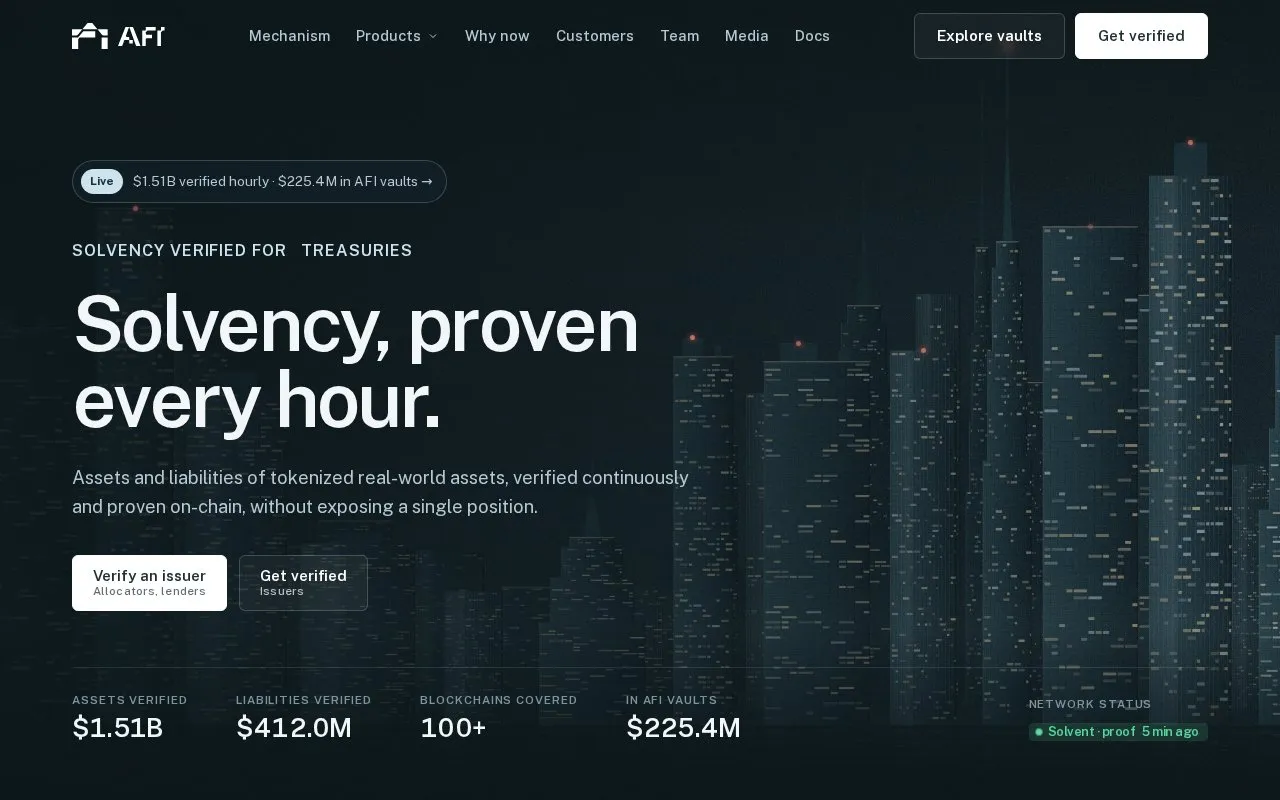
AFI Protocol provides continuous solvency verification for tokenized real-world assets. It reconciles an issuer's assets against liabilities using data captured from custodians, fund administrators and blockchains, then publishes an on-chain proof every hour and at each issuance. Coverage ratios are public, while positions, counterparties and custodian details stay private through zero-knowledge proofs. The homepage cites $1.5B+ verified and shows a sample 3.66× coverage figure.
The service covers two products. Verified Vaults are ERC-4626 vaults on Ethereum and Base that hold only assets with a live solvency proof, with caps that follow coverage. The Verification Dashboard shows live assets, liabilities, coverage and history per issuer in a form that any contract can read, with a Solidity interface and REST API. Enforced on-chain, minting above proven reserves reverts. Issuers can go live in 2–4 weeks without changing their custodian or fund admin, and proofs are mapped to GENIUS, MiCA, VARA, MAS and HKMA reserve requirements. Contracts are audited by Quantstamp and Cantina.
Key features
- Hourly on-chain solvency proofs netting assets against liabilities
- Verified Vaults: ERC-4626 vaults limited to assets with live proofs
- Dashboard shows assets, liabilities, coverage and history per issuer
- Zero-knowledge proofs publish coverage ratios while keeping positions private
- On-chain enforcement reverts minting above proven reserves
- Solidity interface and REST API; issuers live in 2–4 weeks
Best for: Issuers, allocators and lenders in tokenized real-world assets who need continuous, on-chain solvency evidence instead of periodic attestations.
Good for
- Proofs are published every hour and at every issuance rather than quarterly.
- Assets are netted against liabilities instead of relying on reserves alone.
- Coverage is publicly verifiable while positions stay private via zero-knowledge proofs.
Watch out for
- Verified Vaults are offered on Ethereum and Base only.
- Regulatory mapping is named for GENIUS, MiCA, VARA, MAS and HKMA reserve requirements; other jurisdictions are not addressed.
- The protocol is not open source and no public repository is listed.
AFI Protocol at a glance
- Website
- afiprotocol.xyz
- Category
- Crypto & Blockchain › DeFi Protocols
- Type
- Website
- Pricing
- Not confirmed. Check the site
- Platforms
- Web
- Open source
- Not stated
- Language
- English
- Last checked
- Oct 5, 2026 · Online when checked
- Listed
- Oct 5, 2026
AFI Protocol alternatives
Tools and sites you could use instead, ranked by how closely they match.

KAIO provides an appchain protocol for moving tokenized real-world assets and connecting institutional funds with DeFi liquidity.

Robinhood Chain is a Layer 2 blockchain for financial services and tokenized real-world assets, including stock tokens.

Ondo offers tokenized real-world assets on-chain, including institutional financial products and tokenized portfolios.
tzBTC publishes custody addresses and circulation data so users can review the Bitcoin backing its token supply.

3F offers vaults for leveraged exposure to tokenized real-world assets, with stablecoin yield and private beta access on Ethereum.
Pick
24 alternativesPopular in DeFi Protocols
Well-known listings from the same topic.
Aave V3aave.com3Jane Lending3jane.xyzApostroapostro.xyzAvalon CeDeFiavalonfinance.xyzMetalX Lendinglending.metalx.comNeutral Tradeneutral.trade


AFI Protocol FAQ
How often are solvency proofs published?
Hourly, and again at every issuance. The site states 8,760 proofs a year and a 60-minute detection window for a shortfall.
What information is public and what stays private?
The coverage ratio is published on-chain. Positions, counterparties and custodian details remain private through zero-knowledge proofs.
What happens if an issuer mints beyond its proven reserves?
Enforcement is applied on-chain: a mint above proven reserves reverts.
Is something wrong or out of date?
Tell us and an editor will check it.
Own this website?
Claim this listing
Claim the listing and suggest updates yourself. An editor checks every claim first.